

















The next time you see a duck paddling over still water, look behind it. You should see a series of V-shaped waves rippling across the surface, with the two sides of the V forming a roughly 40-degree angle. The term physicists use to describe this distinctive pattern is a Kelvin wake, though other names such as bow waves are also widely used.
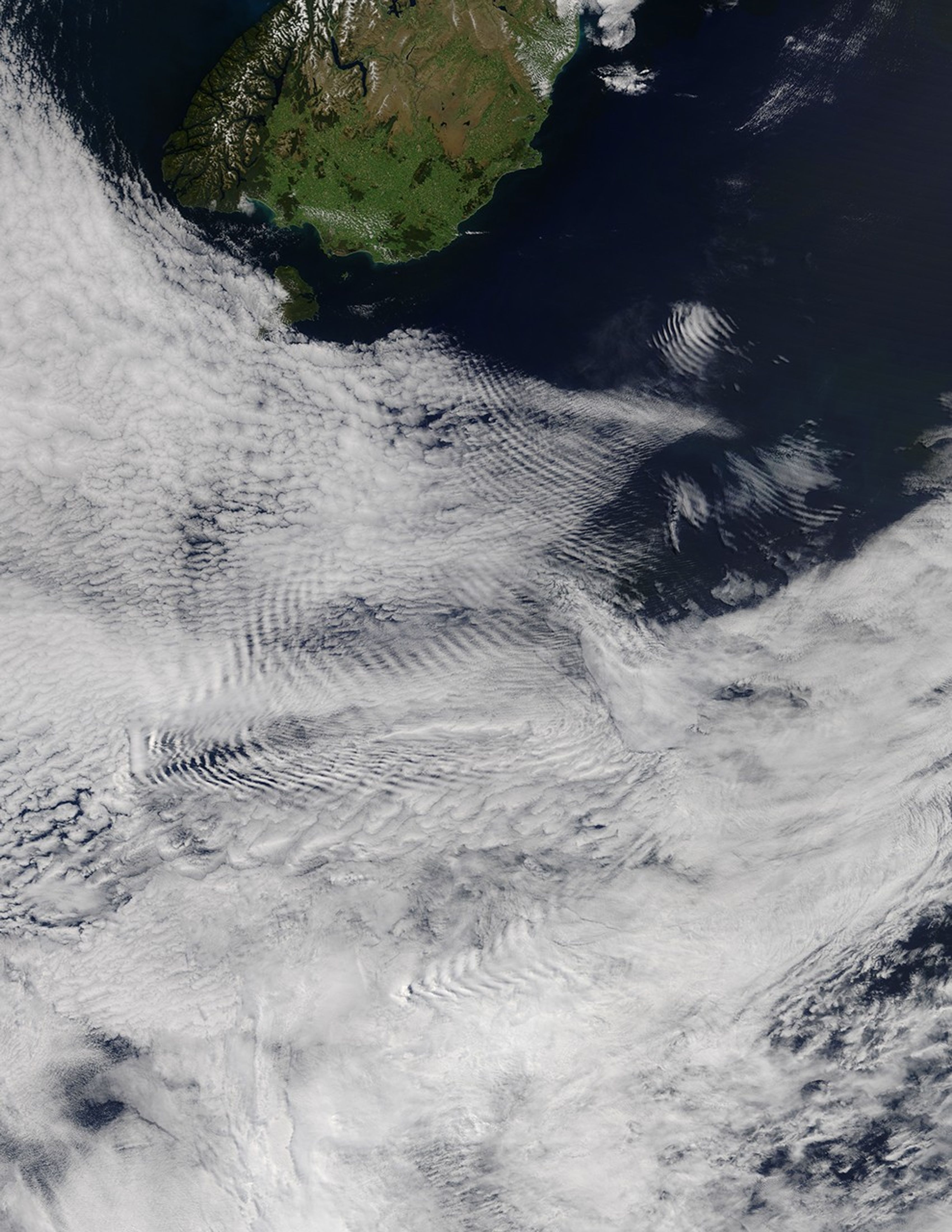
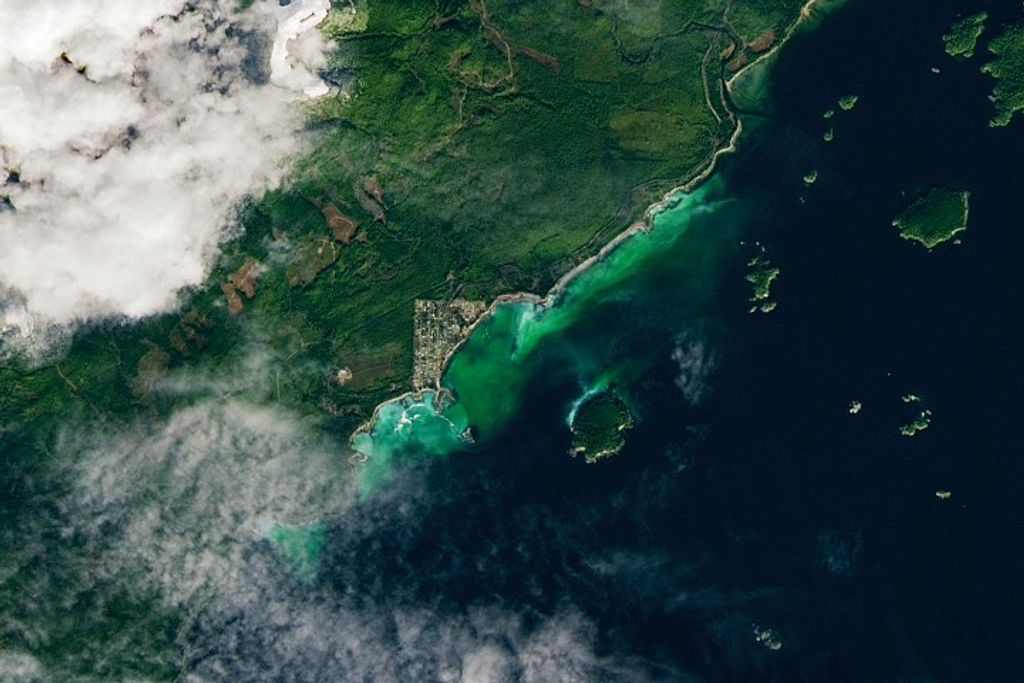
In the duck’s case, the motion across a stationary surface triggers the waves. A similar process can play out when air flows over a stationary object. That’s what was happening when the Moderate Resolution Imaging Spectroradiometer (MODIS) on NASA’s Terra satellite acquired this image of mountain-wave clouds near the Auckland Islands. The wave-driven clouds are flowing in an easterly direction on the lee side of the small archipelago about 450 kilometers (280 miles) south of New Zealand’s South Island.
The islands are known for their rugged terrain, and some of the peaks—including Mount Raynal, Mount D’Urville, and Mount Easton—surpass 600 meters (2,000 feet). With these summits poking well above the ocean surface, the islands disturbed the smooth, easterly flow of air and created atmospheric gravity waves and wave clouds that rippled through the atmosphere.
The presence of clouds makes it possible to see the waves. The cloudy-clear pattern marks the location of wave crests and troughs. The moist, cloudy air over the ocean (meteorologists call this the marine layer) is often capped by a layer of dry air. Clouds form (or persist) at the crests of the waves because air cools as it rises, and water vapor condenses into cloud droplets. In the wave troughs, dry air from above sinks into the marine layer, replacing the cloudy air. In addition, as air sinks, it warms and causes clouds to evaporate.
References & Resources
- American Meteorological Society Lee Waves. Accessed December 1, 2017.
- American Meteorological Society Mountain Wave. Accessed December 1, 2017.
- Atmospheric Optics Atmospheric Gravity Waves. Accessed December 1, 2017.
- Earth Science Picture of the Day (2009, March 31) Wave Cloud Animation. Accessed December 1, 2017.
- Encyclopedia Britannica (2014, April 4) Bow Waves. Accessed December 1, 2017.
- FYFD (2014, April 4) Ducks, boats, and other objects. Accessed December 1, 2017.
- Hong Kong Observatory (2013, June) In the Wake of a Duck. Accessed December 1, 2017.
- Physics World (2013, May 30) Physicists rethink celebrated Kelvin wake pattern for ships. Accessed December 1, 2017.
- Slate (2014, May 11) Islands Awake! Accessed December 1, 2017.
NASA image by Jeff Schmaltz, LANCE/EOSDIS Rapid Response. Story by Adam Voiland.