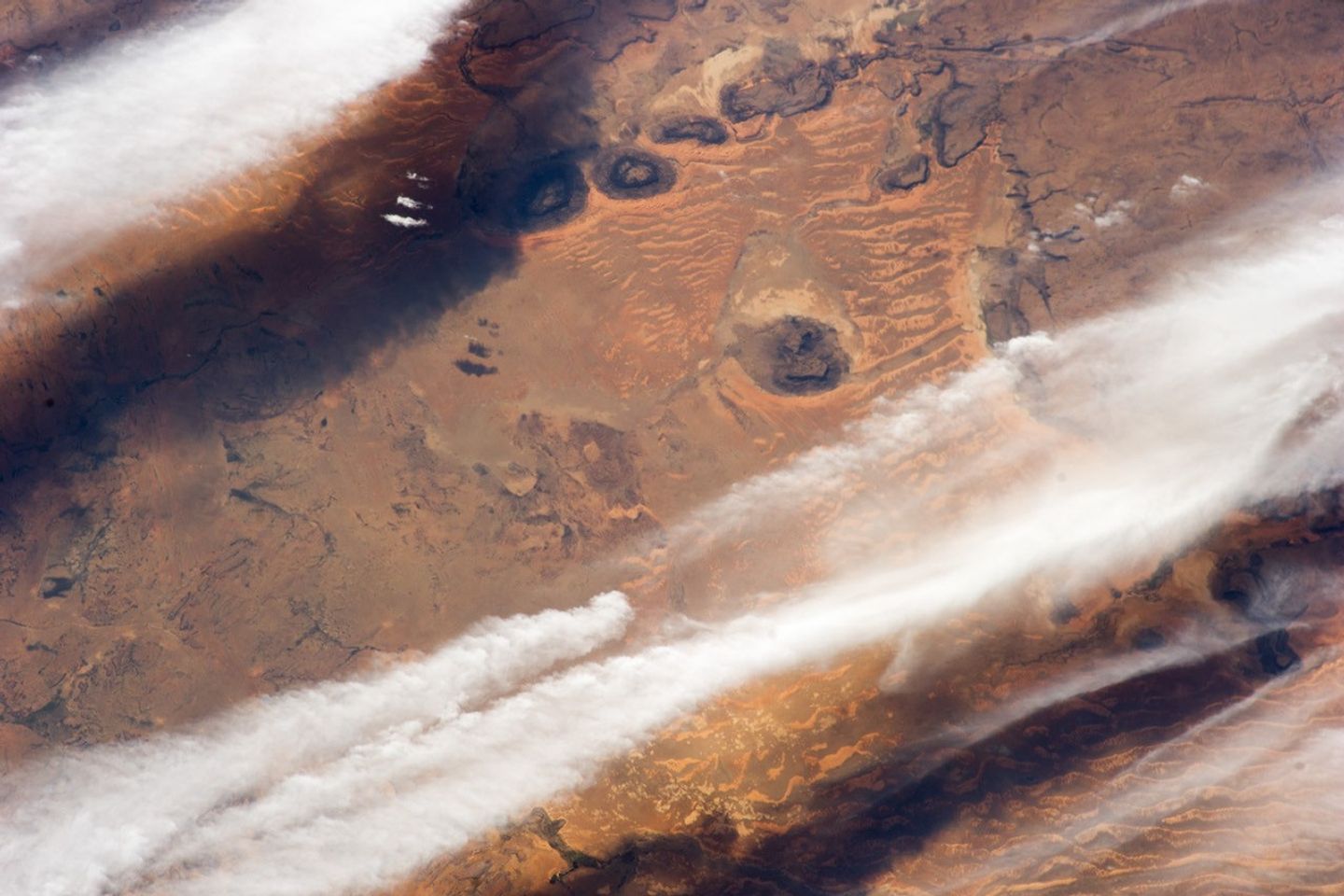








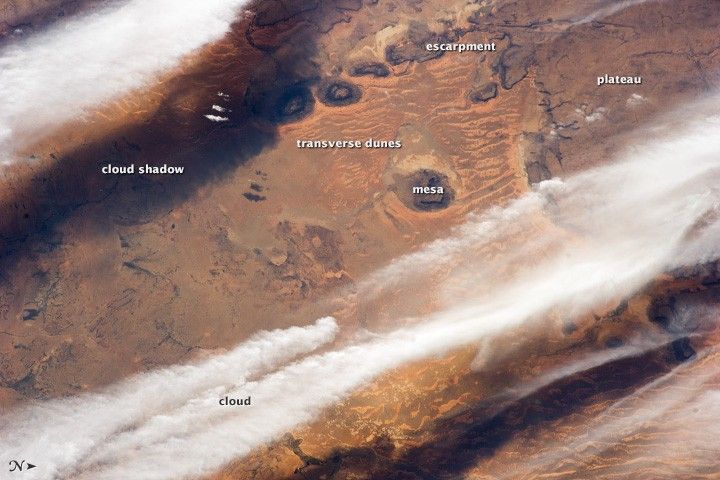
This photograph of cloud bands over southern Mauritania was taken from the International Space Station with an oblique angle such that the cloud shadows are a prominent part of the view. Beneath the clouds, the plateau of dark sedimentary rocks appears as a ragged, near-vertical escarpment (image top right). Isolated remnants of the plateau appear as dark mesas (flat-topped hills) across the top and near the center of the image. The escarpment is about 250 meters high, with a field of orange-colored dunes at the base (image upper right).
Prevailing winds in this part of the Sahara Desert blow from the northeast. (Note that north is to the right.) The wavy dunes are aligned transverse (roughly right angles) to these winds. The sand that makes the dunes is blown in from a zone immediately upwind (just out of the bottom of the image), where dry river beds and dry lakes provide large quantities of mobile sand. This pattern is typical in the western Sahara Desert, where plateau surfaces are mostly dune free and dune fields are located in the surrounding lowlands. Larger rivers deposit sandy sediment on the few occasions when they flow, sometimes only once in decades.
References & Resources
Astronaut photograph ISS038-E-26862 was acquired on January 8, 2014, with a Nikon D3S digital camera using a 180 millimeter lens, and is provided by the ISS Crew Earth Observations experiment and Image Science & Analysis Laboratory, Johnson Space Center. The image was taken by the Expedition 38 crew. It has been cropped and enhanced to improve contrast, and lens artifacts have been removed. The International Space Station Program supports the laboratory as part of the ISS National Lab to help astronauts take pictures of Earth that will be of the greatest value to scientists and the public, and to make those images freely available on the Internet. Additional images taken by astronauts and cosmonauts can be viewed at the NASA/JSC Gateway to Astronaut Photography of Earth. Caption by M. Justin Wilkinson, Jacobs at NASA-JSC.