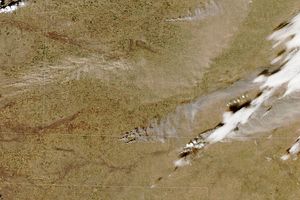









So far in 2011, more than two million acres of land have burned in Texas, and many of those fires occurred in April. This image, taken by the Moderate Resolution Imaging Spectroradiometer (MODIS) on NASA’s Aqua satellite, shows the extent of burned land in central and western Texas on April 30.
Newly burned land is red-brown in this false-color image, which includes both visible and infrared light. Six large fires, Rockhouse, Deaton Cole, Wildcat, Cooper Mountain Ranch, Swenson, and PK Complex, are labeled in the image. Most of these were contained or out on April 30, but the Deaton Cole fire was still burning. The hot spots on the fire’s front glow orange in the infrared light used in the image. Numerous smaller burn scars are scattered across the state.
Texas has been prone to burning in April because of a dangerous combination of high temperatures, high winds, low humidity, and dry vegetation. In such conditions, a small spark can grow into a large, uncontrolled fire very quickly. The image also shows large fires in New Mexico and Mexico, where similar conditions prevailed.
References & Resources
- Texas Forest Service. (2011, May 2). Current Texas wildfire situation. Accessed May 2, 2011.
NASA Earth Observatory image created by Jesse Allen, using data obtained from the Goddard Level 1 and Atmospheric Archive and Distribution System (LAADS). Caption by Holli Riebeek.