









Bougainville Island in Papua New Guinea hosts three large volcanoes along its mountainous middle: Mount Balbi, Mount Bagana, and the Mount Takuan volcanic complex. Of these, only Mount Bagana is currently active.
Since Bagana was first viewed by scientists in the 1840s, it has been erupting nearly nonstop. The remote volcano extrudes thick, blocky, slow-moving andesitic lavas. These have built the stratovolcano to a height of 1,850 meters (6,000 feet) above sea level. The large, symmetrical cone formed in 300 to 500 years, making it one of the youngest and most active volcanoes in the South Pacific. Lava descends the flanks on all sides of the volcano, forming lobes up to 50 meters (165 feet) thick. A small lava dome is sometimes observed near the summit.
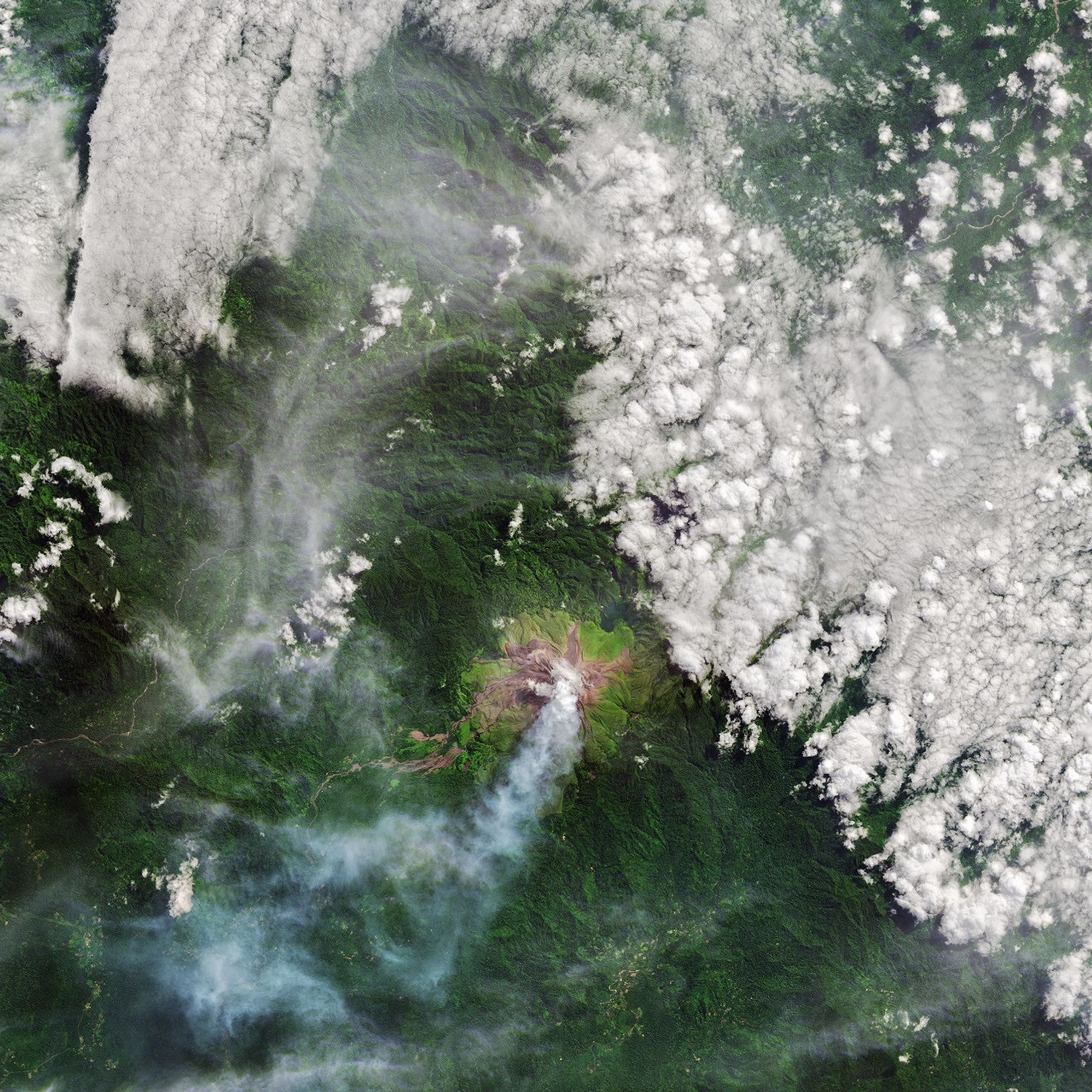
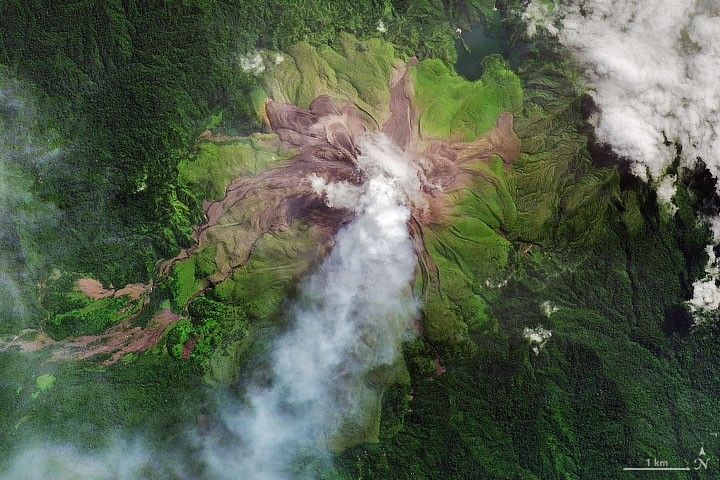
Since February 2000, Bagana has been in an eruptive period, according to the Smithsonian Global Volcanism Program. Recent lava flows are visible in this image acquired on May 28, 2022, by the Operational Land Imager-2 (OLI-2) on Landsat 9. The fresh lava is dark brown, while lighter brown areas were likely stripped of vegetation by volcanic debris or acidic gases. Older lava flows are covered in light green vegetation, and the surrounding forests are dark green. The volcanic plume, as well as some nearby clouds, are white.
Bagana is also a “remarkable emitter of sulfur dioxide,” according to recent research. The volcano belches out several thousand tons of the air pollutant per day, the most of any volcano in the world without a lava lake.
Such robust volcanic activity is due to the geologic setting. In the southwest Pacific, the Australian and Pacific plates are converging at a rate of about 11 centimeters per year. This slow-motion collision has big consequences. As one plate dives down below the other in a process called subduction, a deep-sea trench forms at the leading edge of the lower plate and volcanoes form on the overlying plate. But these forces are ever shifting.
The island of Bougainville formed mainly in two geologic stages. About 45 million years ago, the Pacific Plate was subducting beneath the Australian Plate. Volcanoes began to build up on the seafloor. Then, around 10 million years ago, the direction of subduction changed and the Australian Plate began to subduct beneath the Pacific Plate. This activity produced the more recent volcanic rocks of Bougainville Island, and later led to the formation of Bagana Volcano.
References & Resources
- Davies, H. L. (2015) The Geology of Bougainville In A. J. Regan & H. M. Griffin (Eds.), Bougainville Before the Conflict, pp. 20â30. Australian National University (ANU) Press.
- Global Volcanism Program (2022). Bagana Volcano.
- McCormick Kilbride, B.T., et al. (2019) Multi-year Satellite Observations of Sulfur Dioxide Gas Emissions and Lava Extrusion at Bagana Volcano, Papua New Guinea. Frontiers in Earth Science, 7.
- NASA Earth Observatory (2012, May 16) Fresh Lava Flow on Bagana Volcano.
- NASA Earth Observatory (2009, August 9) Plume from Bagana.
- NASA Earth Observatory (2007, June 28) Plume from Bagana, Bougainville Island.
NASA Earth Observatory image by Joshua Stevens , using Landsat data from the U.S. Geological Survey . Story by Sara E. Pratt .