















Satellite remote sensors view the Earth at many scales of space, ranging from global throughcontinental, regional, and local—even observing details as small as one meter (three feet)across. These data enable scientists to study a wide range of phenomena that occur over these same scales of space, such as El Niño, droughts, storms, and flash floods.
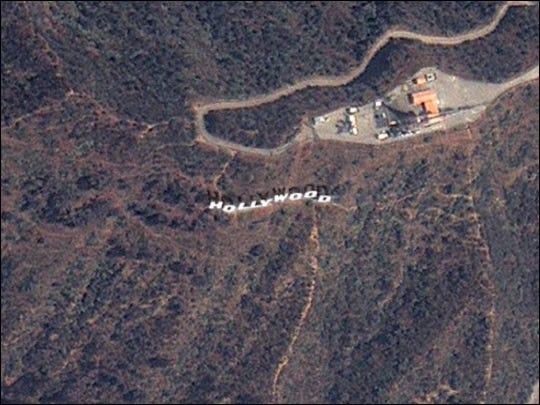
The above image shows the Hollywood sign above Los Angeles, California. It is the finalframe in an animation that demonstrates the wide range of spatial resolutions viewed by current state-of-the-art sensors.
Farthest away in the animation, we see the Earth as a globe, which comes from data collected by the Moderate-resolution Imaging Spectroradiometer(MODIS), an instrument on NASA’s Terra satellite. Thisfirst picture has a resolution of up to 8000 meters per pixel. As ourvirtual camera begins its long descent to ground, we pass through another layer ofMODIS information. Data in the second layer resolves details as small as250 meters across. Our measure of detail has just improved dramatically.
Next we find our apparent speed increasing as the surface of the Earthenvelops our sense of horizon. The data supporting this perspectivecomes from the land imaging workhorse of NASA’s fleet: Landsat 7. These images resolve features as small as 15 meters across.
Finally, as we rush in to the limits of Landsat 7’s data capabilities,we move to our final slice of visual information. Taken by a remarkablecommercial satellite called Ikonos, features as small as one meteracross come into view. Individual cars, trees, and baseball diamondscan be easily distinguished on the ground. In virtual space we’vetraveled more than a thousand miles, but in real terms only electrons, photons, and an elite group of computer and spacecraft personnel moved to make these images possible.
To see more zooms, visit
ÿ
References & Resources
Animation courtesy NASA GSFC Scientific Visualization Studio, based on data from MODIS, Landsat 7, and Space Imaging’s IKONOS. Still image copyright DigitalGlobe.