




1.2. How did our Solar System form?
Navigation


Grades K-2 or Adult Naive Learner
Do you know what a planet is? A planet is a big, round world, floating in space. It can be made mostly of rock or even mostly of gas, just like the air all around us.
You, me, and everyone we know lives on a planet called Earth. Our planet is in space and goes around the Sun. Now, did you know that the Sun is a star? Well, there are also seven other planets going around our star, the Sun. The Sun and the planets are part of what we call the Solar System.
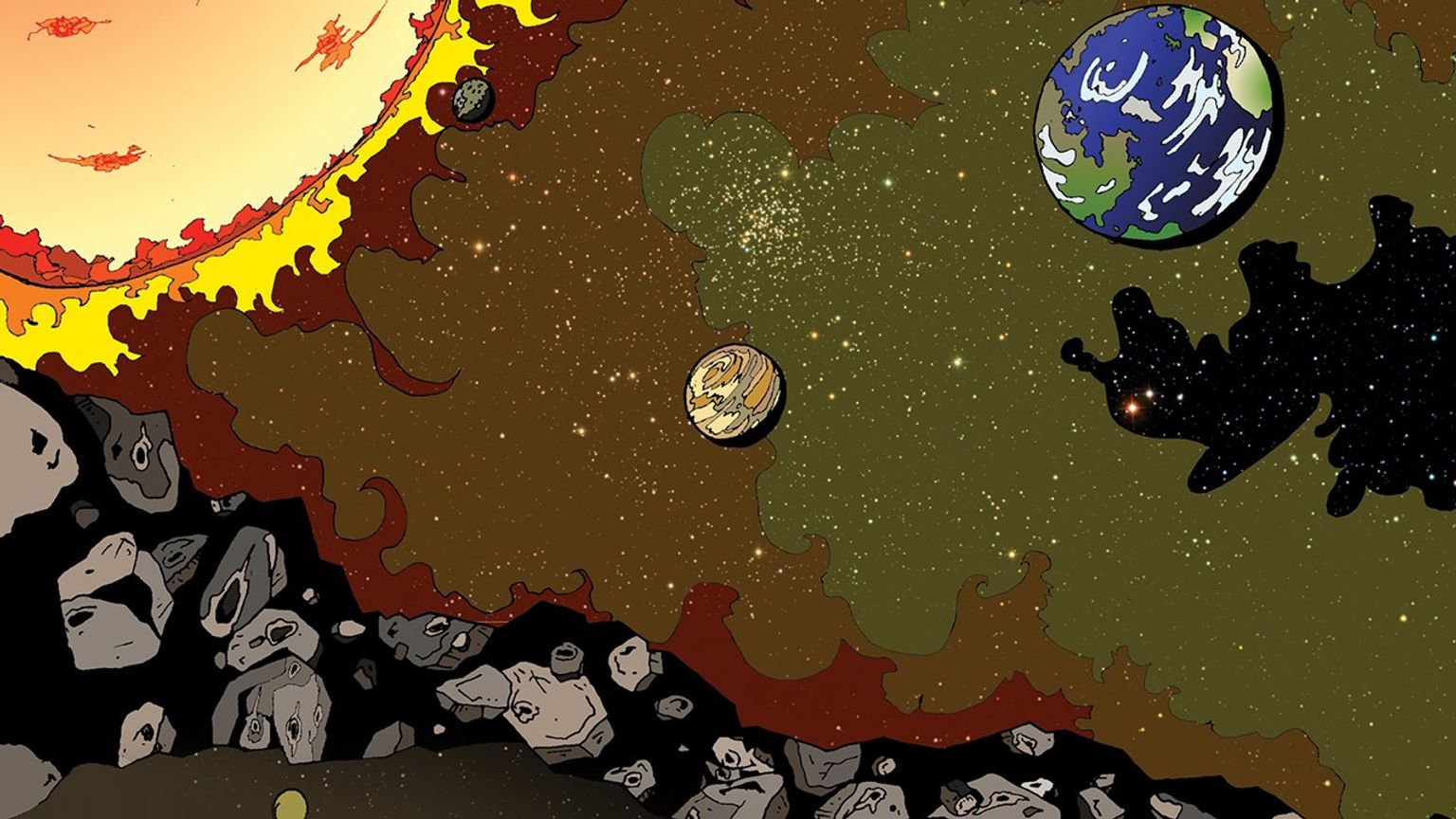
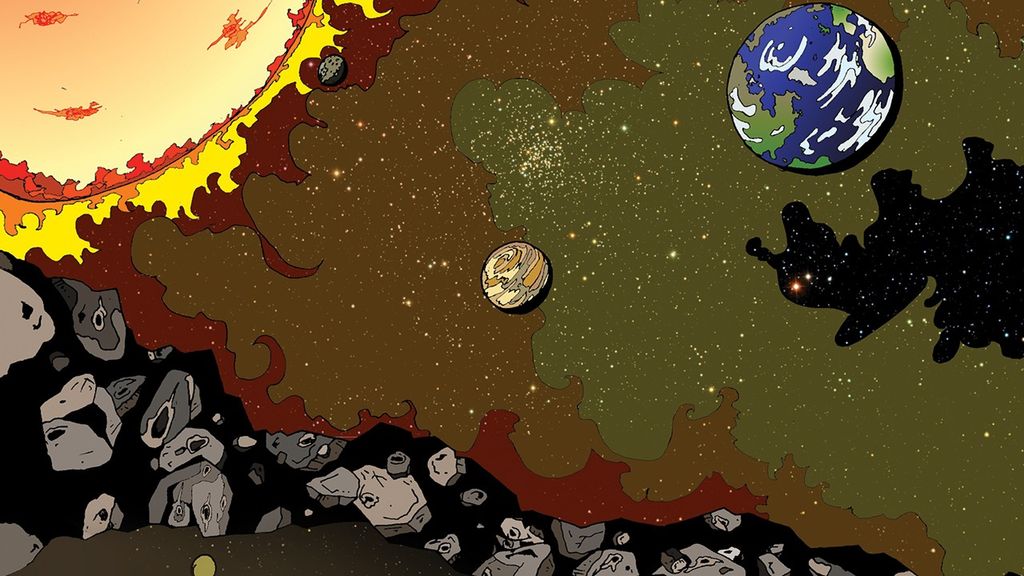
The Solar System is really old. The Sun and all of the planets came from a big cloud of stuff in space. Do you know that raindrops come from clouds in the sky? Well, it turns out that stars and even planets can come from clouds in space. Our Sun came from the middle of a big cloud in space, and the planets of our solar system also formed from that same cloud, moving around the Sun in the same kind of pattern that they follow today.
Disciplinary Core Ideas
ESS1.C: The History of Planet Earth: Some events happen very quickly; others occur very slowly, over a time period much longer than one can observe. (2-ESS1-1)
PS3.B: Conservation of Energy and Energy Transfer: Sunlight warms Earth’s surface. (K-PS3-1, K-PS3-2)
Crosscutting Concepts
Patterns in the natural world can be observed, used to describe phenomena, and used as evidence. (1-ESS1-1, 1-ESS1-2)
Big Ideas: The solar system consists of Earth and seven other planets all spinning around the Sun. Planets are big, round worlds floating in space. The Earth is a planet that goes around a much larger star called the Sun. The Sun and planets formed from a big cloud of gas and dust. The Earth, moon, Sun and planets all move in a pattern called an orbit.
Boundaries: By the end of 2nd grade, seasonal patterns of Sunrise and Sunset can be observed, described and predicted. Temperature (i.e. the Sun warms Earth) is limited to relative measurements such as warmer/cooler. (K-PS3-1)
K-5 The Science of the Sun. In this unit, students focus on the Sun as the center of our solar system and as the source for all energy on Earth. By beginning with what the Sun is and how Earth relates to it in size and distance, students gain a perspective of how powerful the Sun is compared to things we have here on Earth, and the small fraction of its energy we receive. Students also gain an understanding of how Earth relates to the other planets in the solar system. The Sun as a Star (page 17) Students identify the sun as a star. The Scale of Things (page 27). Students explore the scale of the solar system. The Size of Things (page 33) Students describe the relative sizes of the planets in the solar system by making a play-doh model. What is a year (page 37) Students act out the motion of Earth as it travels (revolves) around the Sun. Goddard Space Flight Center/NASA. https://sdo.gsfc.nasa.gov/assets/docs/UnitPlanElementary.pdf
2-12 Toilet Paper Solar System. Even in our own “cosmic neighborhood,” distances in space are so vast they are difficult to imagine. In this activity, participants build a scale model of the distances in the solar system using a roll of toilet paper. https://astrosociety.org/file_download/inline/cfdf9b2c-5947-4c19-9a23-a790ac3c7ae0

Grades 3-5 or Adult Emerging Learner
For us to learn about where we came from, we need to understand how our solar system formed.
The Sun and the planets and all of the asteroids and comets and other stuff in our solar system all formed from a really big cloud of gas and dust in space. There are clouds of gas and dust all around our galaxy. Sometimes these clouds can slowly turn into stars and planets when enough material is available and clumps together forming massive collections of ice and rock.
Do you know what kind of pattern the planets make when they go around the Sun? It kind of looks like a big circle, right? Well, when the planets were first forming from that cloud in space, the cloud itself was spinning in the same way, with the Sun forming in the middle. That’s why we see the planets moving around the Sun the way that they do today! We call that pattern of how a planet moves around the Sun an “orbit.” Have you heard of anything else that has an “orbit”? Our Moon orbits around our Earth, just like our Earth orbits around our Sun, and our entire solar system is also orbiting around the galaxy. Orbits are really important for us to learn about if we want to know where we came from.
Disciplinary Core Ideas
ESS1.C: The History of Planet Earth: Local, regional, and global patterns of rock formations reveal changes over time due to earth forces, such as earthquakes. The presence and location of certain fossil types indicate the order in which rock layers were formed. (4-ESS1-1)
PS1.A: Structure and Properties of Matter: Matter of any type can be subdivided into particles that are too small to see, but even then the matter still exists and can be detected by other means. (5-PS1-1)
PS2.B: Types of Interactions: Objects in contact exert forces on each other. (3-PS2-1) The gravitational force of Earth acting on an object near Earth’s surface pulls that object toward the planet’s center. (5-PS2-1)
Crosscutting Concepts
Patterns can be used as evidence to support an explanation. (4-ESS1-1, 4-ESS2-2) *Science assumes consistent patterns in natural systems. (4-ESS1-1)
Big Ideas: The Solar system formed through condensation from a big cloud of gas and dust. The solar system consists of Earth and seven other planets all orbiting around the Sun. The Sun, moon, and planets all move in predictable patterns called orbits. Many of these orbits are observable from Earth. The entire solar system orbits around the Milky Way galaxy.
Boundaries: In this grade band, students are learning about the different positions of the Sun, moon, and stars as observable from Earth at different times of the day, month, and year. Students are not yet defining the unseen particles or explaining the atomic-scale mechanism of condensation.
K-5 The Science of the Sun. In this unit, students focus on the Sun as the center of our solar system and as the source for all energy on Earth. By beginning with what the Sun is and how Earth relates to it in size and distance, students gain a perspective of how powerful the Sun is compared to things we have here on Earth, and the small fraction of its energy we receive. Students also gain an understanding of how Earth relates to the other planets in the solar system. The Sun as a Star (page 17) Students identify the sun as a star. The Scale of Things (page 27). Students explore the scale of the solar system. The Size of Things (page 33) Students describe the relative sizes of the planets in the solar system by making a play-doh model. What is a year (page 37) Students act out the motion of Earth as it travels (revolves) around the Sun. Goddard Space Flight Center/NASA. https://sdo.gsfc.nasa.gov/assets/docs/UnitPlanElementary.pdf
2-12 Toilet Paper Solar System. Even in our own “cosmic neighborhood,” distances in space are so vast they are difficult to imagine. In this activity, participants build a scale model of the distances in the solar system using a roll of toilet paper. https://astrosociety.org/file_download/inline/cfdf9b2c-5947-4c19-9a23-a790ac3c7ae0
3-5 SpaceMath Problem 543: Timeline for Planet Formation. Students calculate time intervals in millions and billions of years from a timeline of events [Topics: time calculations; integers] https://spacemath.gsfc.nasa.gov/Grade35/10Page6.pdf
3-5 SpaceMath Problem 541: How to Build a Planet. Students study planet growth by using a clay model of planetessimals combining to form a planet by investigating volume addition with spheres. [Topics: graphing; counting] https://spacemath.gsfc.nasa.gov/Grade35/10Page4.pdf
3-5, 6-8, 9-12 Marsbound! In this NGSS aligned activity (three 45-minute sessions), students in grades become NASA project managers and design their own NASA mission to Mars. Mars is significant in astrobiology and more needs to be learned about this planet and its potential for life. Students create a mission that must balance the return of science data with mission limitations such as power, mass and budget. Risk factors play a role and add to the excitement in this interactive mission planning activity. Arizona State University/NASA. http://marsed.asu.edu/lesson_plans/marsbound
3-5 or 6-8 Strange New Planet. This 5E hands-on lesson (2-3 hours) engages students in how scientists gain information from looking at things from different perspectives. Students gain knowledge about simulated planetary surfaces through a variety of missions such as Earth-based telescopes to landed missions. They learn the importance of remote sensing techniques for exploration and observation. NASA /Arizona State University. http://marsed.asu.edu/strange-new-planet
4-8 SpaceMath Problem 300: Does Anybody Really Know What Time It Is? Students use tabulated data for the number of days in a year from 900 million years ago to the present, to estimate the rate at which an Earth day has changed using a linear model. [Topics: graphing; finding slopes; forecasting] https://spacemath.gsfc.nasa.gov/earth/6Page58.pdf
4-12 Meet the Planets. In this activity, kids identify the planets in the solar system, observe and describe their characteristics and features, and build a scale model out of everyday materials. They are also introduced to moons, comets, and asteroids. (Finding life Beyond Earth, page 13) NOVA . https://d43fweuh3sg51.cloudfront.net/media/assets/wgbh/nvfl/nvfl_doc_collection/nvfl_doc_collection.pdf
5-12 Exploring Meteorite Mysteries: The Meteorite Asteroid Connection (4.1). In this lesson, students build an exact-scale model of the inner solar system; the scale allows the model to fit within a normal classroom and also allows the representation of Earth to be visible without magnification. Students chart where most asteroids are, compared to the Earth, and see that a few asteroids come close to the Earth. Students see that the solar system is mostly empty space unlike the way it appears on most charts and maps. NASA . https://er.jsc.nasa.gov/seh/Exploring_Meteorite_Mysteries.pdf
5-12 Exploring Meteorite Mysteries: Building Blocks of Planets (10.1). Chondrites are the most primitive type of rock available for study. The chondrules that make up chondrites are considered the building blocks of planets. In this lesson, students experiment with balloons and static electricity to illustrate the theories about how dust particles collected into larger clusters. Students also manipulate magnetic marbles and steel balls to illustrate the accretion of chondritic material into larger bodies like planets and asteroids. NASA . https://er.jsc.nasa.gov/seh/Exploring_Meteorite_Mysteries.pdf
5-12 Exploring Meteorite Mysteries: Exploration Proposal (17.1). Exploration of the outer Solar System provides clues to the beginnings of the solar system. This is a group-participation simulation based on the premise that water and other resources from the asteroid belt are required for deep space exploration. Students brainstorm or investigate to identify useful resources, including water, that might be found on an asteroid. NASA . https://er.jsc.nasa.gov/seh/Exploring_Meteorite_Mysteries.pdf
5-12 Big Explosions and Strong Gravity. In this one-two day activity, students work in groups to examine the crushing ability of gravity, equilibrium, and a model for the creation of heavy elements through a supernova. This active lesson helps students visualize the variation and life cycle of stars. NASA http://imagine.gsfc.nasa.gov/educators/programs/bigexplosions/activities/supernova_demos.html
Grades 6-8 or Adult Building Learner
Earth is the only world that we know of that has life. All of the plants and animals and microbes and other living things on Earth have evolved here. So, for us to understand where life as we know it came from, we need to understand where our planet came from.
The Sun and the planets and all of the other stuff in our solar system all formed from a really big cloud of gas and dust in space. We call such a cloud a “nebula” and more than one of them we refer to as “nebulae.” There are nebulae all around our galaxy, and it’s from these nebulae that stars and planets form. Nebulae are massive clouds of dust and debris in space and have all the ingredients to form stars and planets. When enough material is available, it begins to stick together forming a large mass. In time, the mass can grow large enough to form a planet or even a new star.
We currently think that our solar system formed from a large nebula, perhaps after the explosion of a nearby star. Some big stars can explode, something called a supernova, and that explosion has enough energy to make the gas and dust in nearby nebulae start swirling and spinning about. As this happened, it caused a lot of the material in the nebula to fall into its center, and that’s where the Sun started forming. Meanwhile, the rest of the gas and dust in the nebula began colliding and sticking together, making little pieces of metal and rock. Those small pieces then collided with each other, forming larger pieces, which then collided with each other to form even larger ones. These were young planets, and eventually, over a long time and through many, many collisions, our eight planets were formed – Mercury, Venus, Earth, Mars, Jupiter, Saturn, Uranus, and Neptune.
We call the pattern that the planets make when they go around the Sun an “orbit.” Well, when the planets were first forming from that cloud in space, the cloud itself was spinning in the same direction as the orbits of the planets today, with the Sun forming in the middle and also spinning in the same direction. That’s why we see the planets moving around the Sun the way that they do today!
You might also know that the Moon orbits around Earth. For something to be a moon, it needs to be in orbit around a planet. One thing that makes a planet is that a planet has to be orbiting a star. But star systems also have orbits. They orbit around their entire galaxy. So, orbits are really important for us to learn about if we want to know where we came from.
Disciplinary Core Ideas
ESS1.A: The Universe and Its Stars:
- Patterns of the apparent motion of the Sun, the Moon, and stars in the sky can be observed, described, predicted, and explained with models. (MS-ESS1-1)
- Earth and its solar system are part of the Milky Way galaxy, which is one of many galaxies in the universe. (MS-ESS1-2)
ESS1.B: Earth and the Solar System:
- The solar system consists of the Sun and a collection of objects, including planets, their moons, and asteroids that are held in orbit around the Sun by its gravitational pull on them. (MS-ESS1-2, MS-ESS1-3)
- This model of the solar system can explain eclipses of the Sun and the Moon. Earth’s spin axis is fixed in direction over the short-term but tilted relative to its orbit around the Sun. The seasons are a result of that tilt and are caused by the differential intensity of sunlight on different areas of Earth across the year. (MS-ESS1-1)
- The solar system appears to have formed from a disk of dust and gas, drawn together by gravity. (MS-ESS1-2)
PS1.A: Structure and Properties of Matter: All substances are made from some 100 different types of atoms, which combine with one another in various ways. Atoms form molecules that range in size from two to thousands of atoms. Pure substances are made from a single type of atom or molecule; each pure substance has characteristic physical and chemical properties that can be used to identify it. (MS-PS1-1)
Crosscutting Concepts
Cause and effect relationships may be used to predict phenomena in natural or designed systems. (MS-PS1-4)
Big Ideas: Condensation causes rain drops to form inside of clouds, and sometimes can cause entire star systems to form inside of clouds. The Solar system formed through condensation from big clouds of gas and dust called nebulae after a supernova, or the explosion of a large star. Planets move around the Sun in an orbit, and the Solar system orbits around the entire galaxy.
Boundaries: Emphasis is on gravity as the force that holds together the solar system and Milky Way galaxy and controls orbital motions within them. (MS-ESS1-2) Does not include Kepler’s Laws of orbital motion or the apparent retrograde motion of the planets as viewed from Earth. (MS-ESS1-2)
2-12 Toilet Paper Solar System. Even in our own “cosmic neighborhood,” distances in space are so vast they are difficult to imagine. In this activity, participants build a scale model of the distances in the solar system using a roll of toilet paper. https://astrosociety.org/file_download/inline/cfdf9b2c-5947-4c19-9a23-a790ac3c7ae0
3-5, 6-8, 9-12 Marsbound! In this NGSS aligned activity (three 45-minute sessions), students in grades become NASA project managers and design their own NASA mission to Mars. Mars is significant in astrobiology and more needs to be learned about this planet and its potential for life. Students create a mission that must balance the return of science data with mission limitations such as power, mass and budget. Risk factors play a role and add to the excitement in this interactive mission planning activity. Arizona State University/NASA. http://marsed.asu.edu/lesson_plans/marsbound
3-5 or 6-8 Strange New Planet. This 5E hands-on lesson (2-3 hours) engages students in how scientists gain information from looking at things from different perspectives. Students gain knowledge about simulated planetary surfaces through a variety of missions such as Earth-based telescopes to landed missions. They learn the importance of remote sensing techniques for exploration and observation. NASA /Arizona State University. http://marsed.asu.edu/strange-new-planet
4-8 SpaceMath Problem 300: Does Anybody Really Know What Time It Is? Students use tabulated data for the number of days in a year from 900 million years ago to the present, to estimate the rate at which an Earth day has changed using a linear model. [Topics: graphing; finding slopes; forecasting] https://spacemath.gsfc.nasa.gov/earth/6Page58.pdf
4-12 Meet the Planets. In this activity, kids identify the planets in the solar system, observe and describe their characteristics and features, and build a scale model out of everyday materials. They are also introduced to moons, comets, and asteroids. (Finding life Beyond Earth, page 13) NOVA . https://d43fweuh3sg51.cloudfront.net/media/assets/wgbh/nvfl/nvfl_doc_collection/nvfl_doc_collection.pdf
5-12 Exploring Meteorite Mysteries: The Meteorite Asteroid Connection (4.1). In this lesson, students build an exact-scale model of the inner solar system; the scale allows the model to fit within a normal classroom and also allows the representation of Earth to be visible without magnification. Students chart where most asteroids are, compared to the Earth, and see that a few asteroids come close to the Earth. Students see that the solar system is mostly empty space unlike the way it appears on most charts and maps. NASA . https://er.jsc.nasa.gov/seh/Exploring_Meteorite_Mysteries.pdf
5-12 Exploring Meteorite Mysteries: Building Blocks of Planets (10.1). Chondrites are the most primitive type of rock available for study. The chondrules that make up chondrites are considered the building blocks of planets. In this lesson, students experiment with balloons and static electricity to illustrate the theories about how dust particles collected into larger clusters. Students also manipulate magnetic marbles and steel balls to illustrate the accretion of chondritic material into larger bodies like planets and asteroids. NASA . https://er.jsc.nasa.gov/seh/Exploring_Meteorite_Mysteries.pdf
5-12 Exploring Meteorite Mysteries: Exploration Proposal (17.1). Exploration of the outer Solar System provides clues to the beginnings of the solar system. This is a group-participation simulation based on the premise that water and other resources from the asteroid belt are required for deep space exploration. Students brainstorm or investigate to identify useful resources, including water, that might be found on an asteroid. NASA . https://er.jsc.nasa.gov/seh/Exploring_Meteorite_Mysteries.pdf
5-12 Big Explosions and Strong Gravity. In this one-two day activity, students work in groups to examine the crushing ability of gravity, equilibrium, and a model for the creation of heavy elements through a supernova. This active lesson helps students visualize the variation and life cycle of stars. NASA http://imagine.gsfc.nasa.gov/educators/programs/bigexplosions/activities/supernova_demos.html
6-8 SpaceMath Problem 542: The Late Heavy Bombardment Era. Students estimate the average arrival time of large asteroids that impacted the moon. They work with the formula for the volume of a sphere to estimate how much additional mass was added to the moon and Earth during this era. [Topics: volume of spheres; proportions] https://spacemath.gsfc.nasa.gov/earth/10Page5.pdf
6-8 SpaceMath Problem 60: When is a planet not a planet? In 2003, Dr. Michael Brown and his colleagues at CalTech discovered an object nearly 30% larger than Pluto, which is designated as 2003UB313. Is 2003UB313 really a planet? In this activity, students examine this topic by surveying various internet resources that attempt to define the astronomical term ‘planet’. [Topics: non-mathematical essay; reading to be informed] https://spacemath.gsfc.nasa.gov/astrob/2page17.pdf
6-8 SpaceMath Problem 59: Getting A Round in the Solar System! How big does a body have to be before it becomes round? In this activity, students examine images of asteroids and planetary moons to determine the critical size for an object to become round under the action of its own gravitational field. [Topics: data analysis; decimals; ratios; graphing] https://spacemath.gsfc.nasa.gov/astrob/2page20.pdf
6-8 Explore! Jupiter’s Family Secrets. This one-hour lesson for formal or informal education settings has students connecting their own life story to a cultural creation story and then to the “life” story of Jupiter, including the Big Bang as the beginning of the universe, the creation of elements through stars and the creation of the solar system. JPL /NASA. http://www.lpi.usra.edu/education/explore/solar_system/activities/birthday/
6-9 Rising Stargirls Teaching and Activity Handbook. 1.2. Art & the Cosmic Connection: (page 19). This activity engages students in space and science education by becoming explorers. Using the elements of art: line, color, texture, shape, and value: students learn to analyze the mysterious surfaces of our rocky celestial neighbors; planets, moons, comets and asteroids, as well as the Earth. Name That Planet (page 25) Students communicate their knowledge about the solar system using different modes of communication—visual, verbal, and kinesthetic. Distance Calculation (page 27) Students calculate the distances between planets using a unit of measurement that is personal to them—themselves! Rising Stargirls activities fuse science and the arts to create enlightened future scientists and imaginative thinkers. Rising Stargirls. https://static1.squarespace.com/static/54d01d6be4b07f8719d7f29e/t/5748c58ec2ea517f705c7cc6/1464386959806/Rising_Stargirls_Teaching_Handbook.compressed.pdf
6-12 Science Fiction Stories with Good Astronomy & Physics: A Topical List: Cosmology. 1.2. The Astronomical Society of the Pacific created this list of short stories and novels that use more or less accurate science and can be used for teaching or reinforcing astronomy or physics concepts including the origin of the universe. https://astrosociety.org/file_download/inline/621a63fc-04d5-4794-8d2b-38e7195056e9
6-12 Where are the Small Worlds? Through an immersive digital experience (1-2 hours), students use a simulation/model of the solar system in order to investigate small worlds in order to learn more about the solar system and its origin. The experience can be standalone or has options to track student tasks or modify the simulation as needed by the teacher. Arizona State University. https://infiniscope.org/lesson/where-are-the-small-worlds/
6-12 Astrobiology Math. This collection of math problems provides an authentic glimpse of modern astrobiology science and engineering issues, often involving actual research data. Students explore concepts in astrobiology through calculations. Relevant topics include Habitable Zones and Stellar Luminosity (page 57) and Ice or Water? (page 49). NASA . https://www.nasa.gov/pdf/637832main_Astrobiology_Math.pdf
6-12 Pocket Solar System. This activity involves making a simple model to give students an overview of the distances between the orbits of the planets and other objects in our solar system. It is also a good tool for reviewing fractions. https://astrosociety.org/file_download/inline/5c27818a-e947-46ad-a9dc-f4af157af7d8
6-12 Origins: The Universe. In this web interactive, scientists use a giant eye in the southern sky to unravel how galaxies are born. Video, pictures, and print weave information for the learner as they more deeply understand the scientific pursuit of astrobiology. UW-Madison. https://origins.wisc.edu/
7-9 SpaceMath Problem 8: Making a Model Planet. Students use the formula for a sphere, and the concept of density, to make a mathematical model of a planet based on its mass, radius and the density of several possible materials (ice, silicate rock, iron, basalt). [Topics: volume of sphere; mass = density x volume; decimal math; scientific notation] https://spacemath.gsfc.nasa.gov/astrob/Week14.pdf
Grades 9-12 or Adult Sophisticated Learner
As the physical context for life as we know it, it is important to learn about Earth’s origins so we can understand life’s origins. Although life may exist in situations other than that of a planet orbiting a star, it makes sense to explore the phenomenon of planetary system formation as a context for the emergence and evolution of life.
The story of the formation of our solar system begins in a region of space of called a “giant molecular cloud”. You might have heard before that a cloud of gas and dust in space is also called a “nebula,” so the scientific theory for how stars and planets form from molecular clouds is also sometimes called the Nebular Theory. Nebular Theory tells us that a process known as “gravitational contraction” occurred, causing parts of the cloud to clump together, which would allow for the Sun and planets to form from it.
Before gravitational contraction, the majority of the material within the giant molecular cloud that formed our solar system consisted of hydrogen and helium produced at the time of the big bang, with small amounts of heavier elements such as carbon and oxygen which were made via nucleosynthesis in prior generations of stars (see 1.1 above). The material in this giant cloud was not uniformly distributed – there were regions of higher density (more dust and gas within a specific volume of space) and regions of lower density (less gas and dust within that same volume).
Evidence from meteorites suggests that the energy produced by a nearby exploding star (a supernova) passed through a higher density region in the cloud and caused it to begin to swirl and twist about. This area of the cloud is sometimes called the pre-solar nebula (“pre” = before; “solar” = star or Sun). As molecules in the pre-solar nebula were swirling about, some of them started bumping into each other and sometimes would even stick together. As more and more of these clumps formed, gravity caused them to start sticking together and to fall into the center of the pre-solar nebula, which only caused gravity to pull even more of the material into the center of the cloud, and this is the process that’s referred to as gravitational contraction.
While all of this was happening, the action of molecules bumping into each other over and over slowly caused the pre-solar nebula to flatten into a spinning disk of dust and gas. This is sometimes called a circumstellar disk (“circum” = around; “stellar” = star) or protoplanetary disk (“proto” = first or before). Almost all of the material in the disk collected in the center, giving rise to the young Sun. However, some of the particles in the spinning disk began colliding with each other and sticking together, forming larger and larger fragments. The larger a fragment became, the more mass it had and therefore the more gravitational pull it exerted. Which in turn drew more and more material to it, and the larger it became, and so on. This process is called “accretion,” and resulted in the production of many planetesimals (small objects that build up into planets), and eventually, the planets themselves.
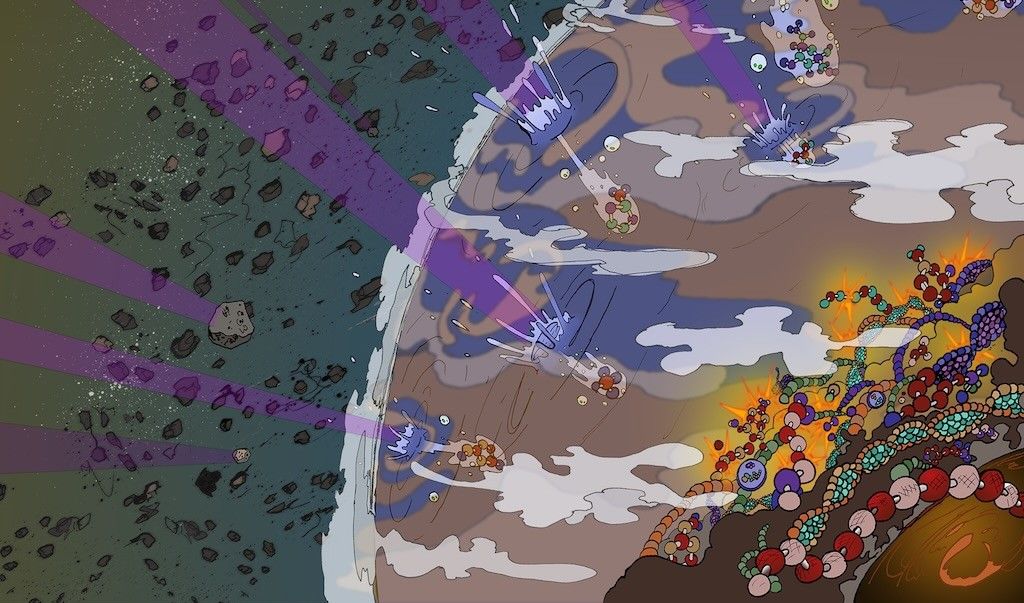
While the young Sun was starting to heat up in the middle of the protoplanetary disk, it warmed up the disk so much that nothing could stay solid really close to the Sun (it all melted). A little further out from the Sun, stuff like metal and rock was able to cool enough to make solid materials for forming the planets. But it was still so hot there that molecules that are often liquids or gases here on Earth (like water, ammonia, carbon dioxide and methane) couldn’t easily stick to the solid planet-forming materials. Those molecules could only really be added to planets that were a lot further from the Sun, where it was cold enough for them to clump together with the other solid stuff. This is why we have gas giant planets like Jupiter and Saturn which are very different from the rocky planets like Earth and Venus.
Disciplinary Core Ideas
ESS1.A: The universe and its Stars: Nearly all observable matter in the universe is hydrogen or helium, which formed in the first minutes after the big bang. Elements other than these remnants of the big bang continue to form within the cores of stars. (HS-ESS1-2) *Nuclear fusion within stars produces all atomic nuclei lighter than and including iron, and the process releases the energy seen as starlight. Heavier elements are produced when certain massive stars achieve a supernova stage and explode. (HS-ESS1-2, HS-ESS1-3) *Stars go through a sequence of developmental stages — they are formed; evolve in size, mass, and brightness; and eventually burn out. Material from earlier stars that exploded as supernovas is recycled to form younger stars and their planetary systems.
ESS1.B: Earth and the Solar System: Kepler’s laws describe common features of the motions of orbiting objects, including their elliptical paths around the Sun. (HS-ESS1-4) *The solar system consists of the Sun and a collection of objects of varying sizes and conditions — including planets and their moons — that are held in orbit around the Sun by its gravitational pull on them. This system appears to have formed from a disk of dust and gas, drawn together by gravity.
PS1.C: Nuclear Processes: Nuclear processes, including fusion, fission, and radioactive decays of unstable nuclei, involve release or absorption of energy. The total number of neutrons plus protons does not change in any nuclear process. (HS-PS1-8)
Crosscutting Concepts
Scientific knowledge is based on the assumption that natural laws operate today as they did in the past and they will continue to doe so in the future (HS-ESS1-2). Science assumes the universe is a vast single system in which basic laws are consistent. (HS-ESS1-2)
Big Ideas: The phenomenon of planetary system formation serves as a context for the emergence and evolution of life. A cloud of gas and dust in space is called a “nebula”. The Nebular Theory is the scientific theory for how stars and planets form from molecular clouds and their own gravity. The majority of the material within the giant molecular cloud that formed our solar system consisted of hydrogen and helium produced at the time of the big bang. Nuclear fusion within stars forms heavier elements under extreme pressure and temperature. The larger the star, the heavier the elements that can be produced through fusion and Supernova. Heavier elements were also made via nucleosynthesis. The circumstellar disk gave rise to the young Sun.
Boundaries: Emphasis is on the way nucleosynthesis, and therefore the different elements created, varies as a function of the mass of a star and the stage of its lifetime.(HS-ESS1-3) Does not include details of the atomic and subatomic processes involved with the Sun’s nuclear fusion. (HS-ESS1-1)
2-12 Toilet Paper Solar System. Even in our own “cosmic neighborhood,” distances in space are so vast they are difficult to imagine. In this activity, participants build a scale model of the distances in the solar system using a roll of toilet paper. https://astrosociety.org/file_download/inline/cfdf9b2c-5947-4c19-9a23-a790ac3c7ae0
3-5, 6-8, 9-12 Marsbound! In this NGSS aligned activity (three 45-minute sessions), students in grades become NASA project managers and design their own NASA mission to Mars. Mars is significant in astrobiology and more needs to be learned about this planet and its potential for life. Students create a mission that must balance the return of science data with mission limitations such as power, mass and budget. Risk factors play a role and add to the excitement in this interactive mission planning activity. Arizona State University/NASA. http://marsed.asu.edu/lesson_plans/marsbound
4-12 Meet the Planets. In this activity, kids identify the planets in the solar system, observe and describe their characteristics and features, and build a scale model out of everyday materials. They are also introduced to moons, comets, and asteroids. (Finding life Beyond Earth, page 13) NOVA . https://d43fweuh3sg51.cloudfront.net/media/assets/wgbh/nvfl/nvfl_doc_collection/nvfl_doc_collection.pdf
5-12 Exploring Meteorite Mysteries: The Meteorite Asteroid Connection (4.1). In this lesson, students build an exact-scale model of the inner solar system; the scale allows the model to fit within a normal classroom and also allows the representation of Earth to be visible without magnification. Students chart where most asteroids are, compared to the Earth, and see that a few asteroids come close to the Earth. Students see that the solar system is mostly empty space unlike the way it appears on most charts and maps. NASA . https://er.jsc.nasa.gov/seh/Exploring_Meteorite_Mysteries.pdf
5-12 Exploring Meteorite Mysteries: Building Blocks of Planets (10.1). Chondrites are the most primitive type of rock available for study. The chondrules that make up chondrites are considered the building blocks of planets. In this lesson, students experiment with balloons and static electricity to illustrate the theories about how dust particles collected into larger clusters. Students also manipulate magnetic marbles and steel balls to illustrate the accretion of chondritic material into larger bodies like planets and asteroids. NASA . https://er.jsc.nasa.gov/seh/Exploring_Meteorite_Mysteries.pdf
5-12 Exploring Meteorite Mysteries: Exploration Proposal (17.1). Exploration of the outer Solar System provides clues to the beginnings of the solar system. This is a group-participation simulation based on the premise that water and other resources from the asteroid belt are required for deep space exploration. Students brainstorm or investigate to identify useful resources, including water, that might be found on an asteroid. NASA . https://er.jsc.nasa.gov/seh/Exploring_Meteorite_Mysteries.pdf
5-12 Big Explosions and Strong Gravity. In this one-two day activity, students work in groups to examine the crushing ability of gravity, equilibrium, and a model for the creation of heavy elements through a supernova. This active lesson helps students visualize the variation and life cycle of stars. NASA http://imagine.gsfc.nasa.gov/educators/programs/bigexplosions/activities/supernova_demos.html
6-9 Rising Stargirls Teaching and Activity Handbook. 1.2. Art & the Cosmic Connection: (page 19). This activity engages students in space and science education by becoming explorers. Using the elements of art: line, color, texture, shape, and value: students learn to analyze the mysterious surfaces of our rocky celestial neighbors; planets, moons, comets and asteroids, as well as the Earth. Name That Planet (page 25) Students communicate their knowledge about the solar system using different modes of communication—visual, verbal, and kinesthetic. Distance Calculation (page 27) Students calculate the distances between planets using a unit of measurement that is personal to them—themselves! Rising Stargirls activities fuse science and the arts to create enlightened future scientists and imaginative thinkers. Rising Stargirls. https://static1.squarespace.com/static/54d01d6be4b07f8719d7f29e/t/5748c58ec2ea517f705c7cc6/1464386959806/Rising_Stargirls_Teaching_Handbook.compressed.pdf
6-12 Science Fiction Stories with Good Astronomy & Physics: A Topical List: Cosmology. 1.2. The Astronomical Society of the Pacific created this list of short stories and novels that use more or less accurate science and can be used for teaching or reinforcing astronomy or physics concepts including the origin of the universe. https://astrosociety.org/file_download/inline/621a63fc-04d5-4794-8d2b-38e7195056e9
6-12 Where are the Small Worlds? Through an immersive digital experience (1-2 hours), students use a simulation/model of the solar system in order to investigate small worlds in order to learn more about the solar system and its origin. The experience can be standalone or has options to track student tasks or modify the simulation as needed by the teacher. Arizona State University. https://infiniscope.org/lesson/where-are-the-small-worlds/
6-12 Astrobiology Math. This collection of math problems provides an authentic glimpse of modern astrobiology science and engineering issues, often involving actual research data. Students explore concepts in astrobiology through calculations. Relevant topics include Habitable Zones and Stellar Luminosity (page 57) and Ice or Water? (page 49). NASA . https://www.nasa.gov/pdf/637832main_Astrobiology_Math.pdf
6-12 Pocket Solar System. This activity involves making a simple model to give students an overview of the distances between the orbits of the planets and other objects in our solar system. It is also a good tool for reviewing fractions. https://astrosociety.org/file_download/inline/5c27818a-e947-46ad-a9dc-f4af157af7d8
6-12 Origins: The Universe. In this web interactive, scientists use a giant eye in the southern sky to unravel how galaxies are born. Video, pictures, and print weave information for the learner as they more deeply understand the scientific pursuit of astrobiology. UW-Madison. https://origins.wisc.edu/
7-9 SpaceMath Problem 8: Making a Model Planet. Students use the formula for a sphere, and the concept of density, to make a mathematical model of a planet based on its mass, radius and the density of several possible materials (ice, silicate rock, iron, basalt). [Topics: volume of sphere; mass = density x volume; decimal math; scientific notation] https://spacemath.gsfc.nasa.gov/astrob/Week14.pdf
9-10 Voyages through Time: Cosmic Evolution. This comprehensive integrated curriculum includes the universe, the totality of all things that exist, origins (beginning with an explosion of space and time and the expansion of a hot, dense mass of elementary particles and photons), and how it has evolved over billions of years into the stars and galaxies we observe today. Sample lesson on the website and the curriculum is available for purchase. SETI . http://www.voyagesthroughtime.org/cosmic/index.html
9-11 SpaceMath Problem 302: How to Build a Planet from the Inside Out. Students model a planet using a spherical core and shell with different densities. The goal is to create a planet of the right size, and with the correct mass using common planet building materials. [Topics: geometry; volume; scientific notation; mass=density x volume] https://spacemath.gsfc.nasa.gov/astrob/6Page72.pdf
9-12 Genesis Science Modules: Cosmic Chemistry: Planetary Diversity. The goal of this module is to acquaint students with the planets of the solar system and some current models for their origin and evolution. The lessons in the Genesis Science Modules challenge students to look for patterns in data, to generate observations, and critically analyze where the data does not fit with the current nebular model. This mini-unit reveals the essence of scientific research and argument within the context of the formation of solar systems. JPL /NASA http://genesismission.jpl.nasa.gov/educate/scimodule/PlanetaryDiversity/index.html
9-12 A101 Slide Set: From Supernovae to Planets. This slide set explains the discoveries of the SOFIA mission and the implications of the new data explaining how supernovae and dust push planet formation and how this is the physical context for life. SOFIA /NASA https://slideplayer.com/slide/8679314/ Teacher’s Guide:
https://www.astrosociety.org/edu/higher-ed/files/A101ss.SOFIA_SupernovaePlanets.v3.pdf
11-12 SpaceMath Problem 305: From Asteroids to Planets. Students explore how long it takes to form a small planet from a collection of asteroids in a planet-forming disk of matter orbiting a star based on a very simple physical model. [Topics: integral calculus] https://spacemath.gsfc.nasa.gov/astrob/6Page82.pdf
11-12 SpaceMath Problem 304: From Dust Balls to Asteroids. Students calculate how long it takes to form an asteroid-sized body using a simple differential equation based on a very simple physical model. [Topics: integral calculus] https://spacemath.gsfc.nasa.gov/astrob/6Page81.pdf
11-12 SpaceMath Problem 303: From Dust Grains to Dust Balls. Students create a model of how dust grains grow to centimeter-sized dust balls as part of forming a planet based on a very simple physical model. [Topics: integral calculus] https://spacemath.gsfc.nasa.gov/astrob/6Page80.pdf
Storyline Extensions
The planets are named after stories from long ago:
Our planets are named Mercury, Venus, Earth, Mars, Jupiter, Saturn, Uranus, and Neptune. Seven of the planets are named after gods from Roman mythology. These are Mercury, Venus, Mars, Jupiter, Saturn, and Neptune. However, Uranus is a name from Greek mythology (Uranus was the god of the sky). Also, the name for our planet, Earth, comes from Old English, and appears to have come from people who lived in Northern Europe long ago.
Our location in the galaxy:
Our Milky Way galaxy is really big! If we could travel outside of the galaxy and look back at it, it would look like a big disk of dust and gas and stars, with a big bulging sphere of stars near the middle. The disk of the galaxy is about 100,000 lightyears in diameter. That means that it takes light about 100,000 years to travel from one side to the other. Our little solar system (little in comparison to the galaxy, that is) lies about 30,000 lightyears from the center of the galaxy. Just as moons orbit around planets, and planets orbit around stars, star systems also orbit around the center of the galaxy. Our own solar system is traveling through the galaxy at over 500,000 miles per hour! And our very long orbit around the galaxy takes almost 250 million years! But we’re not alone out here. There are lots of other stars and other worlds in the galaxy. Our best estimates right now are that there are about 100-400 billion stars in the Milky Way. And, even though we’ve only just begun finding exoplanets, some astronomers believe there is evidence for more planets than stars in the milky way and other galaxies. That’s an awful lot of worlds!