



















APOD
Astronomy Picture of the Day
Discover the cosmos! Each day a different image or photograph of our fascinating universe is featured, along with a brief explanation written by a professional astronomer.
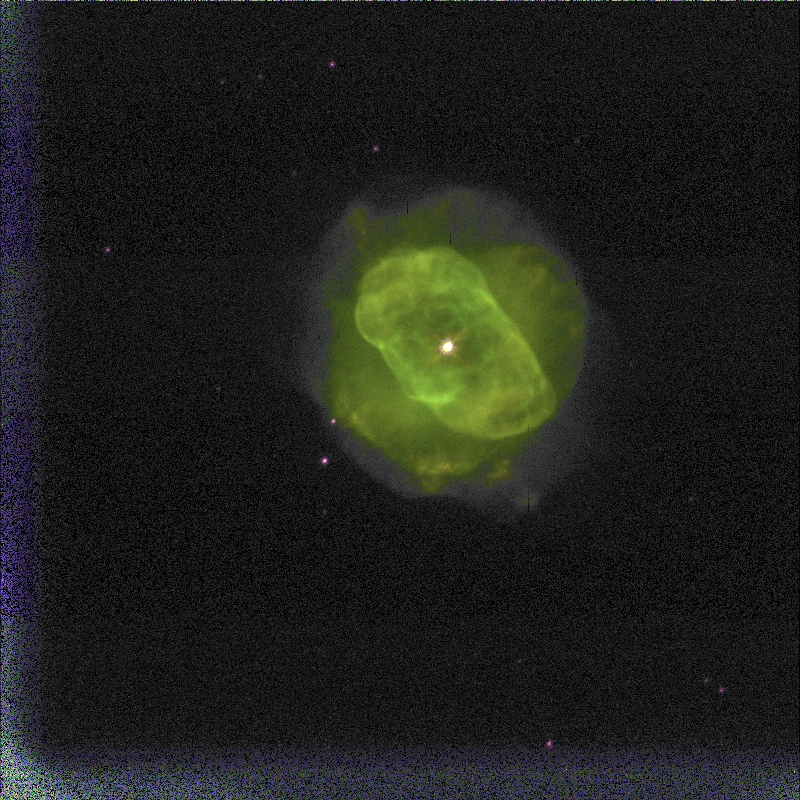
NGC 5882: A Small Planetary Nebula
Explanation: Will most stars one day look like this? Pictured above is the planetary nebula NGC 5882, captured by the Hubble Space Telescope . Although planetary nebulae can appear similar to planets like Uranus and Neptune , they are actually gas clouds surrounding stars typically hundreds of light years away. Planetary nebula form when a typical star completes fusion in its core and ejects an outer envelope of gas - usually about 10 percent of the star's initial mass. This gas shell dims in about 50,000 years - short compared to the lifetimes of stars . Therefore, although only about 1000 planetary nebula are known in our Galaxy , it is thought that most stars go through this phase. Green light is emitted when oxygen ions acquire electrons from the surrounding gas.
| Date | August 28, 1996 |
|---|---|
| Credit | Credit: H. Bond, HST, STSci, NASA |
| Authors & editors: | Robert Nemiroff (MTU) & Jerry Bonnell (UMCP) |
| A service of: |
ASD at NASA / GSFC, NASA Science Activation & Michigan Tech. U. |