






















APOD
Astronomy Picture of the Day
Discover the cosmos! Each day a different image or photograph of our fascinating universe is featured, along with a brief explanation written by a professional astronomer.
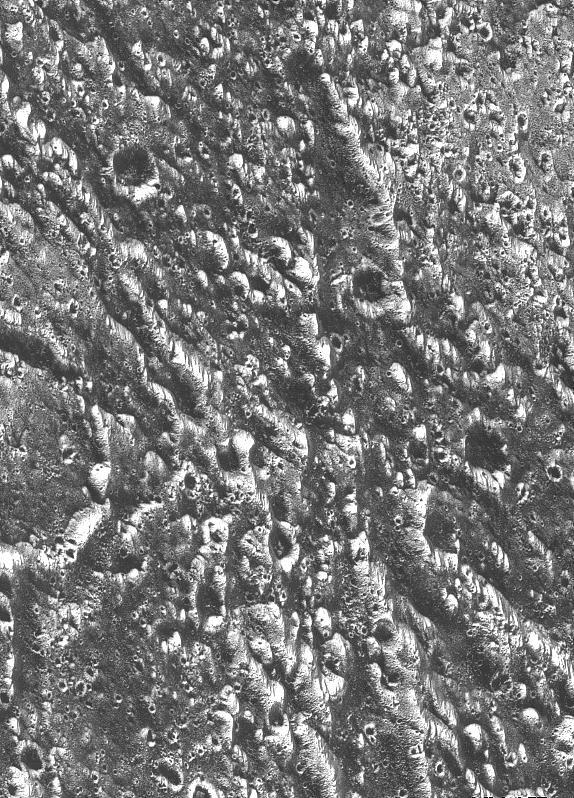
Ancient Cratered Plains on Ganymede
Explanation: The largest moon in the Solar System shows regions that are ancient and battered. The high density of craters demonstrate that patches of Ganymede are indeed billions of years old. This photo is one of a series released by NASA two days ago from the Galileo spacecraft orbiting Jupiter . The large impact crater on the left is 19 kilometers across, while dark indentations in Ganymede 's crusty surface-ice run diagonally. Ganymede is composed of half rock and half water-ice. The Galileo spacecraft will continue to orbit Jupiter over the next 16 months and send back data about Jupiter and its four largest moons: Io , Europa , Ganymede , and Callisto .
APOD's Archive of Galileo at Ganymede
| Date | July 12, 1996 |
|---|---|
| Credit | Credit: Galileo Mission Team, Galileo Spacecraft, NASA |
| Authors & editors: | Robert Nemiroff (MTU) & Jerry Bonnell (UMCP) |
| A service of: |
ASD at NASA / GSFC, NASA Science Activation & Michigan Tech. U. |