





















APOD
Astronomy Picture of the Day
Discover the cosmos! Each day a different image or photograph of our fascinating universe is featured, along with a brief explanation written by a professional astronomer.
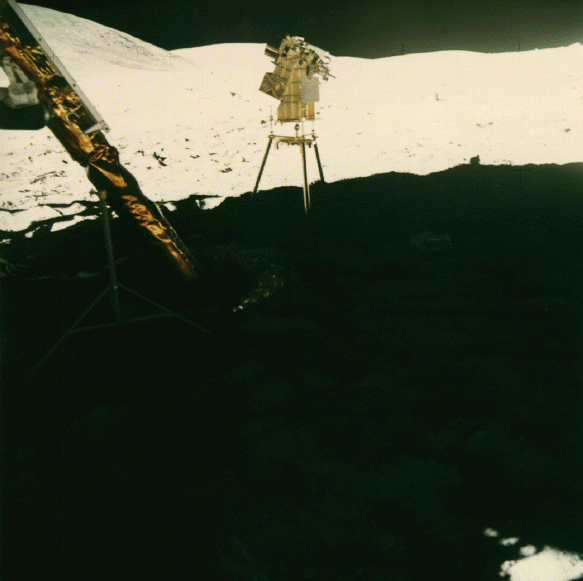
The First Lunar Observatory
Explanation: The first and only lunar astronomical observatory was deployed by the Apollo 16 crew in 1972. The Far Ultraviolet Camera / Spectrograph used a 3-inch diameter telescope to photograph the Earth , various nebulae , star clusters , and the Large Magellanic Cloud . The camera is seen above placed in the shadow of the Lunar Module so it would not overheat. A leg of the Lunar Module enters the picture from the left. The camera took pictures in ultraviolet light which would normally be blocked by the Earth's atmosphere . The Far Ultraviolet Camera was created by George Carruthers ( NRL ), had a field of view of 20 degrees, and could detect stars having visual magnitude brighter than 11. 178 images were recorded in a film cartridge which was returned to Earth . The observatory stands on the Moon even today.
| Date | June 8, 1996 |
|---|---|
| Credit | Credit: NASA, Apollo 16 |
| Authors & editors: | Robert Nemiroff (MTU) & Jerry Bonnell (UMCP) |
| A service of: |
ASD at NASA / GSFC, NASA Science Activation & Michigan Tech. U. |