























APOD
Astronomy Picture of the Day
Discover the cosmos! Each day a different image or photograph of our fascinating universe is featured, along with a brief explanation written by a professional astronomer.
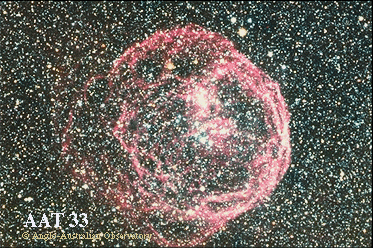
Henize 70: A SuperBubble In The LMC
Explanation: Massive stars (tens of times the mass of the Sun) profoundly affect their galactic environment. Churning and mixing the clouds of gas and dust between the stars, they leave their mark in the compositions and locations of future generations of stars and star systems. Dramatic evidence of this is beautifully illustrated in our neighboring galaxy, the Large Magellanic Cloud (LMC), by the lovely ring shaped nebula, Henize 70 (also known as N70 and DEM301 ). It is actually a luminous “superbubble” of interstellar gas about 300 lightyears in diameter, blown by winds from hot, massive stars and supernova explosions , its interior filled with tenuous hot expanding gas. These superbubbles offer astronomers a chance to explore this crucial connection between the lifecycles of stars and the evolution of galaxies.
| Date | May 10, 1996 |
|---|---|
| Credit |
Credit: Anglo-Australian Telescope photograph by David Malin Copyright: Anglo-Australian Telescope Board |
| Authors & editors: | Robert Nemiroff (MTU) & Jerry Bonnell (UMCP) |
| A service of: |
ASD at NASA / GSFC, NASA Science Activation & Michigan Tech. U. |