


























APOD
Astronomy Picture of the Day
Discover the cosmos! Each day a different image or photograph of our fascinating universe is featured, along with a brief explanation written by a professional astronomer.
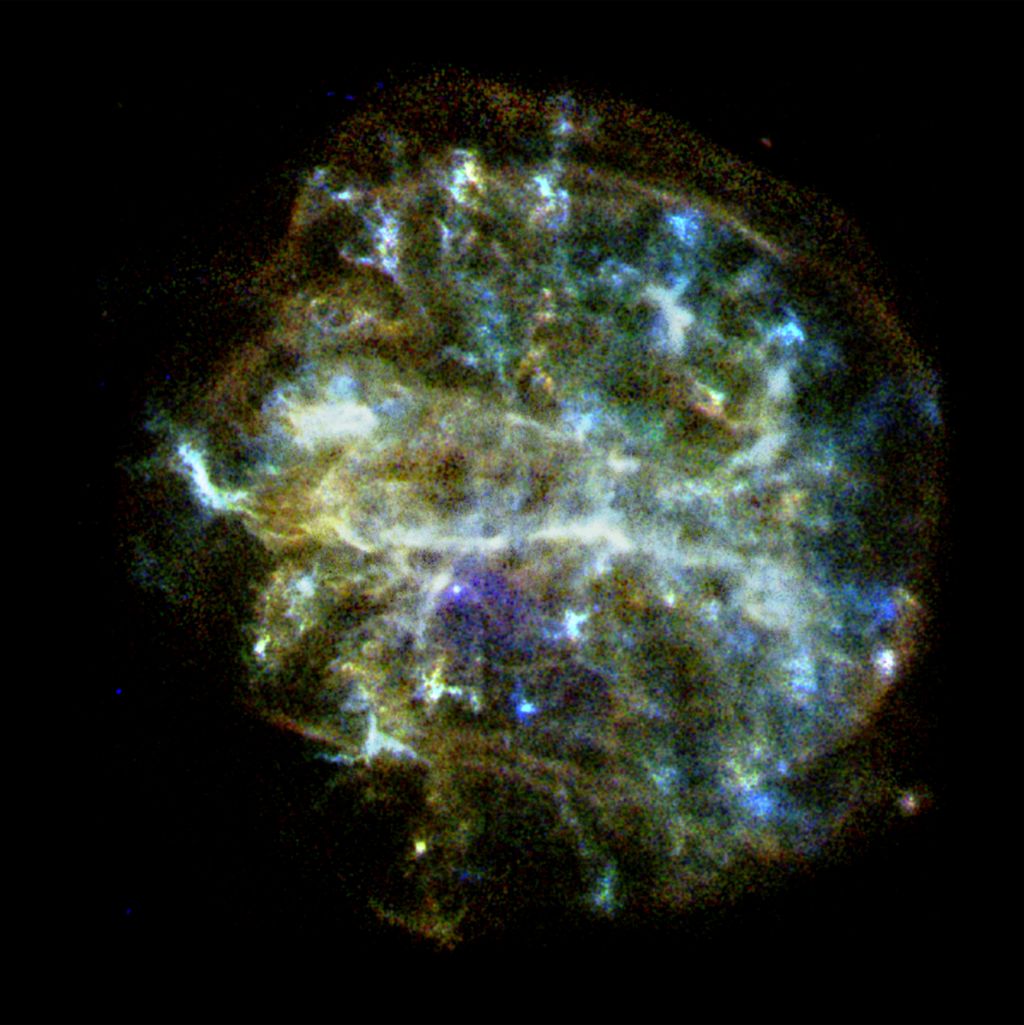
Elements in the Aftermath
Explanation: Massive stars spend their brief lives furiously burning nuclear fuel. Through fusion at extreme temperatures and densities surrounding the stellar core, nuclei of light elements like Hydrogen and Helium are combined to heavier elements like Carbon, Oxygen, etc. in a progression which ends with Iron. And so a supernova explosion , a massive star's inevitable and spectacular demise, blasts back into space debris enriched in heavier elements to be incorporated into other stars and planets (and people! ). This detailed false-color x-ray image from the orbiting Chandra Observatory shows such a hot, expanding stellar debris cloud about 36 light-years across. Cataloged as G292.0+1.8, this young supernova remnant in the southern constellation Centaurus resulted from a massive star which exploded an estimated 1,600 years ago. Bluish colors highlight filaments of the mulitmillion degree gas which are exceptionally rich in Oxygen, Neon, and Magnesium. Just below and left of center, a point like object in the Chandra image suggests that the enriching supernova also produced a pulsar in its aftermath, a rotating neutron star remnant of the collapsed stellar core.

| Date | October 26, 2001 |
|---|---|
| Credit | Credit: J.Hughes ( Rutgers ) et al., CXC , NASA |
| Authors & editors: | Robert Nemiroff (MTU) & Jerry Bonnell (UMCP) |
| A service of: |
ASD at NASA / GSFC, NASA Science Activation & Michigan Tech. U. |