




























APOD
Astronomy Picture of the Day
Discover the cosmos! Each day a different image or photograph of our fascinating universe is featured, along with a brief explanation written by a professional astronomer.
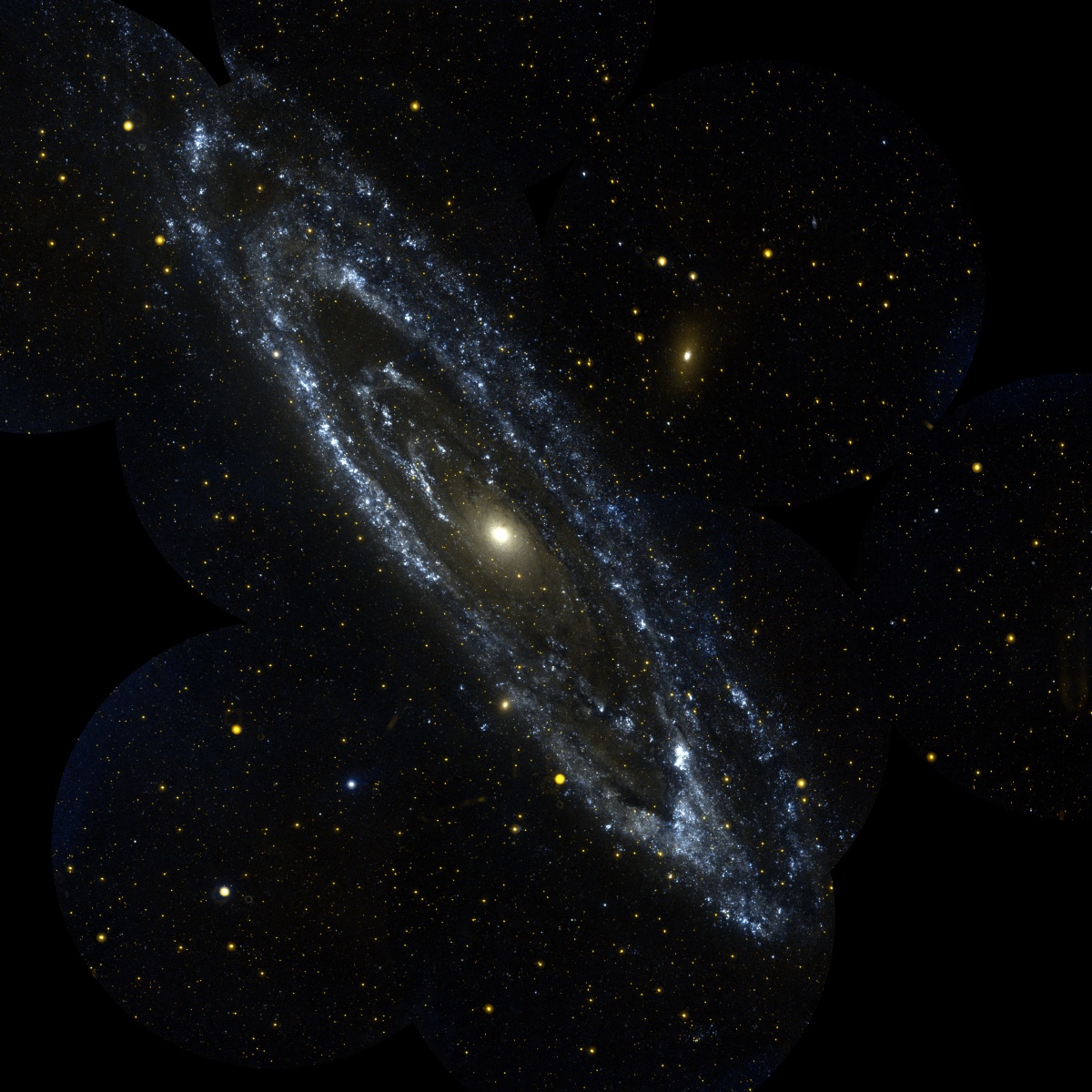
The Andromeda Galaxy from GALEX
Explanation: Why does the Andromeda Galaxy have a giant ring? Viewed in ultraviolet light , the closest major galaxy to our Milky Way Galaxy looks more like a ring galaxy than a spiral . The ring is highlighted beautifully in this newly released image mosaic of Andromeda (M31) taken by the GALaxy Evolution Explorer (GALEX), a satellite launched into Earth orbit in April. In the above image , ultraviolet colors have been digitally shifted to the visual. Young blue stars dominate the image, indicating the star forming ring as well as other star forming regions even further from the galactic center . The origin of the huge 150,000- light year ring is unknown but likely related to gravitational interactions with small satellite galaxies that orbit near the galactic giant. M31 lies about three million light-years distant and is bright enough to be seen without binoculars toward the constellation of Andromeda .
News: Today is the December Solstice .
| Date | December 22, 2003 |
|---|---|
| Credit | Credit: GALEX team , Caltech , NASA |
| Authors & editors: | Robert Nemiroff (MTU) & Jerry Bonnell (UMCP) |
| A service of: |
ASD at NASA / GSFC, NASA Science Activation & Michigan Tech. U. |