






















APOD
Astronomy Picture of the Day
Discover the cosmos! Each day a different image or photograph of our fascinating universe is featured, along with a brief explanation written by a professional astronomer.
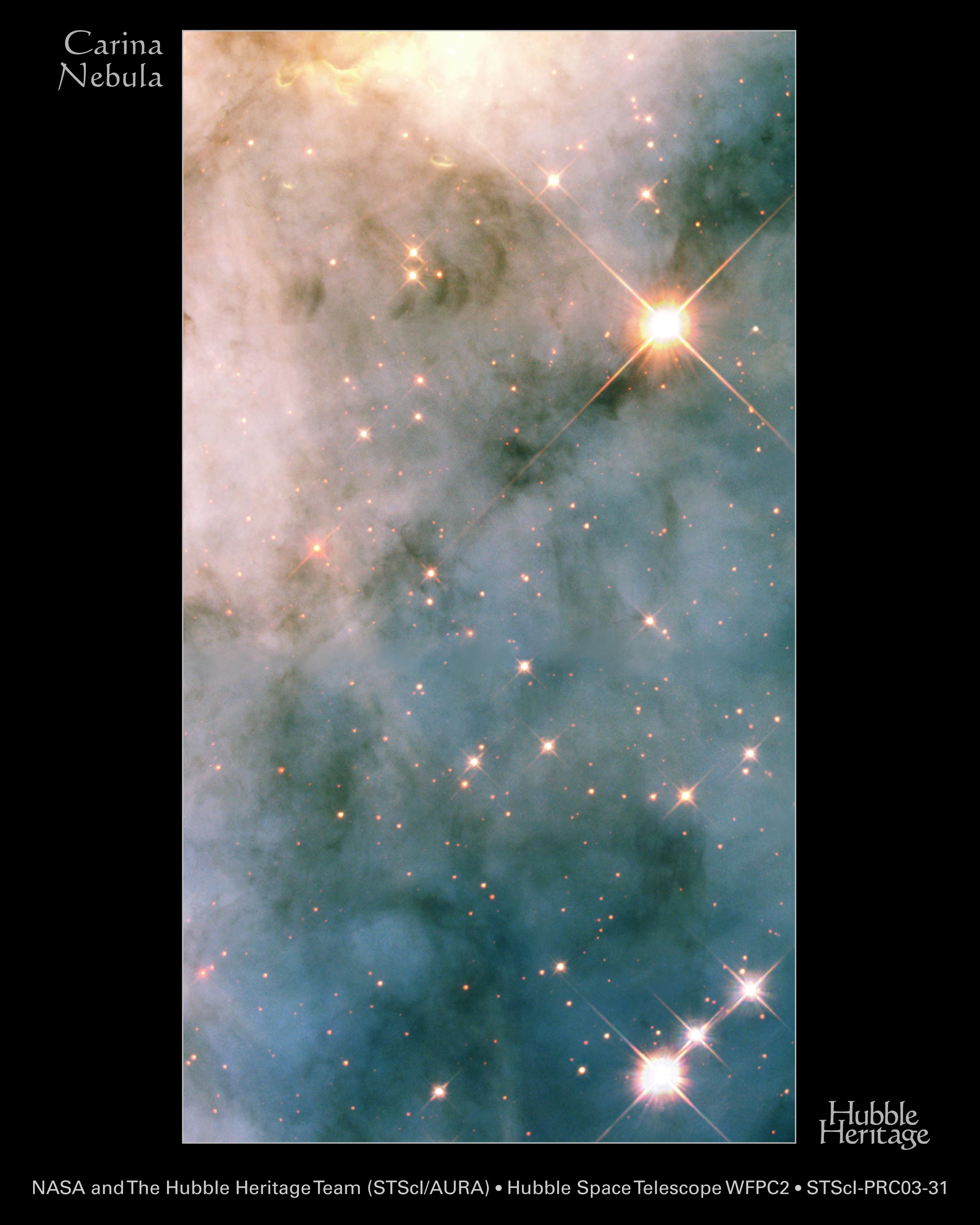
The Turbulent Neighborhood of Eta Carina
Explanation: How do violent stars affect their surroundings? To help find out, astronomers pointed the Hubble Space Telescope to the regions surrounding Eta Carina , a star showing signs that it may explode sometime in the next million years. The nearby nebulosity, shown above , is home to streams of hot gas , pools of cool gas, knots of dark globules , and pillars of dense dusty interstellar matter likely forming young stars. The above image explores about three light-years , a region size intermediate to the Eta Carina cocoon , which spans only about one-half of a light year, and the Great Nebula in Carina , which spans over 300 light years. In April of 1843 Eta Car briefly became second only to Sirius as the brightest star in planet Earth's night sky, even though at a distance of about 7,500 light-years, it is about 800 times farther away.
| Date | November 26, 2003 |
|---|---|
| Credit | Credit: Hubble Heritage Team ( AURA / STScI ), S. Casertano ( STScI ) et al. , NASA |
| Authors & editors: | Robert Nemiroff (MTU) & Jerry Bonnell (UMCP) |
| A service of: |
ASD at NASA / GSFC, NASA Science Activation & Michigan Tech. U. |