


























APOD
Astronomy Picture of the Day
Discover the cosmos! Each day a different image or photograph of our fascinating universe is featured, along with a brief explanation written by a professional astronomer.
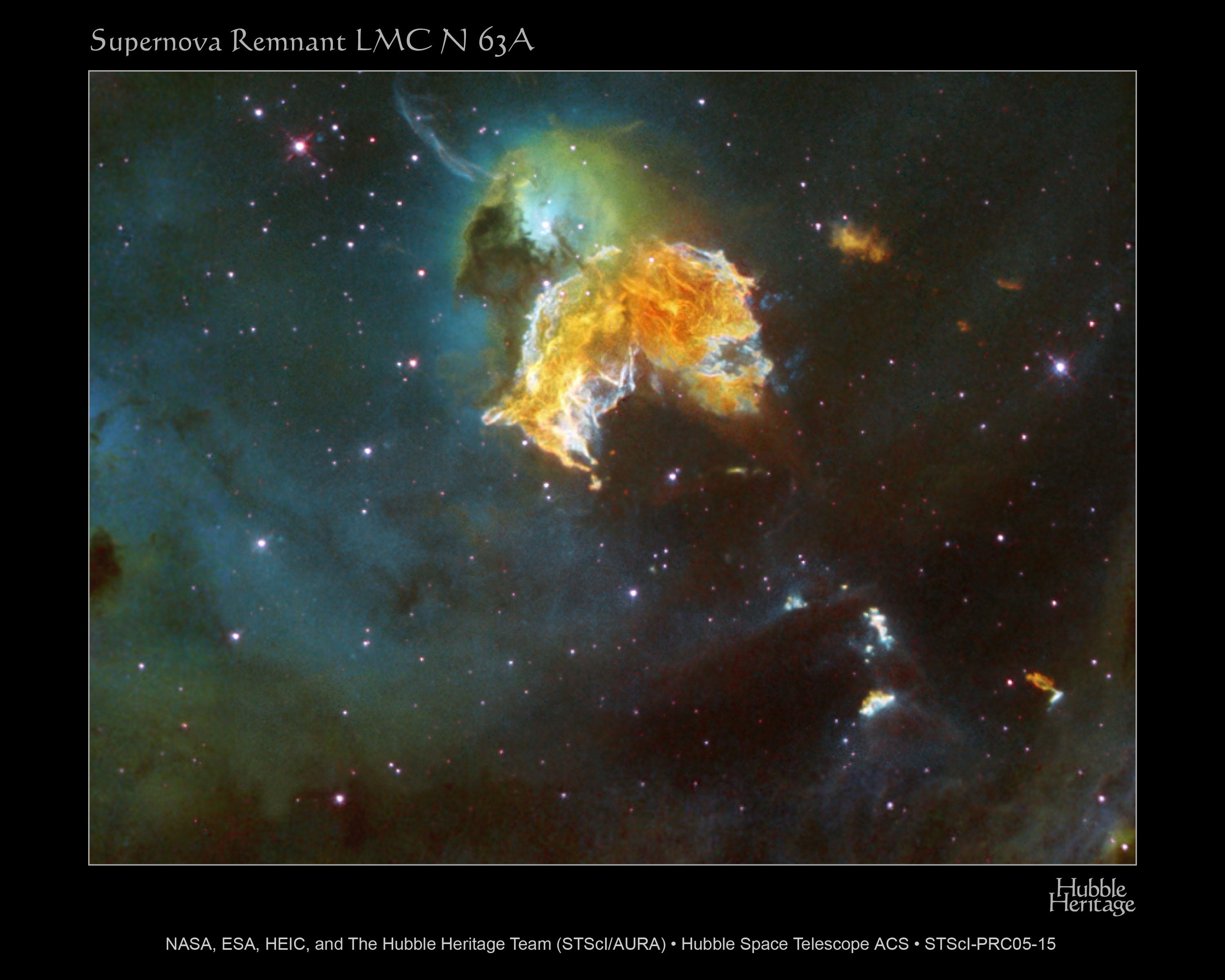
Rampaging Supernova Remnant N63A
Explanation: What has this supernova left behind? As little as 2,000 years ago, light from a massive stellar explosion in the Large Magellanic Cloud (LMC) first reached planet Earth. The LMC is a close galactic neighbor of our Milky Way Galaxy and the rampaging explosion front is now seen moving out - destroying or displacing ambient gas clouds while leaving behind relatively dense knots of gas and dust. What remains is one of the largest supernova remnants in the LMC : N63A. Many of the surviving dense knots have been themselves compressed and may further contract to form new stars. Some of the resulting stars may then explode in a supernova, continuing the cycle. Pictured above is a close-up of one of the largest remaining knots of dust and gas in N63A taken by the orbiting Hubble Space Telescope . N63A spans over 25 light years and lies about 150,000 light years away toward the southern constellation of Dorado .
| Date | June 8, 2005 |
|---|---|
| Credit |
Credit: NASA , ESA , HEIC , and The Hubble Heritage Team ( STScI / AURA ); Acknowledgment: Y.-H. Chu & R. M. Williams ( UIUC ) |
| Authors & editors: | Robert Nemiroff (MTU) & Jerry Bonnell (UMCP) |
| A service of: |
ASD at NASA / GSFC, NASA Science Activation & Michigan Tech. U. |