




























APOD
Astronomy Picture of the Day
Discover the cosmos! Each day a different image or photograph of our fascinating universe is featured, along with a brief explanation written by a professional astronomer.
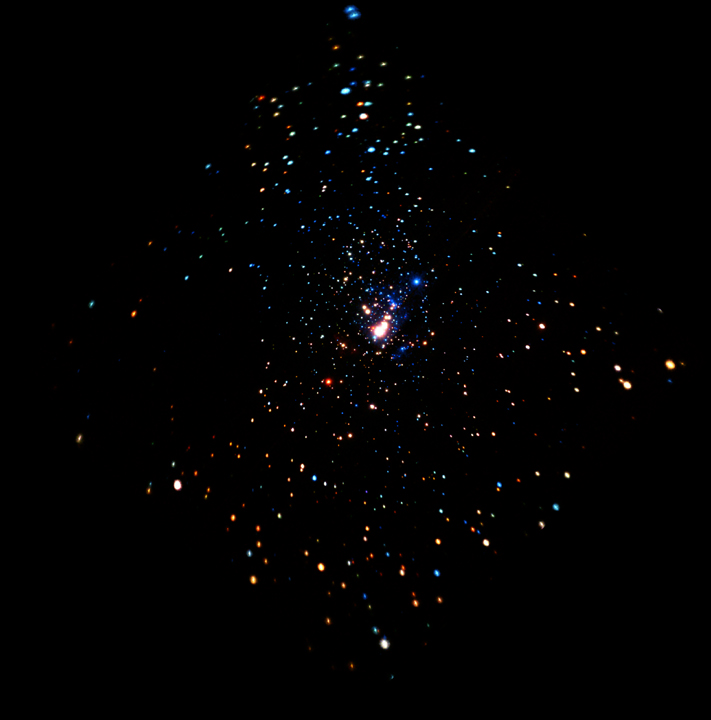
X-Ray Stars in the Orion Nebula
Explanation: When our middle-aged Sun was just a few million years old it was thousands of times brighter in x-rays . In fact, it was likely similar to some of the stars found in this false-color x-ray composite of the Orion Nebula region from the Chandra Observatory . The image is centered on bright stars of the nebula's Trapezium star cluster, and while analyzing the Chandra data astronomers have now found examples of young, sun-like stars producing intense x-ray flares . It sounds dangerous, but the situation may actually favor the formation of hospitable planetary systems like our own. Energetic flares can produce turbulence in the planet-forming disks surrounding the stars - preventing rocky earth-like planets from spiraling uncomfortably close to and even falling into their active, young parent stars. About 1,500 light-years away, the Orion Nebula is the closest large stellar nursery. At that distance, this Chandra image spans about 10 light-years.
| Date | May 19, 2005 |
|---|---|
| Credit |
Credit: E.Feigelson & K.Getman ( PSU ) et al. CXC / NASA |
| Authors & editors: | Robert Nemiroff (MTU) & Jerry Bonnell (UMCP) |
| A service of: |
ASD at NASA / GSFC, NASA Science Activation & Michigan Tech. U. |