


























APOD
Astronomy Picture of the Day
Discover the cosmos! Each day a different image or photograph of our fascinating universe is featured, along with a brief explanation written by a professional astronomer.
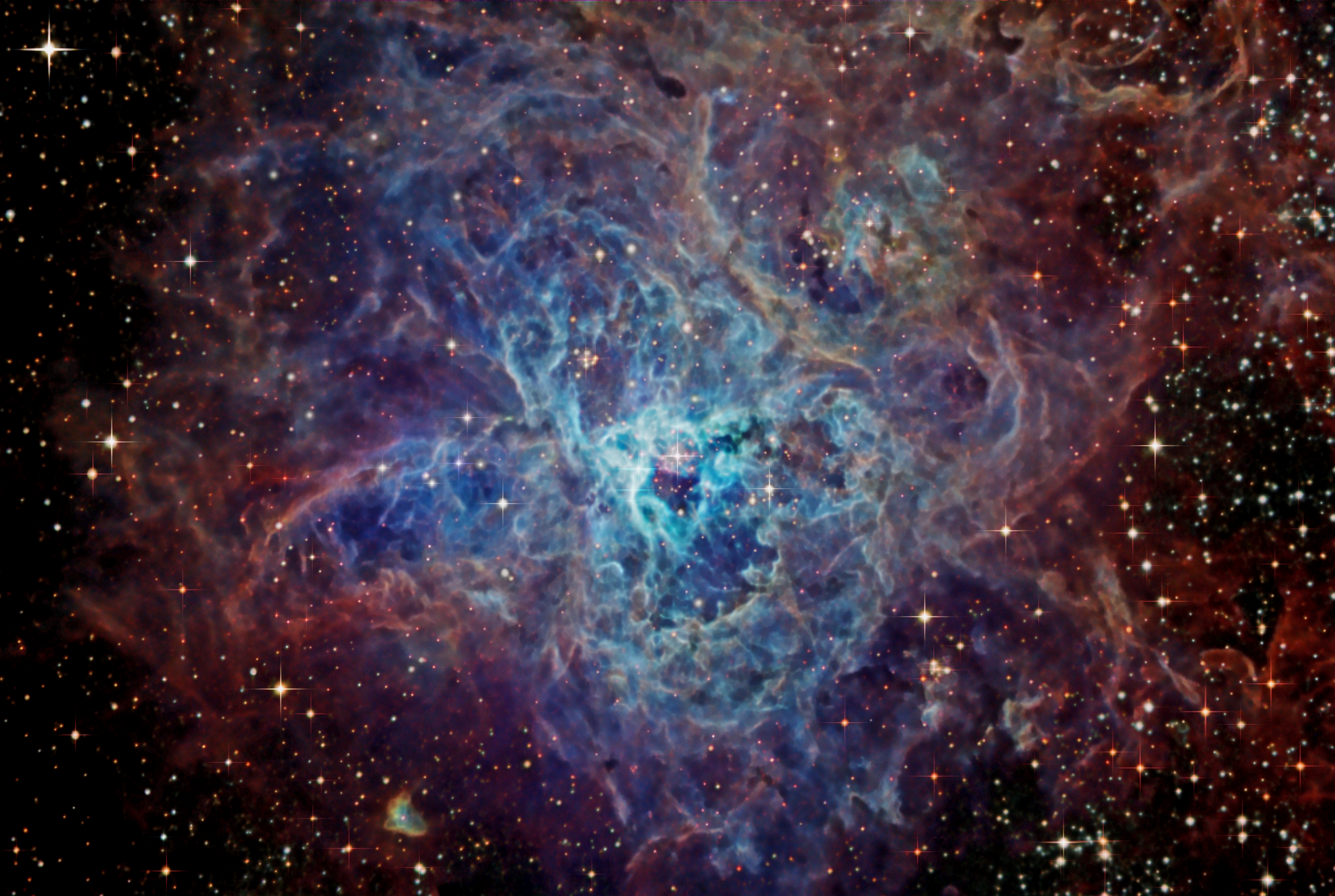
The Cosmic Web of the Tarantula Nebula
Explanation: First cataloged as a star, 30 Doradus is actually an immense star forming region in nearby galaxy The Large Magellanic Cloud . The region's spidery appearance is responsible for its popular name, the Tarantula nebula , except that this tarantula is about 1,000 light-years across, and 180,000 light-years away in the southern constellation Dorado . If the Tarantula nebula were at the distance of the Orion Nebula (1,500 light-years), the nearest stellar nursery to Earth, it would appear to cover about 30 degrees (60 full moons ) on the sky. The spindly arms of the Tarantula nebula surround NGC 2070 , a star cluster that contains some of the brightest, most massive stars known. Intriguing details of the nebula are visible in this scientifically-colored image . The cosmic Tarantula also lies near the site of the closest recent supernova .
| Date | November 11, 2008 |
|---|---|
| Credit | Credit & Copyright: Joseph Brimacombe |
| Authors & editors: | Robert Nemiroff (MTU) & Jerry Bonnell (UMCP) |
| A service of: |
ASD at NASA / GSFC, NASA Science Activation & Michigan Tech. U. |