
























APOD
Astronomy Picture of the Day
Discover the cosmos! Each day a different image or photograph of our fascinating universe is featured, along with a brief explanation written by a professional astronomer.
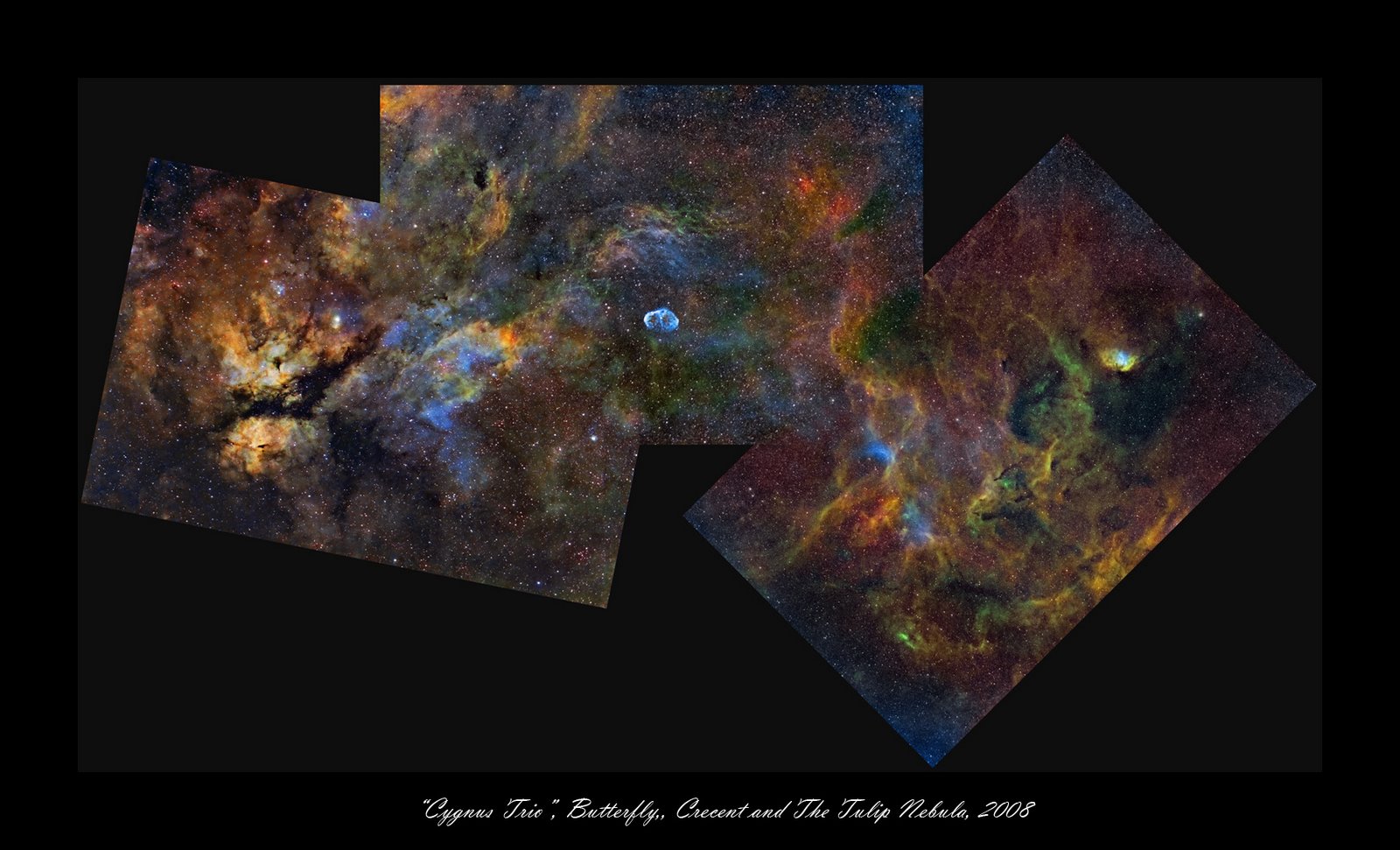
Cygnus Trio
Explanation: In this colorful mosaic, filaments of gas and dust span some 9 degrees across central Cygnus, a nebula rich constellation along the northern Milky Way . A trio of nebulae with popular names highlights the beautiful skyscape - the Butterfly, the Crescent, and the Tulip. At left, the Butterfly Nebula (IC 1318), lies near bright star Gamma Cygni. The Butterfly's expansive, glowing, wing-shaped gas clouds are divided by a dark dust lane. Near center, the Crescent Nebula (NGC 6888) is more compact, a cosmic bubble with a bright edge blown by winds from a massive Wolf-Rayet star. On the right is the Tulip Nebula (Sh2-101), a small emission region shaped like a blossoming flower viewed from the side. All are within a few thousand light-years of the Sun in the Orion spiral arm of our galaxy. The gorgeous mosaic is presented in false color , constructed from image data recorded through narrow band filters. The range of colors was created by a mapping of emission from hydrogen, sulfur and oxygen atoms in the nebula to red, green, and blue hues.
Take a survey on Aesthetics and Astronomy.
| Date | November 7, 2008 |
|---|---|
| Credit | Credit & Copyright: J-P Metsävainio ( Astro Anarchy ) |
| Authors & editors: | Robert Nemiroff (MTU) & Jerry Bonnell (UMCP) |
| A service of: |
ASD at NASA / GSFC, NASA Science Activation & Michigan Tech. U. |