
























APOD
Astronomy Picture of the Day
Discover the cosmos! Each day a different image or photograph of our fascinating universe is featured, along with a brief explanation written by a professional astronomer.
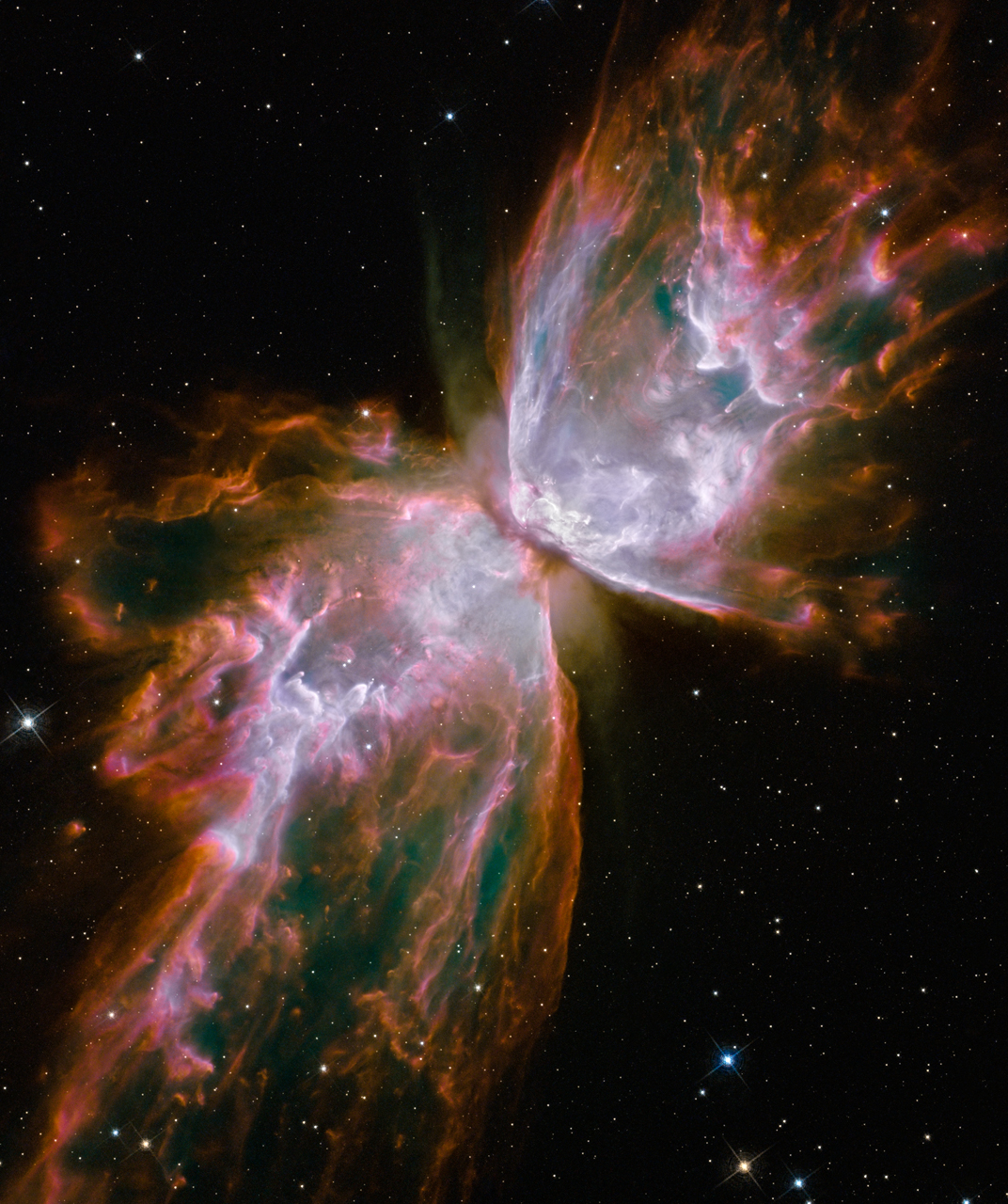
The Butterfly Nebula from Upgraded Hubble
Explanation: The bright clusters and nebulae of planet Earth's night sky are often named for flowers or insects , and NGC 6302 is no exception. With an estimated surface temperature of about 250,000 degrees C, the central star of this particular planetary nebula is exceptionally hot though -- shining brightly in ultraviolet light but hidden from direct view by a dense torus of dust. This dramatically detailed close-up of the dying star's nebula was recorded by the newly upgraded Hubble Space Telescope . Cutting across a bright cavity of ionized gas, the dust torus surrounding the central star is near the center of this view, almost edge-on to the line-of-sight. Molecular hydrogen has been detected in the hot star's dusty cosmic shroud. NGC 6302 lies about 4,000 light-years away in the arachnologically correct constellation Scorpius .
| Date | September 10, 2009 |
|---|---|
| Credit | Credit: NASA , ESA , and the Hubble SM4 ERO Team |
| Authors & editors: | Robert Nemiroff (MTU) & Jerry Bonnell (UMCP) |
| A service of: |
ASD at NASA / GSFC, NASA Science Activation & Michigan Tech. U. |