

























APOD
Astronomy Picture of the Day
Discover the cosmos! Each day a different image or photograph of our fascinating universe is featured, along with a brief explanation written by a professional astronomer.
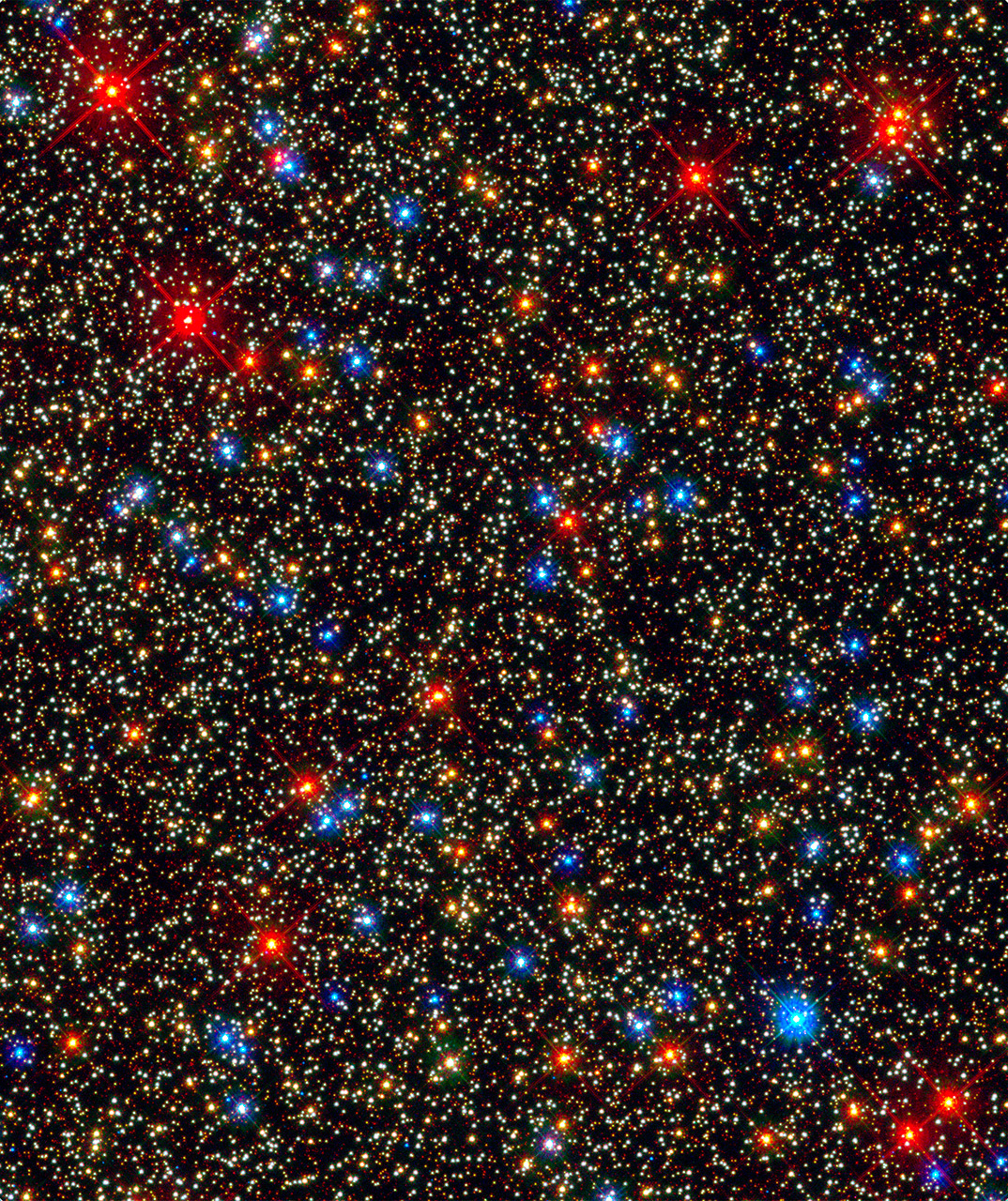
The Center of Globular Cluster Omega Centauri
Explanation: What is left over after stars collide? To help answer this question, astronomers have been studying the center of the most massive ball of stars in our Milky Way Galaxy . In the center of globular cluster Omega Centauri, stars are packed in 10,000 times more densely than near our Sun. Pictured above , the newly upgraded Hubble Space Telescope has resolved the very center of Omega Centauri into individual stars. Visible are many faint yellow-white stars that are smaller than our Sun , several yellow-orange stars that are Red Giants , and an occasional blue star . When two stars collide they likely either combine to form one more massive star, or they stick, forming a new binary star system. Close binary stars interact, sometimes emitting ultraviolet or X-ray light when gas falls from one star onto the surface of a compact companion such as a white dwarf or neutron star . Two such binaries have now been located in Omega Centauri 's center. The star cluster lies about 15,000 light-years away and is visible toward the constellation of Centaurus .
| Date | September 14, 2009 |
|---|---|
| Credit | Credit: NASA , ESA , and the Hubble SM4 ERO Team |
| Authors & editors: | Robert Nemiroff (MTU) & Jerry Bonnell (UMCP) |
| A service of: |
ASD at NASA / GSFC, NASA Science Activation & Michigan Tech. U. |