























APOD
Astronomy Picture of the Day
Discover the cosmos! Each day a different image or photograph of our fascinating universe is featured, along with a brief explanation written by a professional astronomer.
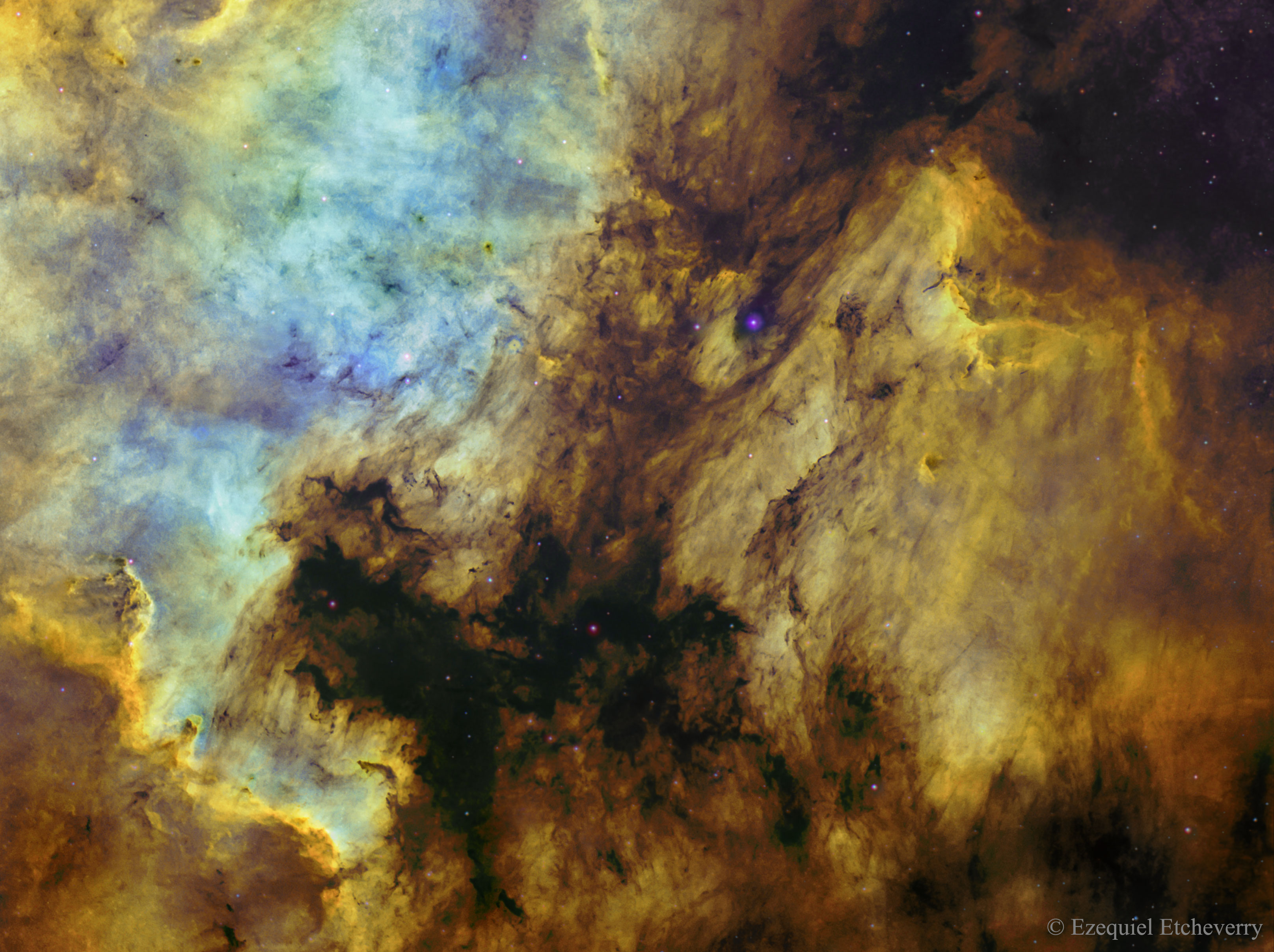
The North America and Pelican Nebulas
Explanation: Here lie familiar shapes in unfamiliar locations . On the left is an emission nebula cataloged as NGC 7000, famous partly because it resembles our fair planet's continent of North America . The emission region to the right of the North America Nebula is IC 5070, also known for its suggestive outlines as the Pelican Nebula . Separated by a dark cloud of obscuring dust , the two bright nebulae are about 1,500 light-years away. At that distance, the 4 degree wide field of view spans 100 light-years. This spectacular cosmic portrait combines narrow band images to highlight bright ionization fronts with fine details of dark, dusty forms in silhouette. Emission from atomic hydrogen , sulfur , and oxygen is captured in the narrow band image in scientifically assigned colors . These nebulae can be seen with binoculars from a dark location .
| Date | June 14, 2016 |
|---|---|
| Credit | Image Credit & Copyright: Ezequiel Etcheverry |
| Authors & editors: | Robert Nemiroff (MTU) & Jerry Bonnell (UMCP) |
| A service of: |
ASD at NASA / GSFC, NASA Science Activation & Michigan Tech. U. |