


























APOD
Astronomy Picture of the Day
Discover the cosmos! Each day a different image or photograph of our fascinating universe is featured, along with a brief explanation written by a professional astronomer.
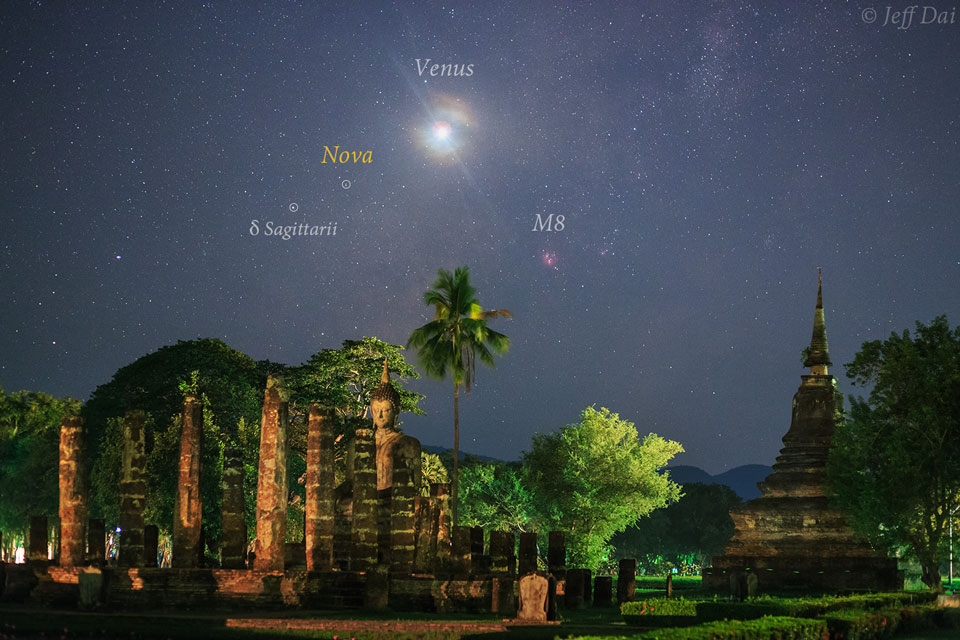

Nova over Thailand
Explanation: A nova in Sagittarius is bright enough to see with binoculars. Discovered last month by the All-Sky Automated Survey for Supernovae (ASAS-SN), the stellar explosion even approached the limit of naked-eye visibility last week. A classical nova results from a thermonuclear explosion on the surface of a white dwarf star -- a dense star having the size of our Earth but the mass of our Sun. In the featured image, the nova was captured last week above ancient Wat Mahathat in Sukhothai , Thailand . To see Nova Sagittarius 2016 yourself, just go out just after sunset and locate near the western horizon the constellation of the Archer ( Sagittarius ), popularly identified with an iconic teapot . Also visible near the nova is the very bright planet Venus. Don�t delay, though, because not only is the nova fading , but that part of the sky is setting continually closer to sunset.
| Date | November 21, 2016 |
|---|---|
| Credit | Image Credit & Copyright: Jeff Dai (TWAN) |
| Authors & editors: | Robert Nemiroff (MTU) & Jerry Bonnell (UMCP) |
| A service of: |
ASD at NASA / GSFC, NASA Science Activation & Michigan Tech. U. |