





















APOD
Astronomy Picture of the Day
Discover the cosmos! Each day a different image or photograph of our fascinating universe is featured, along with a brief explanation written by a professional astronomer.
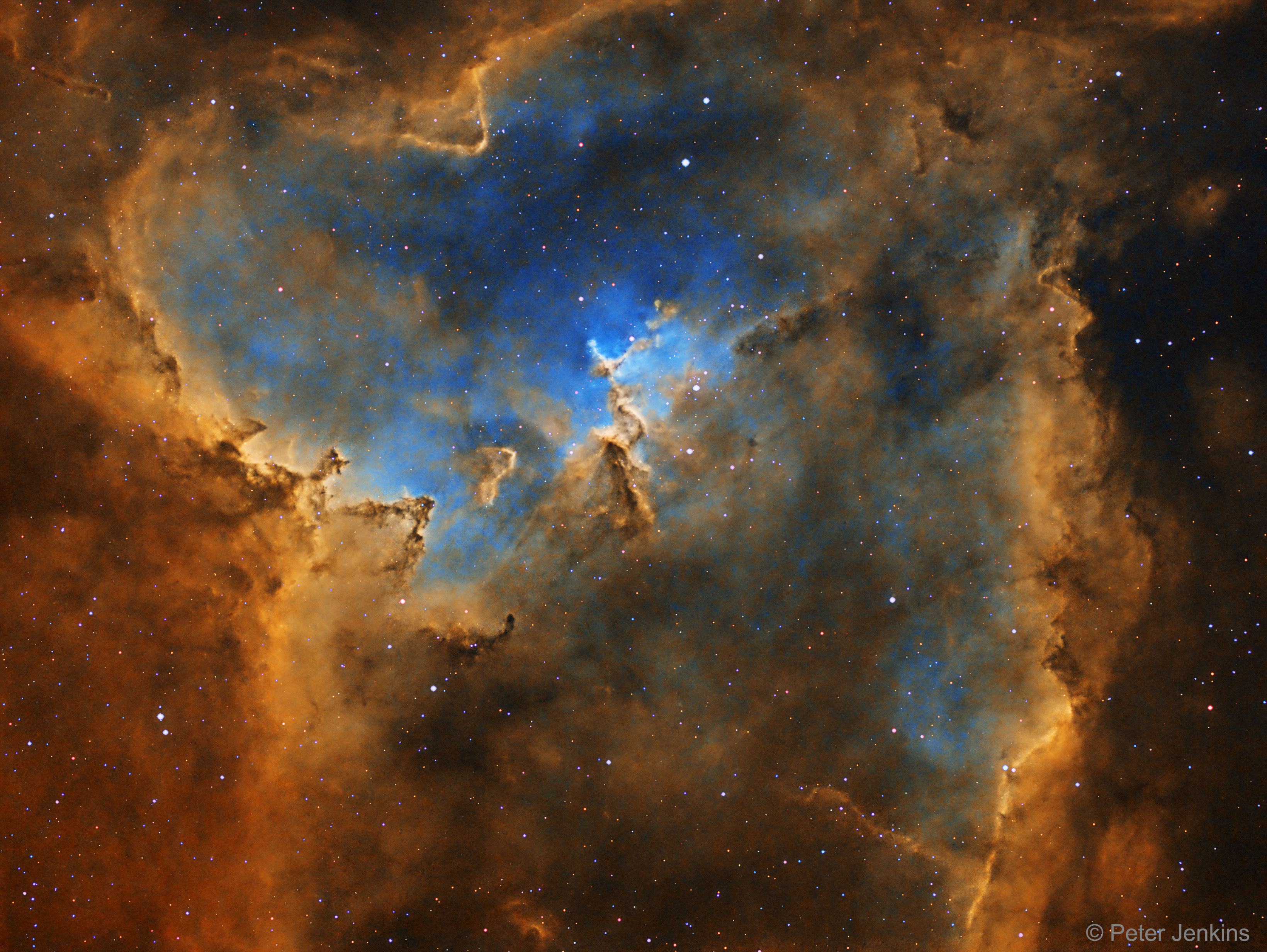
The Heart Nebula in Hydrogen, Oxygen, and Sulfur
Explanation: What powers the Heart Nebula? The large emission nebula dubbed IC 1805 looks, in whole, like a heart . The nebula's glow -- as well as the shape of the gas and dust clouds -- is powered by by stellar wind s and radiation from massive hot stars in the nebula's newborn star cluster Melotte 15 . This deep telescopic image maps the pervasive light of narrow emission lines from atoms of hydrogen , oxygen , and sulfur in the nebula. The field of view spans just over two degrees on the sky, so that it appears larger than four times the diameter of a full moon. The cosmic heart is found in the constellation of Cassiopeia , the boastful mythical Queen of Aethiopia .
| Date | August 27, 2017 |
|---|---|
| Credit | Image Credit & Copyright: Peter Jenkins |
| Authors & editors: | Robert Nemiroff (MTU) & Jerry Bonnell (UMCP) |
| A service of: |
ASD at NASA / GSFC, NASA Science Activation & Michigan Tech. U. |