























APOD
Astronomy Picture of the Day
Discover the cosmos! Each day a different image or photograph of our fascinating universe is featured, along with a brief explanation written by a professional astronomer.
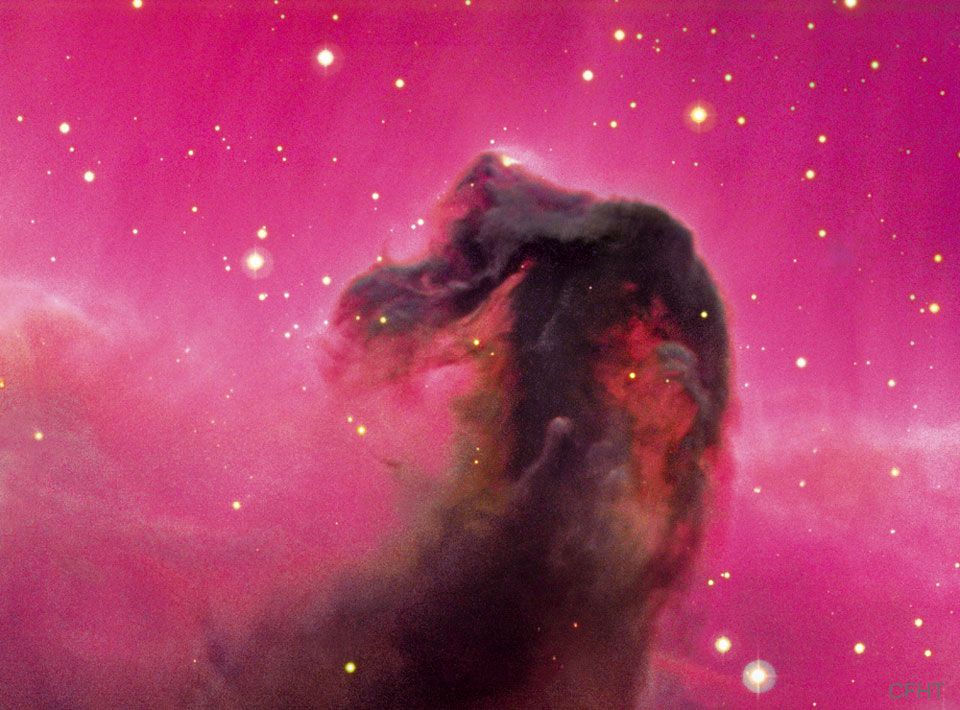
The Horsehead Nebula
Explanation: One of the most identifiable nebulae in the sky, the Horsehead Nebula in Orion , is part of a large, dark, molecular cloud . Also known as Barnard 33, the unusual shape was first discovered on a photographic plate in the late 1800s. The red glow originates from hydrogen gas predominantly behind the nebula, ionized by the nearby bright star Sigma Orionis . The darkness of the Horsehead is caused mostly by thick dust , although the lower part of the Horsehead 's neck casts a shadow to the left. Streams of gas leaving the nebula are funneled by a strong magnetic field . Bright spots in the Horsehead Nebula 's base are young stars just in the process of forming . Light takes about 1,500 years to reach us from the Horsehead Nebula . The featured image was taken with the large 3.6-m Canada-France-Hawaii Telescope in Hawaii , USA .
Free APOD Lectures: January 5 in NYC & January 9 in DC
| Date | December 27, 2017 |
|---|---|
| Credit | Image Credit: CFHT , Coelum , MegaCam , J.-C. Cuillandre ( CFHT ) & G. A. Anselmi ( Coelum ) |
| Authors & editors: | Robert Nemiroff (MTU) & Jerry Bonnell (UMCP) |
| A service of: |
ASD at NASA / GSFC, NASA Science Activation & Michigan Tech. U. |