


























APOD
Astronomy Picture of the Day
Discover the cosmos! Each day a different image or photograph of our fascinating universe is featured, along with a brief explanation written by a professional astronomer.
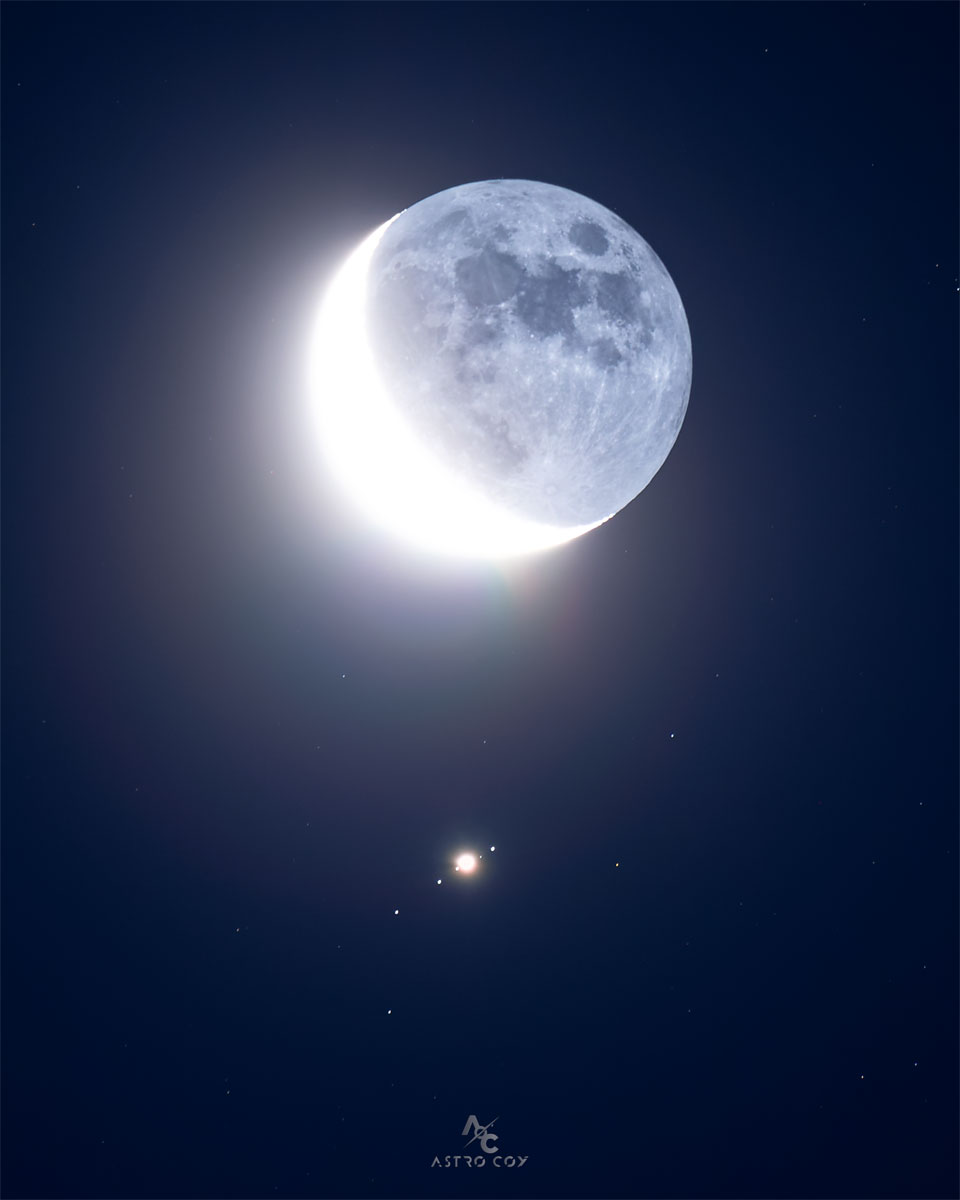

Moon Meets Jupiter
Explanation: What's that below the Moon? Jupiter -- and its largest moons. Many skygazers across planet Earth enjoyed the close conjunction of Earth's Moon passing nearly in front of Jupiter in mid-June. The featured image is a single exposure of the event taken from Morón de la Frontera , Spain . The sunlit lunar crescent on the left is overexposed, while the Moon's night side, on the right, is only faintly illuminated by Earthshine . Lined up diagonally below the Moon, left to right, are Jupiter's bright Galilean satellites: Callisto , Ganymede , Io (hard to see as it is very near to Jupiter), and Europa . In fact , Callisto, Ganymede, and Io are larger than Earth's Moon, while Europa is only slightly smaller. NASA's robotic spacecraft Juno is currently orbiting Jupiter and made a close pass near Io only a week ago. If you look up in the night sky tonight , you will again see two of the brightest objects angularly close together -- because tonight is another Moon-Jupiter conjunction .
| Date | August 8, 2023 |
|---|---|
| Credit | Credit & Copyright: Jordi L. Coy |
| Authors & editors: | Robert Nemiroff (MTU) & Jerry Bonnell (UMCP) |
| A service of: |
ASD at NASA / GSFC, NASA Science Activation & Michigan Tech. U. |