
























APOD
Astronomy Picture of the Day
Discover the cosmos! Each day a different image or photograph of our fascinating universe is featured, along with a brief explanation written by a professional astronomer.
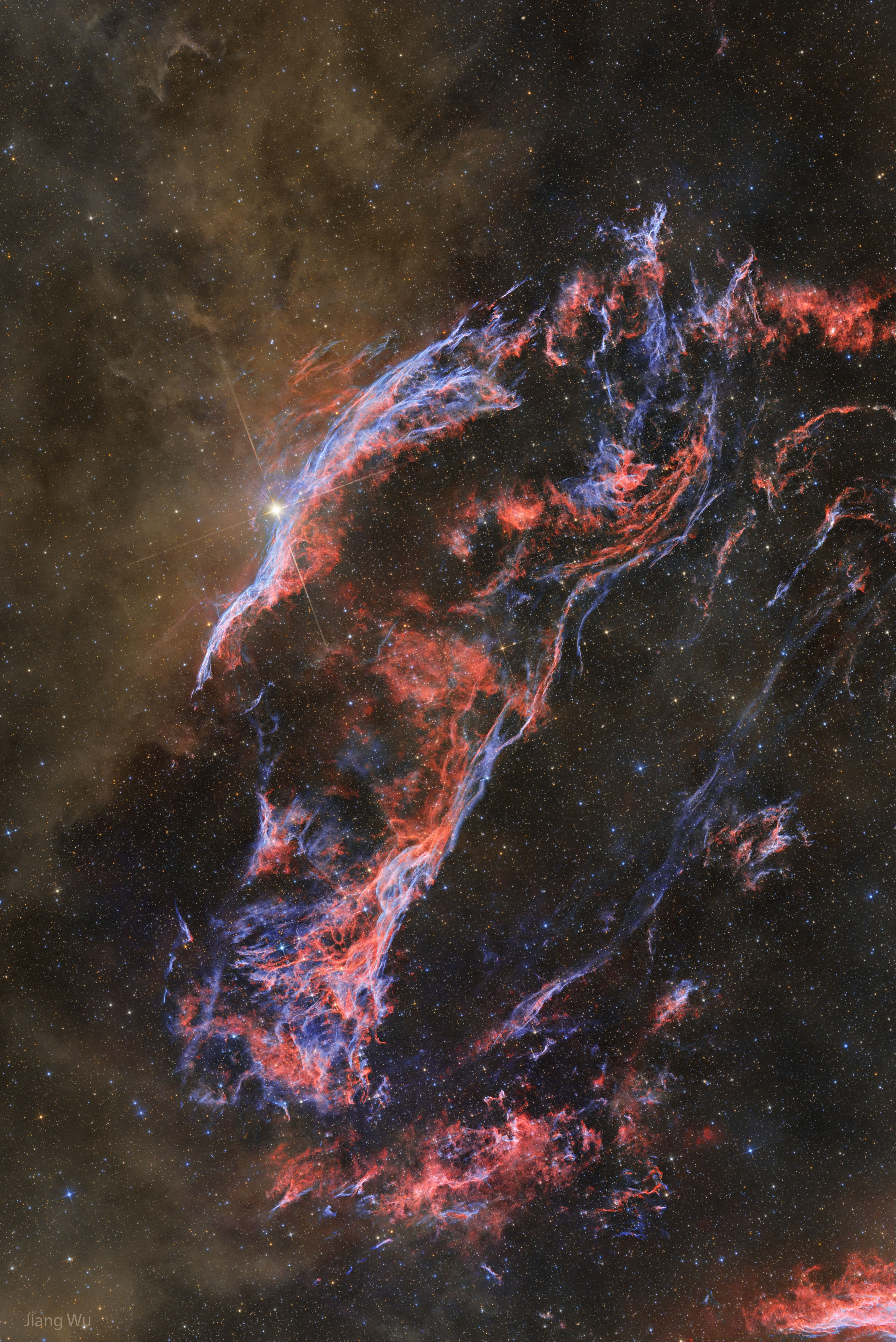
Dust and the Western Veil Nebula
Explanation: It's so big it is easy to miss. The entire Veil Nebula spans six times the diameter of the full moon , but is so dim you need binoculars to see it. The nebula was created about 15,000 years ago when a star in the constellation of the Swan ( Cygnus ) exploded. The spectacular explosion would have appeared brighter than even Venus for a week - but there is no known record of it. Pictured is the western edge of the still-expanding gas cloud. Notable gas filaments include the Witch's Broom Nebula on the upper left near the bright foreground star 52 Cygni , and Fleming's Triangular Wisp (formerly known as Pickering's Triangle ) running diagonally up the image middle. What is rarely imaged -- but seen in the featured long exposure across many color bands -- is the reflecting brown dust that runs vertically up the image left, dust likely created in the cool atmospheres of massive stars .
| Date | October 18, 2023 |
|---|---|
| Credit | Image Credit & Copyright: Jiang Wu |
| Authors & editors: | Robert Nemiroff (MTU) & Jerry Bonnell (UMCP) |
| A service of: |
ASD at NASA / GSFC, NASA Science Activation & Michigan Tech. U. |