



























APOD
Astronomy Picture of the Day
Discover the cosmos! Each day a different image or photograph of our fascinating universe is featured, along with a brief explanation written by a professional astronomer.
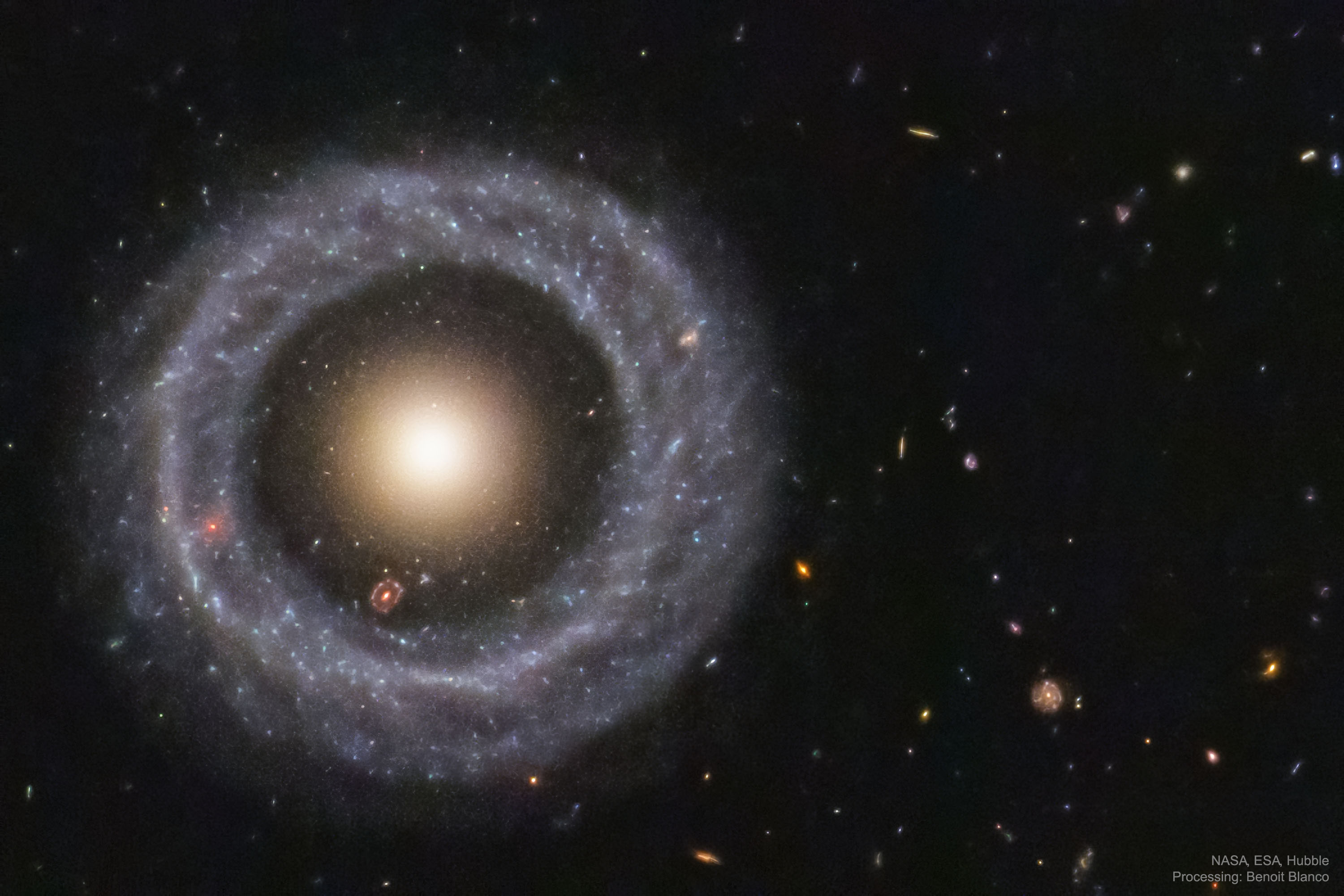
Hoag's Object: A Nearly Perfect Ring Galaxy
Explanation: Is this one galaxy or two? This question came to light in 1950 when astronomer Arthur Hoag chanced upon this unusual extragalactic object. On the outside is a ring dominated by bright blue stars, while near the center lies a ball of much redder stars that are likely much older. Between the two is a gap that appears almost completely dark. How Hoag's Object formed, including its nearly perfectly round ring of stars and gas, remains unknown. Genesis hypotheses include a galaxy collision billions of years ago and the gravitational effect of a central bar that has since vanished . The featured photo was taken by the Hubble Space Telescope and reprocessed using an artificially intelligent de-noising algorithm . Observations in radio waves indicate that Hoag's Object has not accreted a smaller galaxy in the past billion years. Hoag's Object spans about 100,000 light years and lies about 600 million light years away toward the constellation of the Snake ( Serpens ). Many galaxies far in the distance are visible toward the right, while coincidentally , visible in the gap at about seven o'clock, is another but more distant ring galaxy .
| Date | February 18, 2024 |
|---|---|
| Credit | Image Credit: NASA , ESA , Hubble ; Processing: Benoit Blanco |
| Authors & editors: | Robert Nemiroff (MTU) & Jerry Bonnell (UMCP) |
| A service of: |
ASD at NASA / GSFC, NASA Science Activation & Michigan Tech. U. |