

























APOD
Astronomy Picture of the Day
Discover the cosmos! Each day a different image or photograph of our fascinating universe is featured, along with a brief explanation written by a professional astronomer.
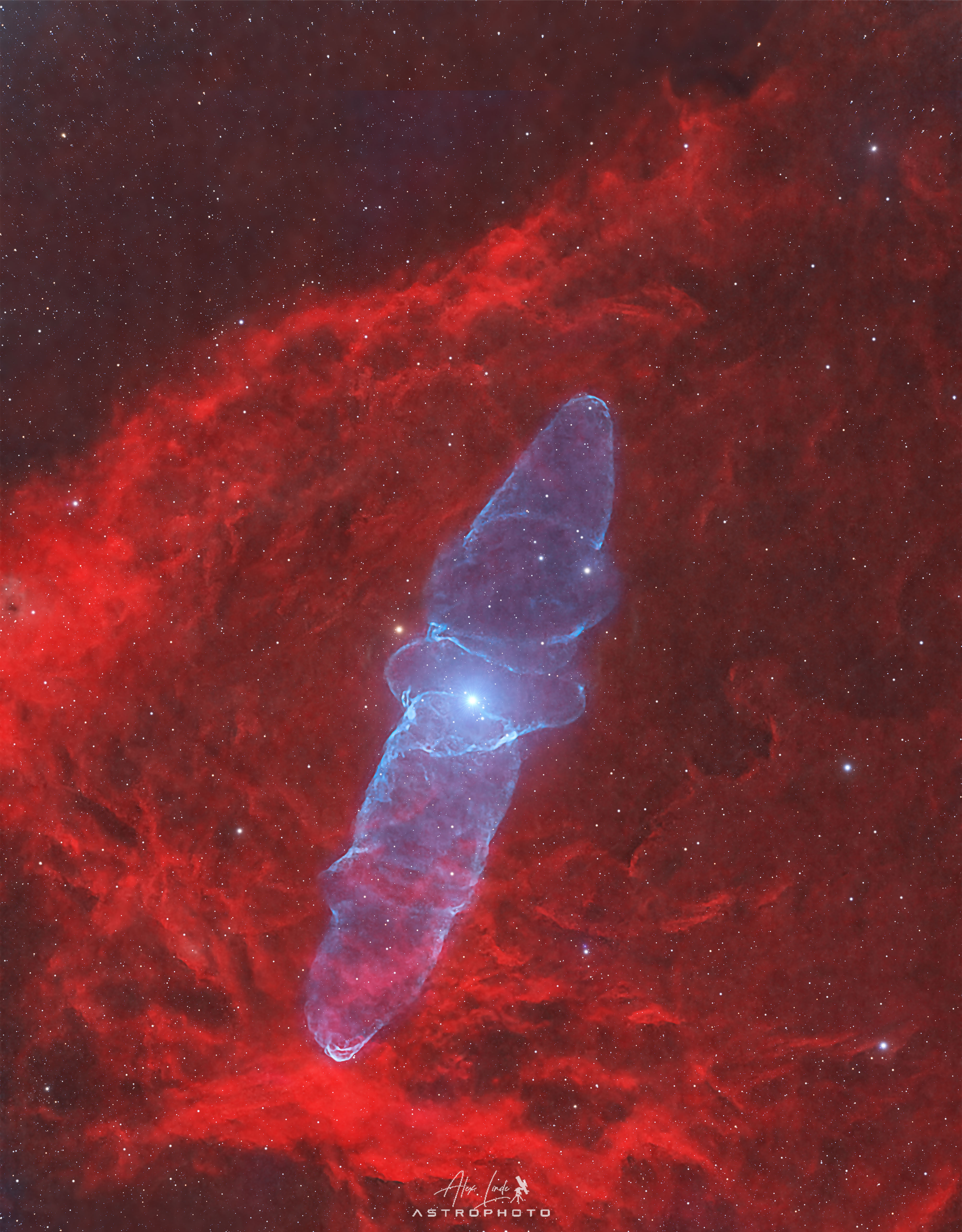
Ou4: The Giant Squid Nebula
Explanation: Squids on Earth aren't this big. This mysterious squid-like cosmic cloud spans nearly three full moon s on planet Earth's sky. Discovered in 2011 by French astro-imager Nicolas Outters , the Squid Nebula's bipolar shape is distinguished here by the telltale blue emission from doubly ionized oxygen atoms. Though apparently surrounded by the reddish hydrogen emission region Sh2-129, the true distance and nature of the Squid Nebula have been difficult to determine . Still, one investigation suggests Ou4 really does lie within Sh2-129 some 2,300 light-years away. Consistent with that scenario, the cosmic squid would represent a spectacular outflow of material driven by a triple system of hot, massive stars, cataloged as HR8119 , seen near the center of the nebula. If so, this truly giant squid nebula would physically be over 50 light-year s across.
| Date | June 17, 2024 |
|---|---|
| Credit | Image Credit & Copyright: Alex Linde |
| Authors & editors: | Robert Nemiroff (MTU) & Jerry Bonnell (UMCP) |
| A service of: |
ASD at NASA / GSFC, NASA Science Activation & Michigan Tech. U. |