



























APOD
Astronomy Picture of the Day
Discover the cosmos! Each day a different image or photograph of our fascinating universe is featured, along with a brief explanation written by a professional astronomer.
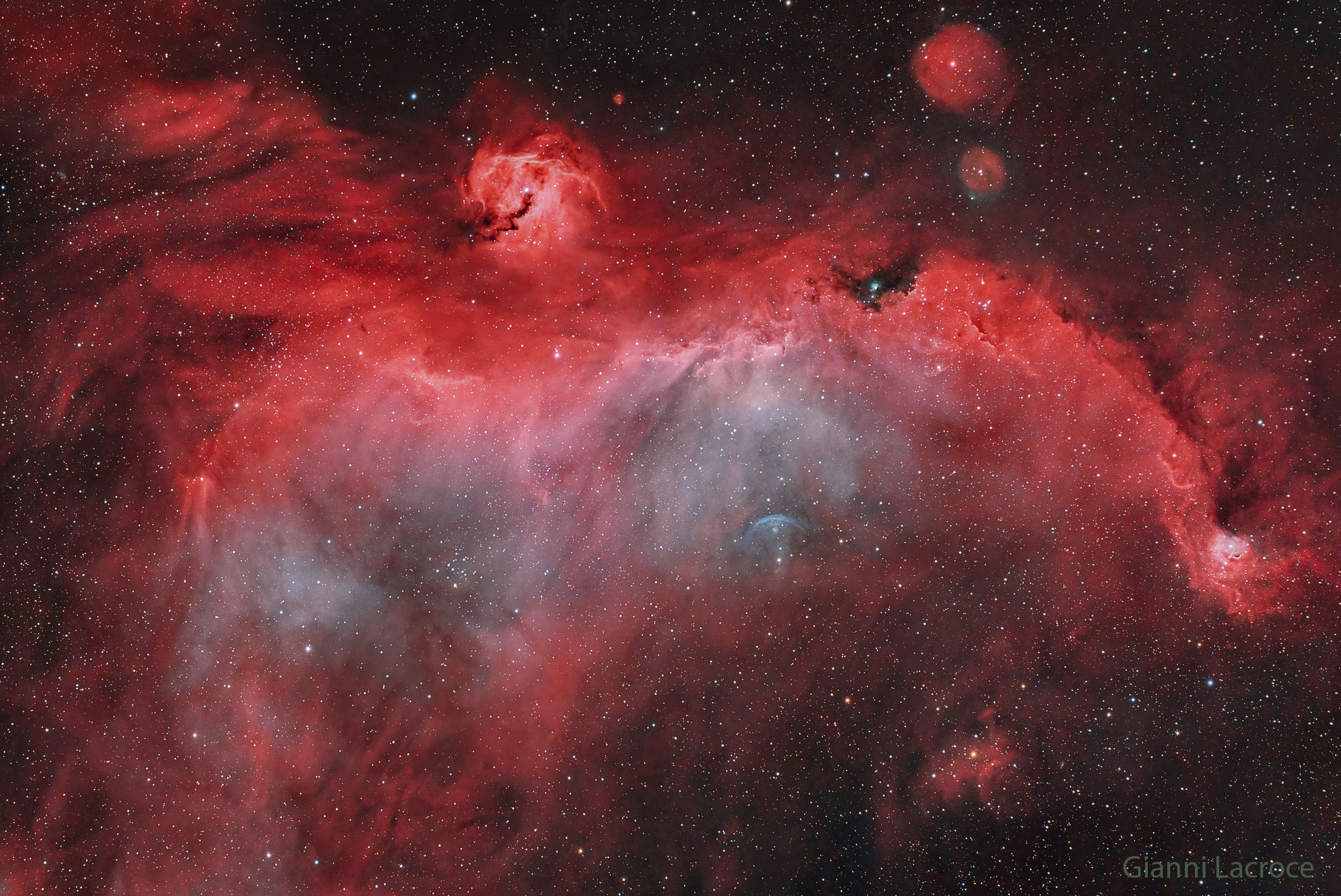
The Seagull Nebula
Explanation: A broad expanse of glowing gas and dust presents a bird-like visage to astronomers from planet Earth , suggesting its popular moniker: the Seagull Nebula . This portrait of the cosmic bird covers a 2.5-degree wide swath across the plane of the Milky Way, near the direction of Sirius , alpha star of the constellation of the Big Dog ( Canis Major ). Of course, the region includes objects with other catalog designations: notably NGC 2327 , a compact, dusty emission and reflection nebula with an embedded massive star that forms the bird's head . Likely part of a larger shell structure swept up by successive supernova explosions, the broad Seagull Nebula is cataloged as Sh2-296 and IC 2177. The prominent bluish arc below and right of center is a bow shock from runaway star FN Canis Majoris . Dominated by the reddish glow of atomic hydrogen, this complex of gas and dust clouds with other stars of the Canis Majoris OB1 association spans over 200 light-years at the Seagull Nebula's estimated 3,800 light-year distance.
Almost Hyperspace: Random APOD Generator
| Date | March 13, 2024 |
|---|---|
| Credit | Credit & Copyright: Gianni Lacroce |
| Authors & editors: | Robert Nemiroff (MTU) & Jerry Bonnell (UMCP) |
| A service of: |
ASD at NASA / GSFC, NASA Science Activation & Michigan Tech. U. |