




























APOD
Astronomy Picture of the Day
Discover the cosmos! Each day a different image or photograph of our fascinating universe is featured, along with a brief explanation written by a professional astronomer.
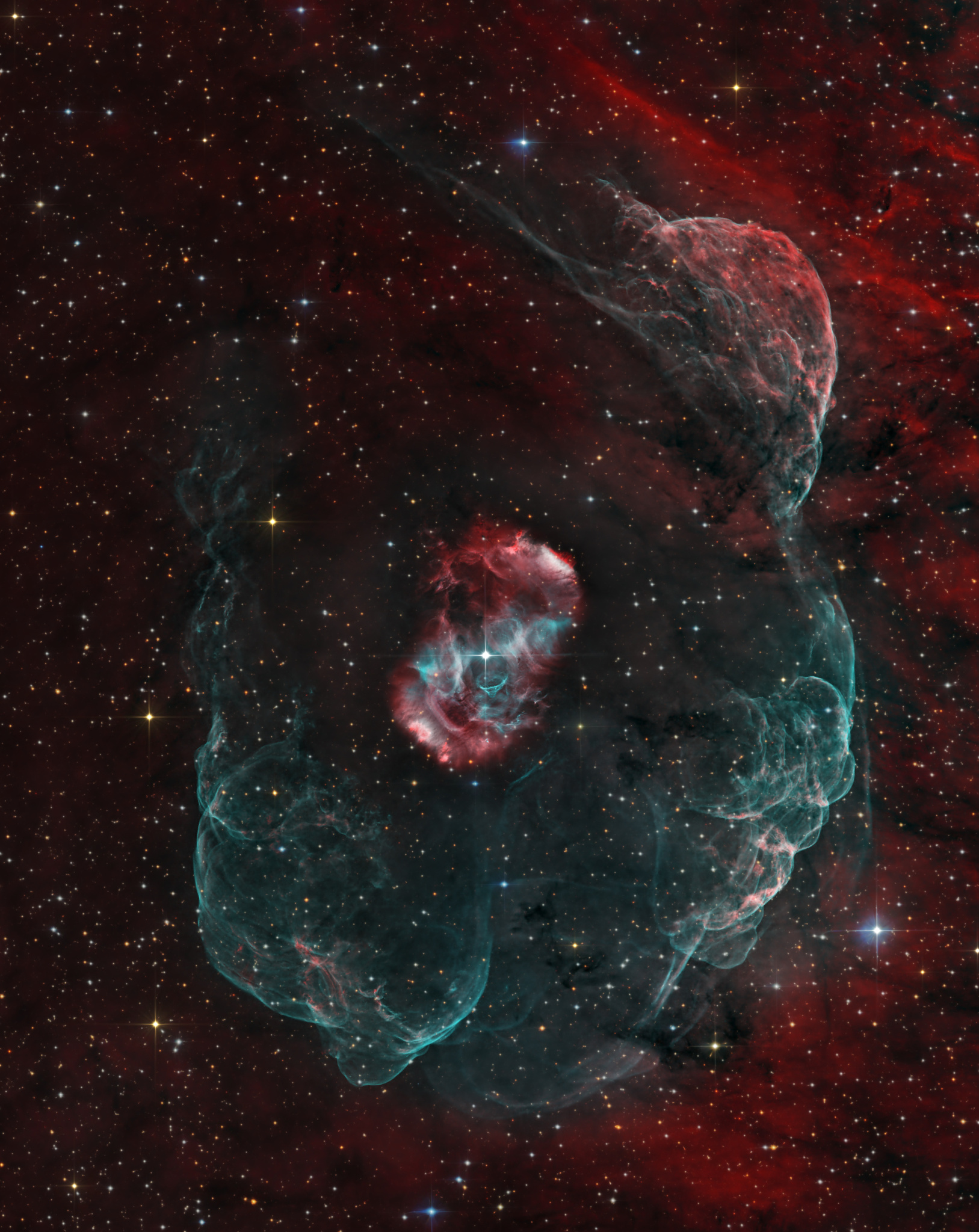
NGC 6164: A Dragon's Egg
Explanation: Beautiful emission nebula NGC 6164 was created by a rare, hot, luminous O-type star, some 40 times as massive as the Sun. Seen at the center of the cosmic cloud, the star is a mere 3 to 4 million years old. In another three to four million years the massive star will end its life in a supernova explosion . Spanning around 4 light-years, the nebula itself has a bipolar symmetry. That makes it similar in appearance to more common and familiar planetary nebulae - the gaseous shrouds surrounding dying sun-like stars. Also like many planetary nebulae, NGC 6164 has been found to have an extensive, faint halo , revealed in this deep image of the region. Expanding into the surrounding interstellar medium , the material in the halo is likely from an earlier active phase of the O star. This gorgeous telescopic view is a composite of extensive narrow-band image data, highlighting glowing atomic hydrogen gas in red and oxygen in greenish hues, with broad-band data for the surrounding starfield. Also known as the Dragon's Egg nebula , NGC 6164 is 4,200 light-years away in the right-angled southern constellation of Norma .
| Date | April 24, 2025 |
|---|---|
| Credit | Image Credit & Copyright: Daniel Stern |
| Authors & editors: | Robert Nemiroff (MTU) & Jerry Bonnell (UMCP) |
| A service of: |
ASD at NASA / GSFC, NASA Science Activation & Michigan Tech. U. |