























APOD
Astronomy Picture of the Day
Discover the cosmos! Each day a different image or photograph of our fascinating universe is featured, along with a brief explanation written by a professional astronomer.
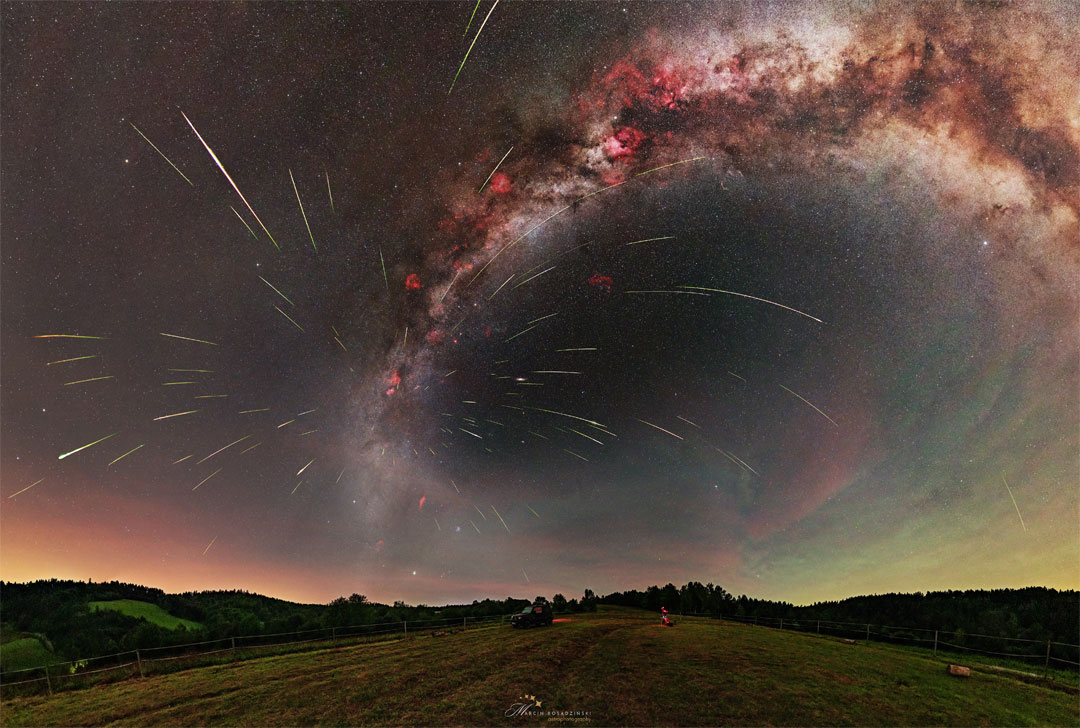

Perseids from Perseus
Explanation: Where are all of these meteors coming from? In terms of direction on the sky, the pointed answer is the constellation of Perseus. That is why the meteor shower that peaks tonight is known as the Perseids -- the meteors all appear to come from a radiant toward Perseus . In terms of parent body, though, the sand-sized debris that makes up the Perseids meteors come from Comet Swift-Tuttle . The comet follows a well-defined orbit around our Sun, and the part of the orbit that approaches Earth is superposed in front of Perseus. Therefore, when Earth crosses this orbit, the radiant point of falling debris appears in Perseus. Featured here , a composite image taken over six nights and containing over 100 meteors from 2024 August Perseids meteor shower shows many bright meteor s that streaked over the Bieszczady Mountains in Poland . This year's Perseids , usually one of the best meteor showers of the year, will compete with a bright moon that will rise , for many locations, soon after sunset.
| Date | August 12, 2025 |
|---|---|
| Credit | Image Credit & Copyright: Marcin Rosadziński |
| Authors & editors: | Robert Nemiroff (MTU) & Jerry Bonnell (UMCP) |
| A service of: |
ASD at NASA / GSFC, NASA Science Activation & Michigan Tech. U. |