





























APOD
Astronomy Picture of the Day
Discover the cosmos! Each day a different image or photograph of our fascinating universe is featured, along with a brief explanation written by a professional astronomer.
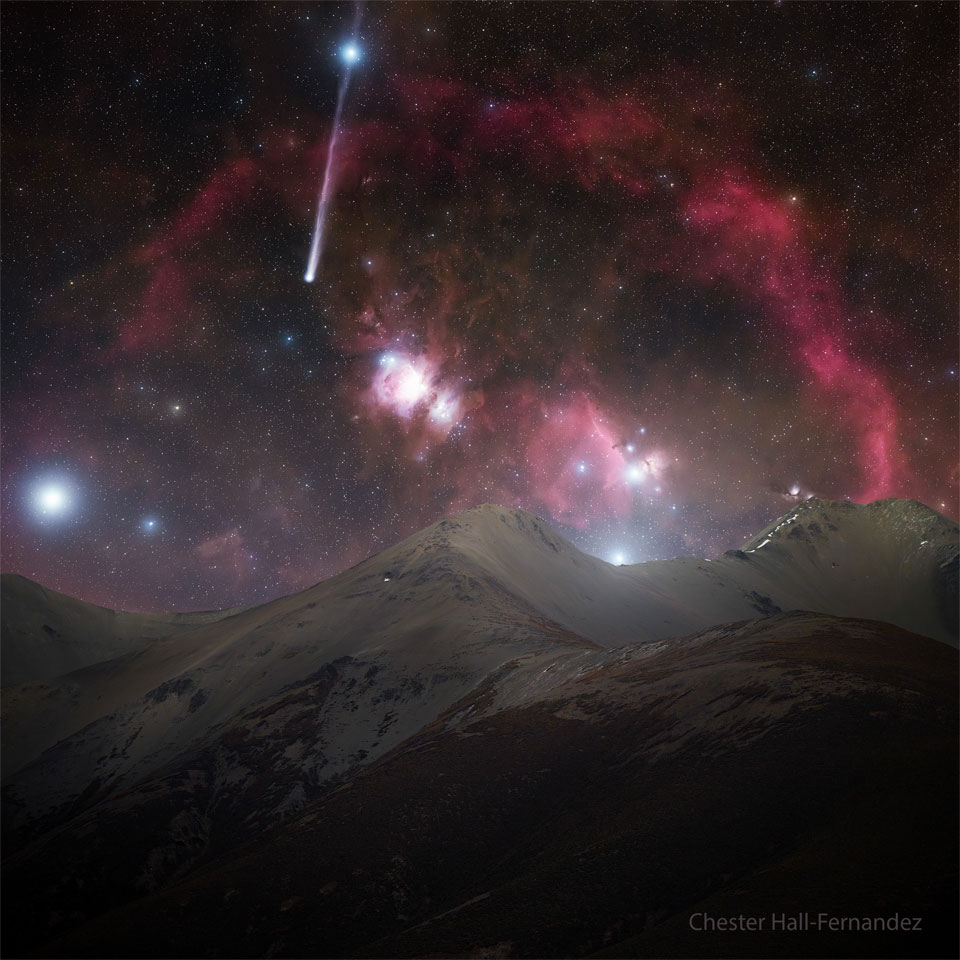

R3 PanSTARRS: An Orion Comet
Explanation: Comet R3 PanSTARRS might be best remembered as an Orion comet. A key reason is because Comet C/2025 R3 (PanSTARRS) was near its most spectacular -- in terms of tail visibility -- when passing in front of the iconic constellation . Although rare, other bright comets , too, have ventured across Orion, including Lovejoy in 2015 , Hale-Bopp in 1997 , and the Great Comet of 1264 . Best visible in long duration exposures, the featured image was captured last week from the Craigieburn Mountain Range in New Zealand . Visible in the deep background image are the Orion Nebula , Barnard's Loop , and through R3's tail, the bright star Saiph , the sixth brightest star in the constellation of Orion. Comet R3 PanSTARRS continues to fade as it moves further south, passing into the constellation of the Unicorn ( Monoceros ) in the next few days.
Sky Surprise: What picture did APOD feature on your birthday? (after 1995)
| Date | May 15, 2026 |
|---|---|
| Credit | Image Credit & Copyright: Chester Hall-Fernandez |
| Authors & editors: | Robert Nemiroff (MTU) & Jerry Bonnell (UMCP) |
| A service of: |
ASD at NASA / GSFC, NASA Science Activation & Michigan Tech. U. |