






















APOD
Astronomy Picture of the Day
Discover the cosmos! Each day a different image or photograph of our fascinating universe is featured, along with a brief explanation written by a professional astronomer.
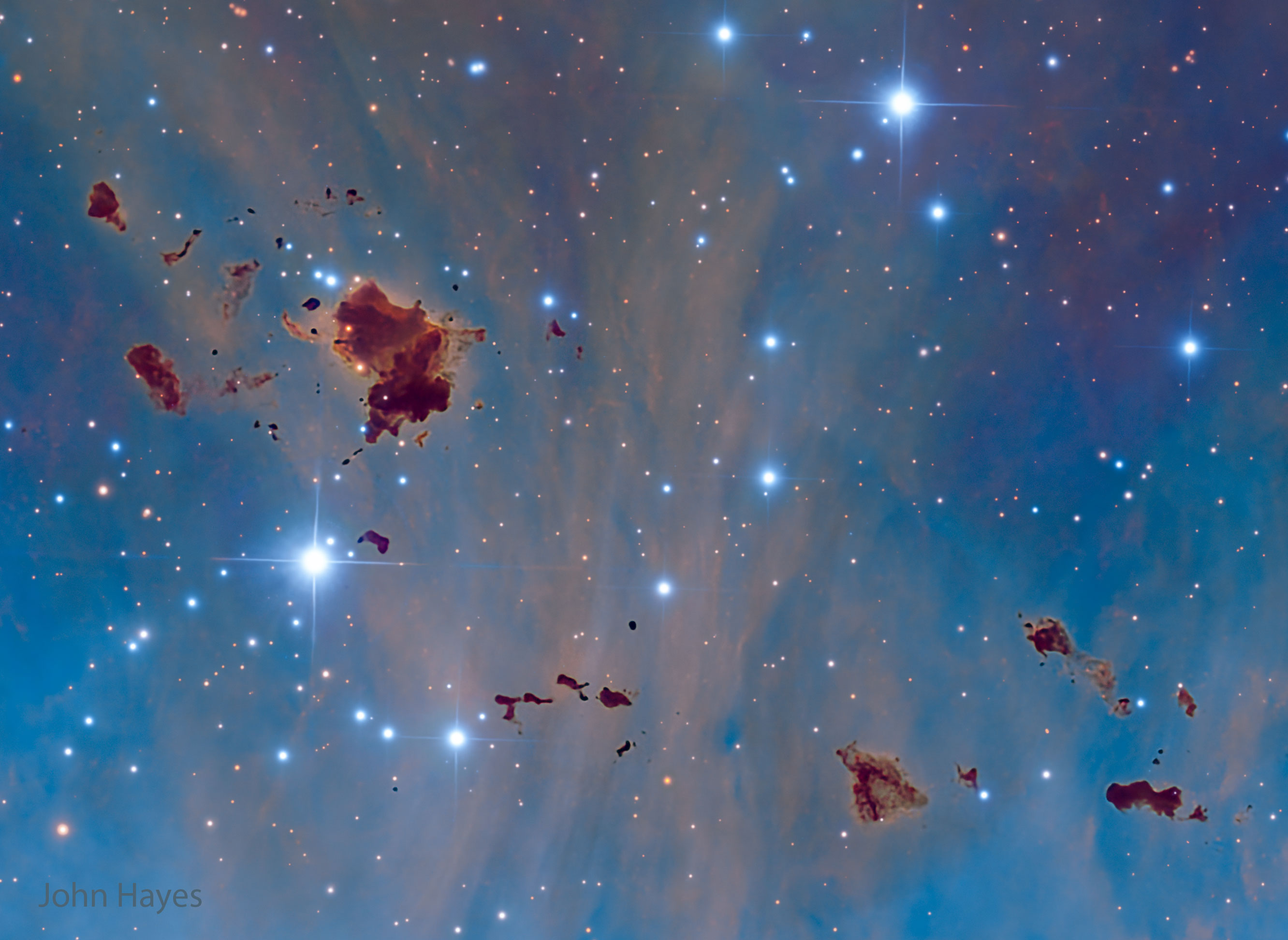
Thackeray's Globules
Explanation: What are these strange space globs? Situated in rich star field s and glowing hydrogen gas, these opaque clouds of interstellar dust and gas are so large they might be able to form stars. Their home is known as IC 2944 , a bright stellar nursery located about 7,600 light years away toward the constellation of the Centaur ( Centaurus ). The largest of these dark globules , first spotted by A. D. Thackeray in 1950 using a telescope in South Africa , is likely two separate but overlapping clouds, each more than one light-year wide. Along with other data, the featured Hubble palette image from the El Sauce Observatory in Chile, indicates that Thackeray's globules are fractured and churning as a result of intense ultraviolet radiation from young, hot stars already energizing and heating the bright emission nebula . These and similar dark globules known to be associated with other star forming regions may ultimately be dissipated by their hostile environment -- like cosmic lumps of butter in a hot frying pan .
Interstellar Jigsaw: Astronomy Puzzle of the Day
| Date | May 25, 2026 |
|---|---|
| Credit | Image Credit & Copyright: John Hayes |
| Authors & editors: | Robert Nemiroff (MTU) & Jerry Bonnell (UMCP) |
| A service of: |
ASD at NASA / GSFC, NASA Science Activation & Michigan Tech. U. |