
























Hubble Monitors Changing Weather and Seasons on Jupiter
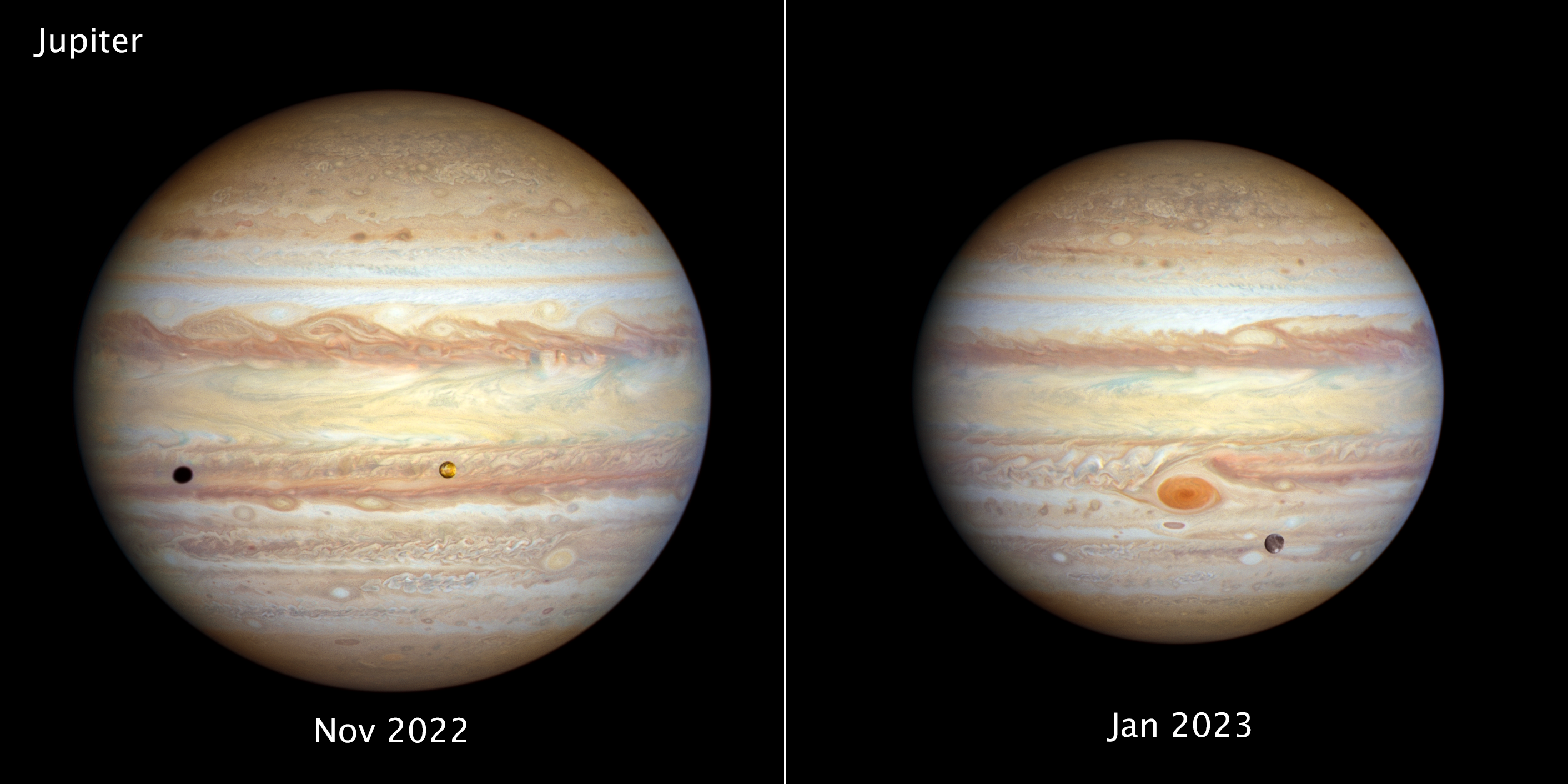
Ever since its launch in 1990, the Hubble Space Telescope has been an interplanetary weather observer for keeping an eye on the largely gaseous outer planets, which all have ever-changing atmospheres. (Left) The forecast for Jupiter is stormy weather at low northern latitudes. A prominent string of alternating storms is visible, forming a “vortex street” as some planetary astronomers call it. This is a wave pattern of nested anticyclones and cyclones, locked together like in a machine with alternating gears moving clockwise and counterclockwise. The orange moon Io photobombs this view of Jupiter’s multicolored cloud tops, casting a shadow toward the planet’s western limb. Hubble can see Io’s mottled-orange appearance that ties into its numerous active volcanoes. This photo was taken on November 12, 2022. (Right) Jupiter’s legendary Great Red Spot takes center stage in this view. Though this vortex is big enough to swallow Earth, it has actually shrunken to the smallest size it has ever been over observation records dating back 150 years. Jupiter’s icy moon Ganymede can be seen transiting the giant planet at lower right. Slightly larger than the planet Mercury, Ganymede is the largest moon in the solar system. (This image is smaller in size because Jupiter was 81,000 miles farther from Earth when the photo was taken). This photo was taken on January 6, 2023.
Image Credit: NASA, ESA, STScI, Amy Simon (NASA-GSFC), and Michael H. Wong (UC Berkeley); Image Processing: Joseph DePasquale (STScI)
- X
https://science.nasa.gov/image-detail/amf-03cd5527-64f3-4260-aedf-6c54b7b206f8/
Image CreditNASA, ESA, STScI, Amy Simon (NASA-GSFC), and Michael H. Wong (UC Berkeley); Image Processing: Joseph DePasquale (STScI)
Size2824x1412px