

























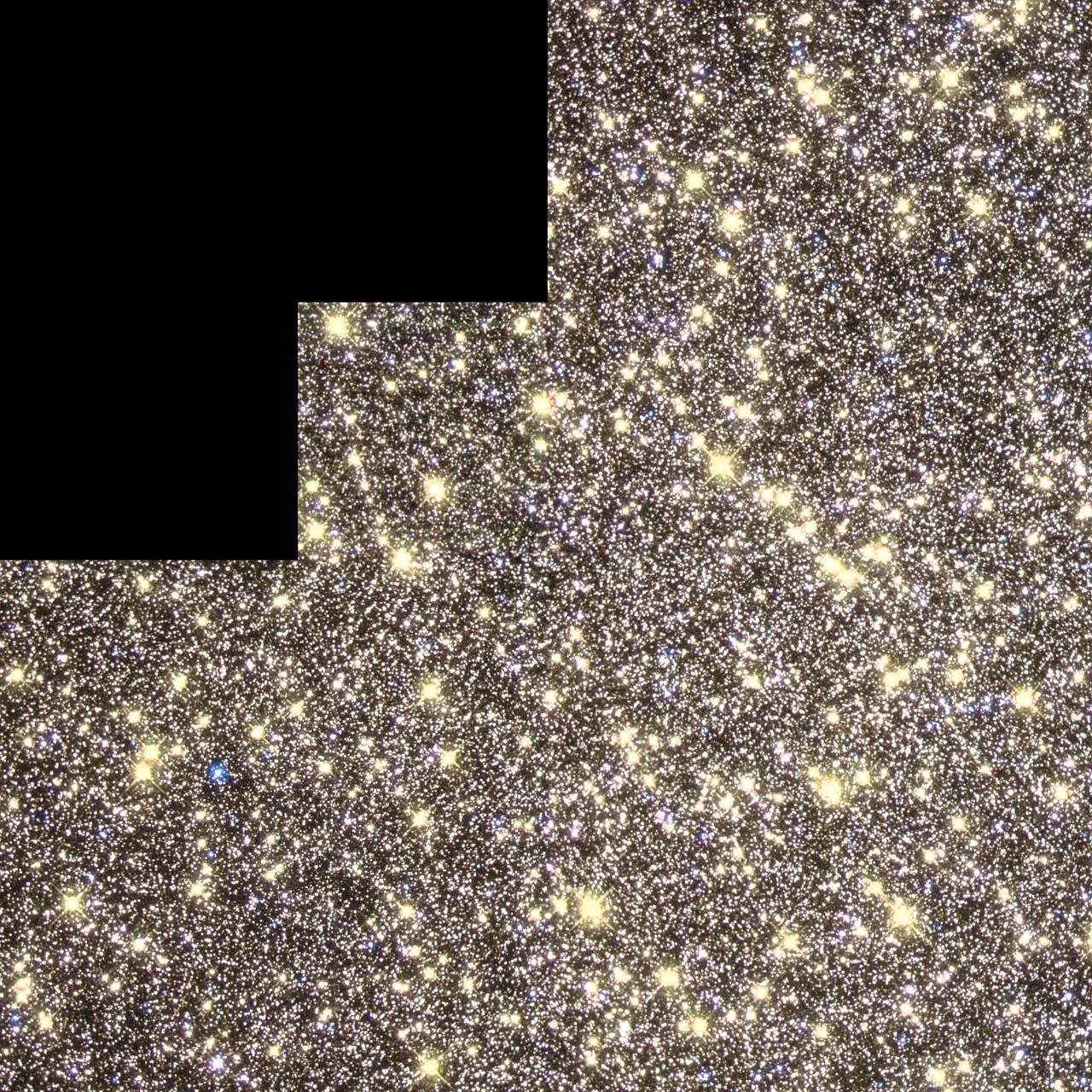
Peering into the Core of Globular Cluster Omega Centauri
This image peers into the center of a dense swarm of stars called Omega Centauri. Located some 17,000 light-years from Earth, Omega Centauri is a massive globular star cluster, containing several million stars swirling in locked orbits around a common center of gravity. The stars are packed so densely in the cluster's core that it is difficult for ground-based telescopes to make out individual stars. Hubble's high resolution is able to pick up where ground-based telescopes leave off, capturing distinct points of light from stars at the very center of the cluster. Omega Centauri is so large in our sky that only a small part of it fit within the field of view of Hubble's Wide Field and Planetary Camera 2 instrument, which captured this image. Yet even this tiny patch contains some 50,000 stars, all packed into a region only about 13 light-years wide. For comparison, a similarly sized region centered on the Sun would contain about a half dozen stars. The vast majority of stars in this Hubble image are faint, yellow-white dwarf stars similar to our Sun. The handful of bright yellow-orange stars are expanding, dying red giants. A number of faint blue stars are also visible in the image. These are in a brief phase of evolution between the dwarf stage and the red-giant stage, during which the surface temperature is high. The stars in Omega Centauri are very old, about 12 billion years. The stars in the core of Omega Centauri are so densely packed that occasionally one of them will actually collide with another one. Even in the dense center of Omega Centauri, stellar collisions will be infrequent. But the cluster is so old that many thousands of collisions have occurred.
Image Credit: NASA/ESA and the Hubble Heritage Team (STScI/AURA); Acknowledgment: A. Cool (SFSU)
- X
https://science.nasa.gov/image-detail/c80-2/
Image CreditNASA/ESA and the Hubble Heritage Team (STScI/AURA); Acknowledgment: A. Cool (SFSU)
Size1280x1280px