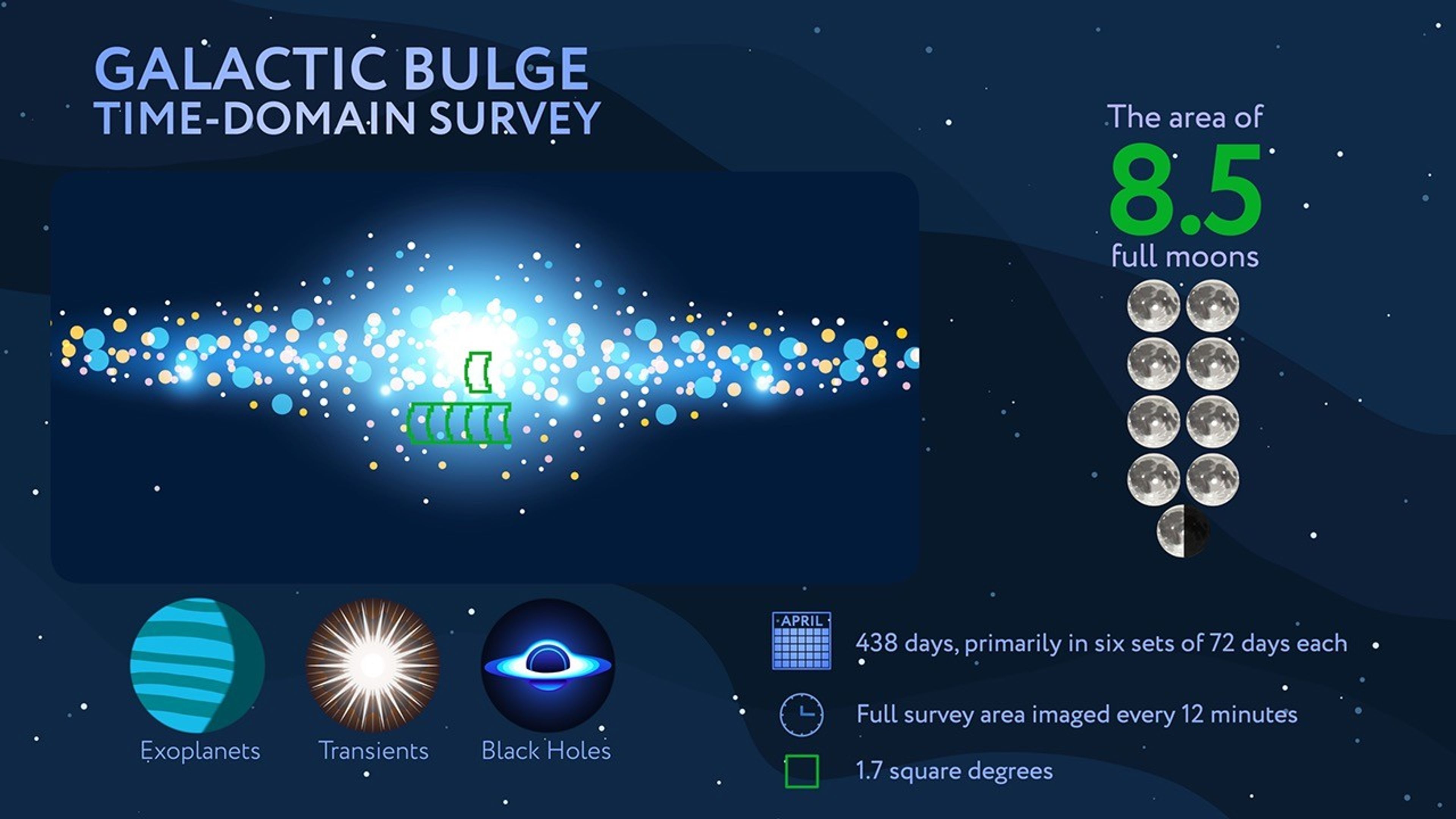
Galactic Bulge Time-Domain Survey
TECHNICAL Facts
High-cadence observations of 12.1-mins over 6 seasons (3 early and 3 late in Roman’s 5-year mission)
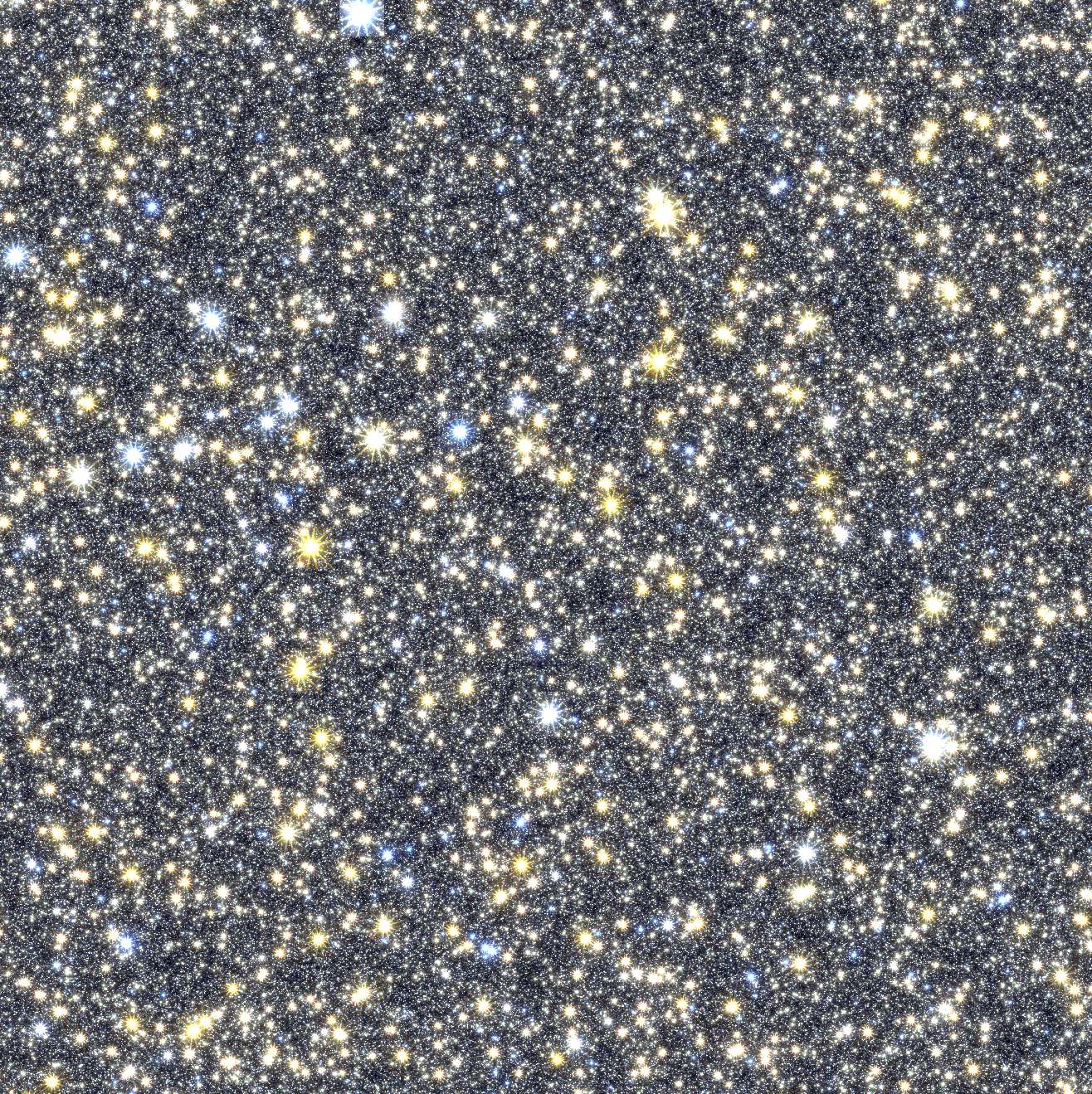
Low-cadence observations search for long-duration microlensing events and other variable types
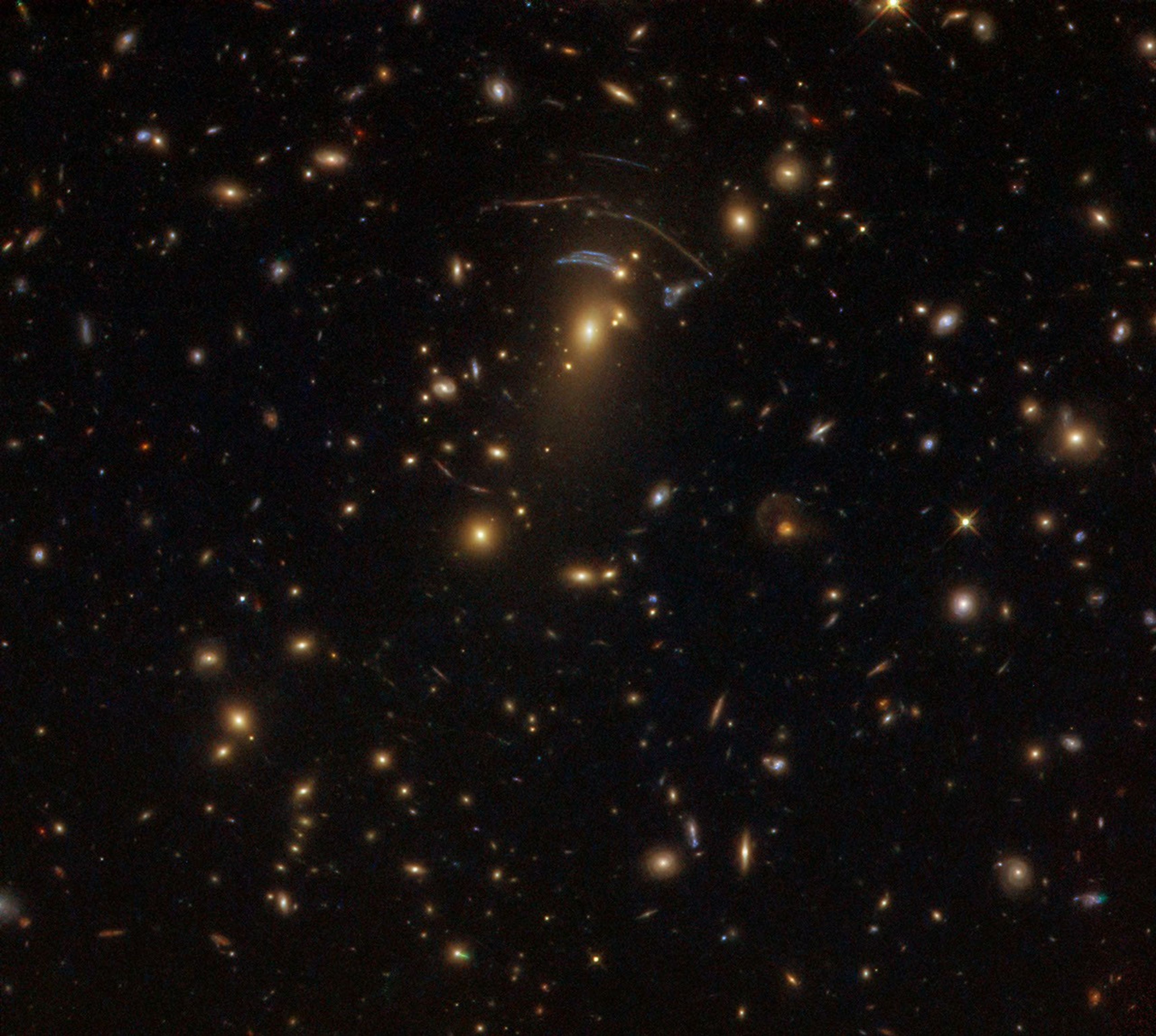
Snapshots of the survey fields with multiband photometry measure stellar temperatures, metallicities, and radial velocities.

A time domain imaging survey of the Galactic bulge to detect more than a thousand wide-orbit planets, as well as stars and black holes, via microlensing, detect more than 105 transiting planets, measure asteroseismic masses for over 104 evolved stars, and enable a wide range of other studies of stellar and Galactic astrophysics.
The Galactic Bulge Time-Domain Survey is designed to measure the demographics of exoplanets via gravitational microlensing, sensitive to a regime of mass and orbital separation that is complementary to those of the Kepler and TESS missions, including free floating planets.
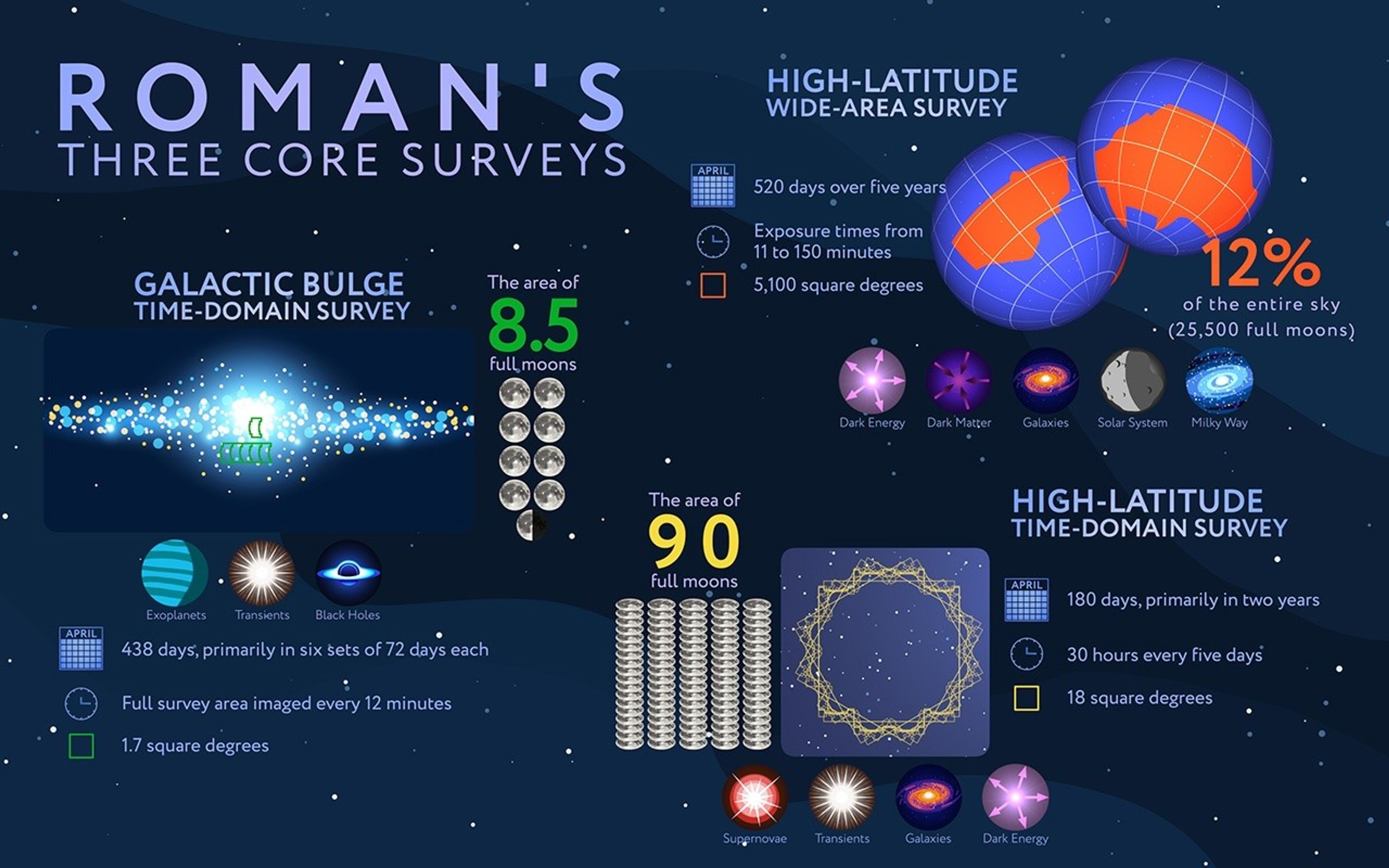
The Galactic Bulge Time-Domain Survey features high-cadence observations of 12.1-mins over 6 seasons (3 early and 3 late in Roman’s 5-year mission). The survey also includes low-cadence seasons of 5-days or faster for long-duration microlensing events and other variable types in the middle bulge seasons of Roman’s 5-year mission. Lastly, this survey will have “snapshots” of the survey fields with multiband photometry for stellar characterization and grism spectroscopy for measuring stellar temperatures, metallicities, and radial velocities. This survey is allocated ~15 months of time.
High-cadence Observations
- To achieve microlensing survey science requirements
- 12.1-min F146 (wide) filter observing cadence
- 12-hours or faster with F087 (Z) and F213 (K) filters
- Over 6 seasons (3 early and 3 late)
Low-cadence Observations
- To search for long-duration microlensing events and other variable types
- 3-day cadence with F146 (wide) and F213 (K) filters
- 4 seasons during middle bulge seasons
Snapshots
- Multiband photometry - 30 snapshots
- For stellar characterization
- With the 5 filters not used for high- or low-cadence observations
- Grism spectroscopy - 30 snapshots
- For measuring stellar temperatures, metallicities, and radial velocities
![Galactic Bulge Time-Domain Survey [figure A]](https://assets.science.nasa.gov/dynamicimage/assets/science/missions/rst/science/gbtds_figureA.png?w=1000&h=738&fit=clip&crop=faces%2Cfocalpoint)