






















Description

Map Projected Browse Image
Click on image for larger version
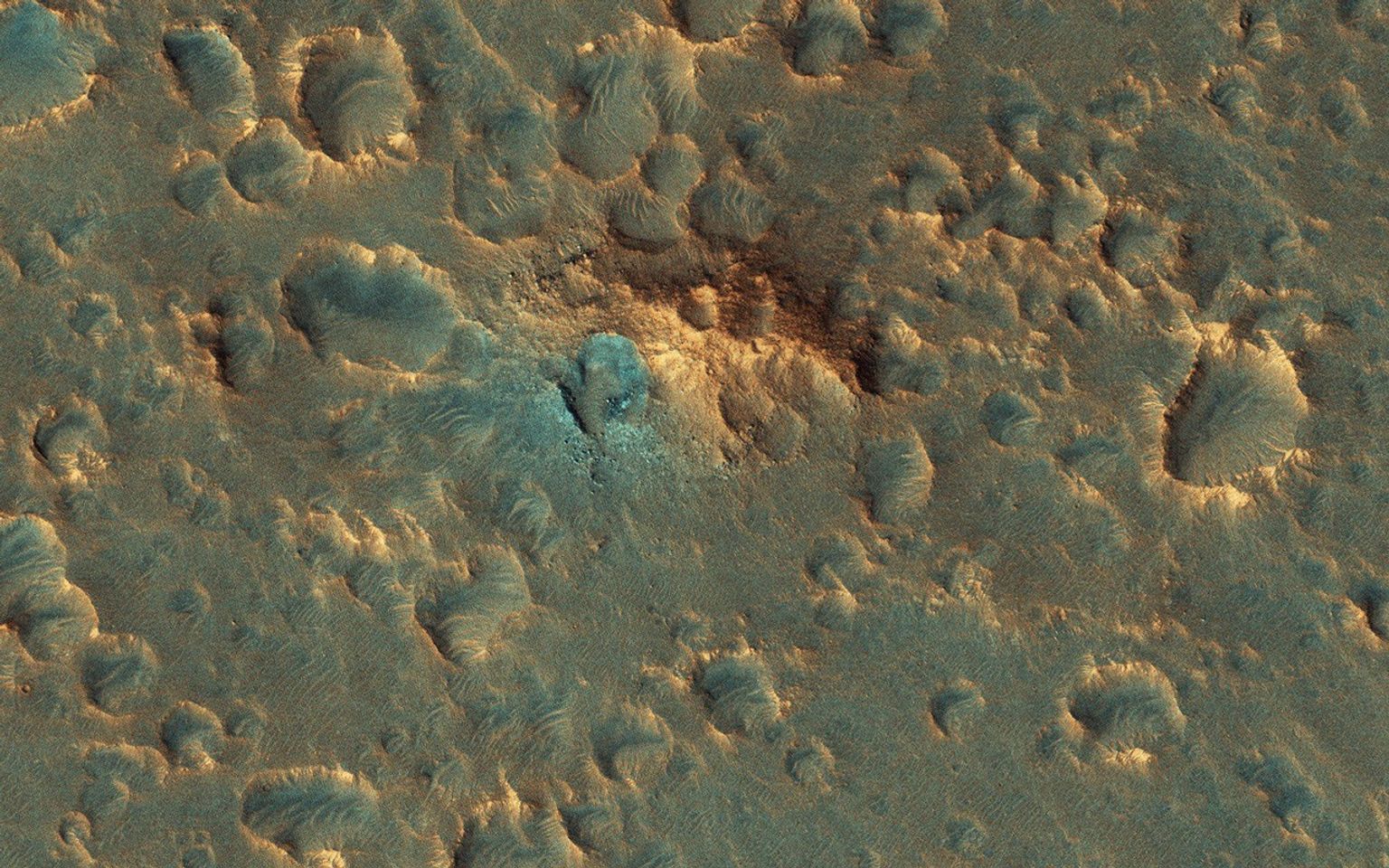
HiRISE plays an important role in finding suitable landing sites for future rover missions. Scientists have narrowed down the candidate landing sites for the upcoming European ExoMars rover mission to two regions: the plains of Oxia and Mawrth Vallis.
Images covering these areas aid scientists in picking a location that will be both scientifically interesting and a safe place to land and operate. HiRISE pictures help to assess the risk for each particular location so that a final landing site can be selected.
If you look very closely, the image may appear hazy. This is due to additional dust lingering in the atmosphere from the massive summer global dust storm at the time we acquired this observation. ExoMars is due to launch to Mars in 2020.
The map is projected here at a scale of 25 centimeters (9.8 inches) per pixel. [The original image scale is 28.3 centimeters (11.1 inches) per pixel (with 1 x 1 binning); objects on the order of 85 centimeters (33.5 inches) across are resolved.] North is up.
The University of Arizona, Tucson, operates HiRISE, which was built by Ball Aerospace & Technologies Corp., Boulder, Colorado. NASA's Jet Propulsion Laboratory, a division of Caltech in Pasadena, California, manages the Mars Reconnaissance Orbiter Project for NASA's Science Mission Directorate, Washington.