













Description
Click on the image above for browser view
 |  |
| Download the High Resolution JPEG Click on the image above for browser view | Download the High Resolution JPEG Click on the image above for browser view |
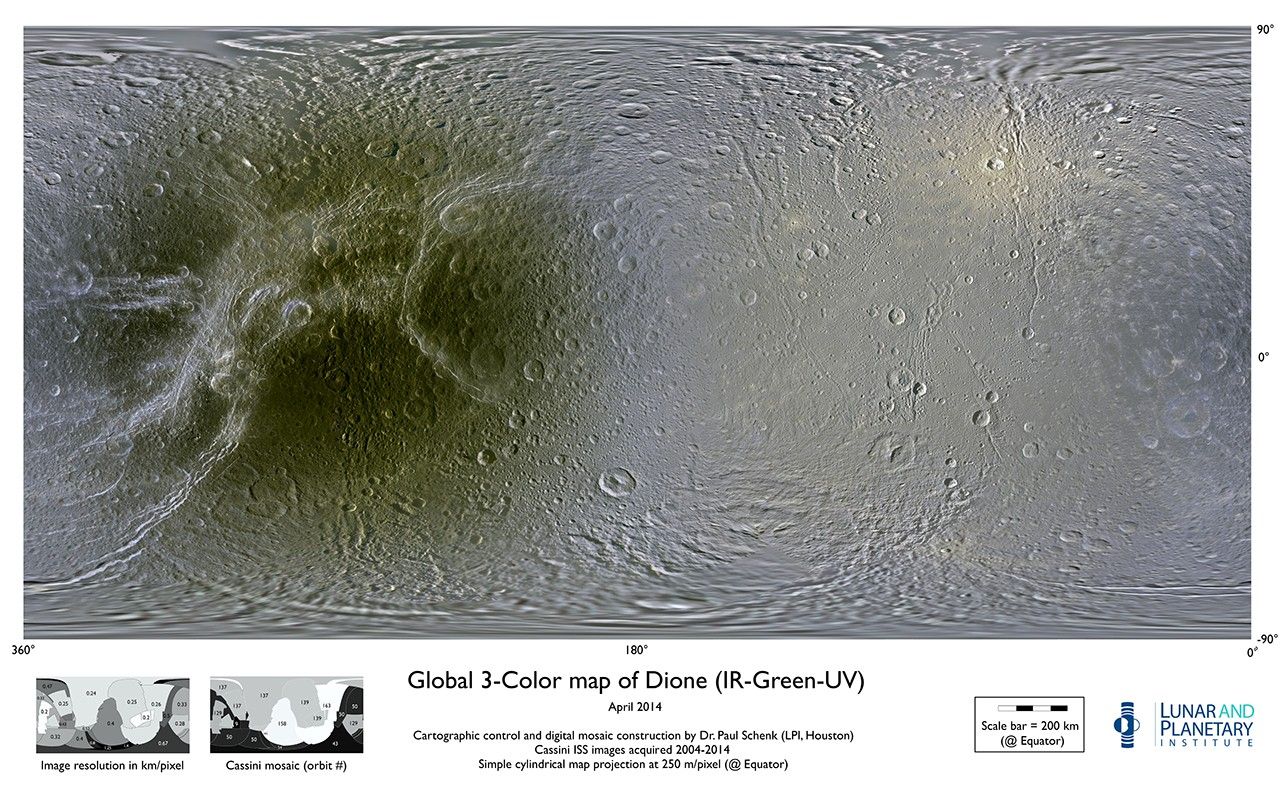
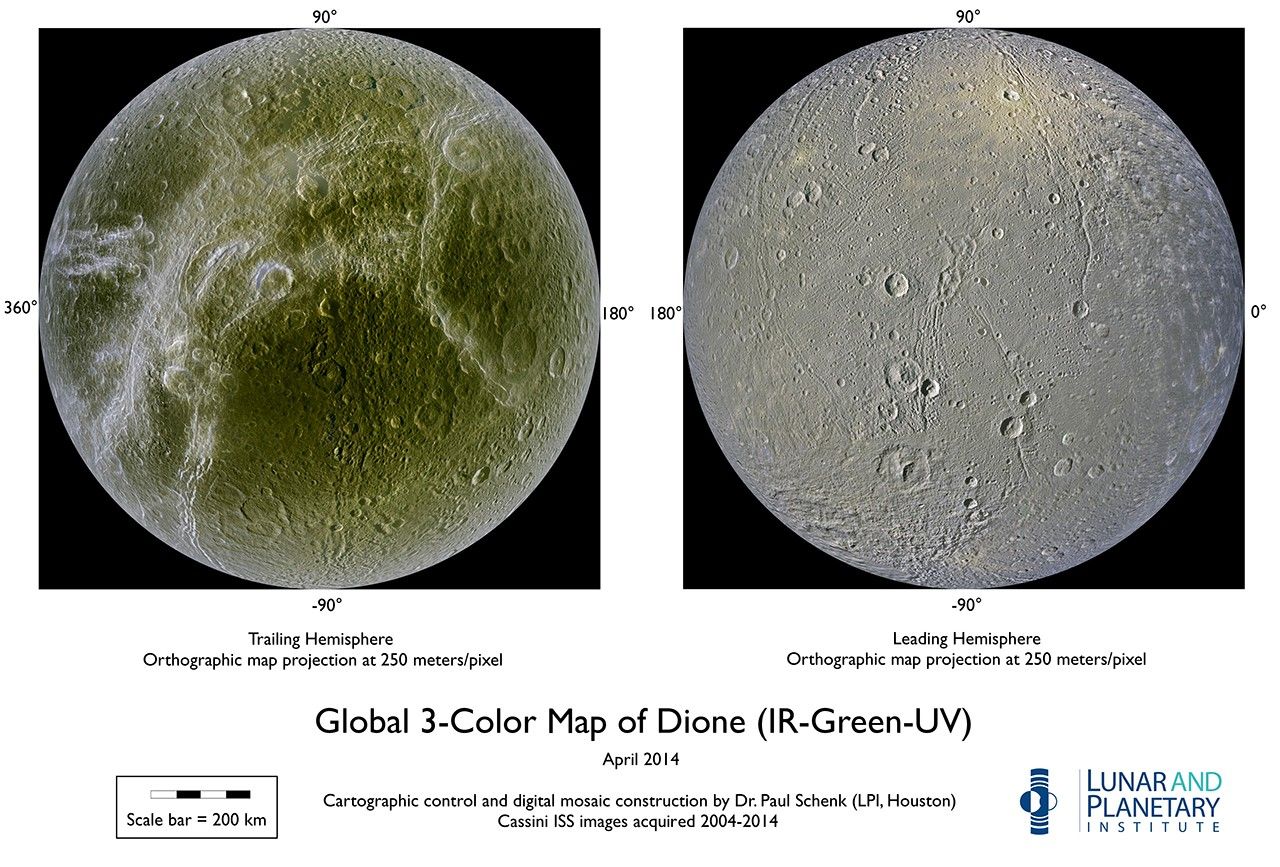
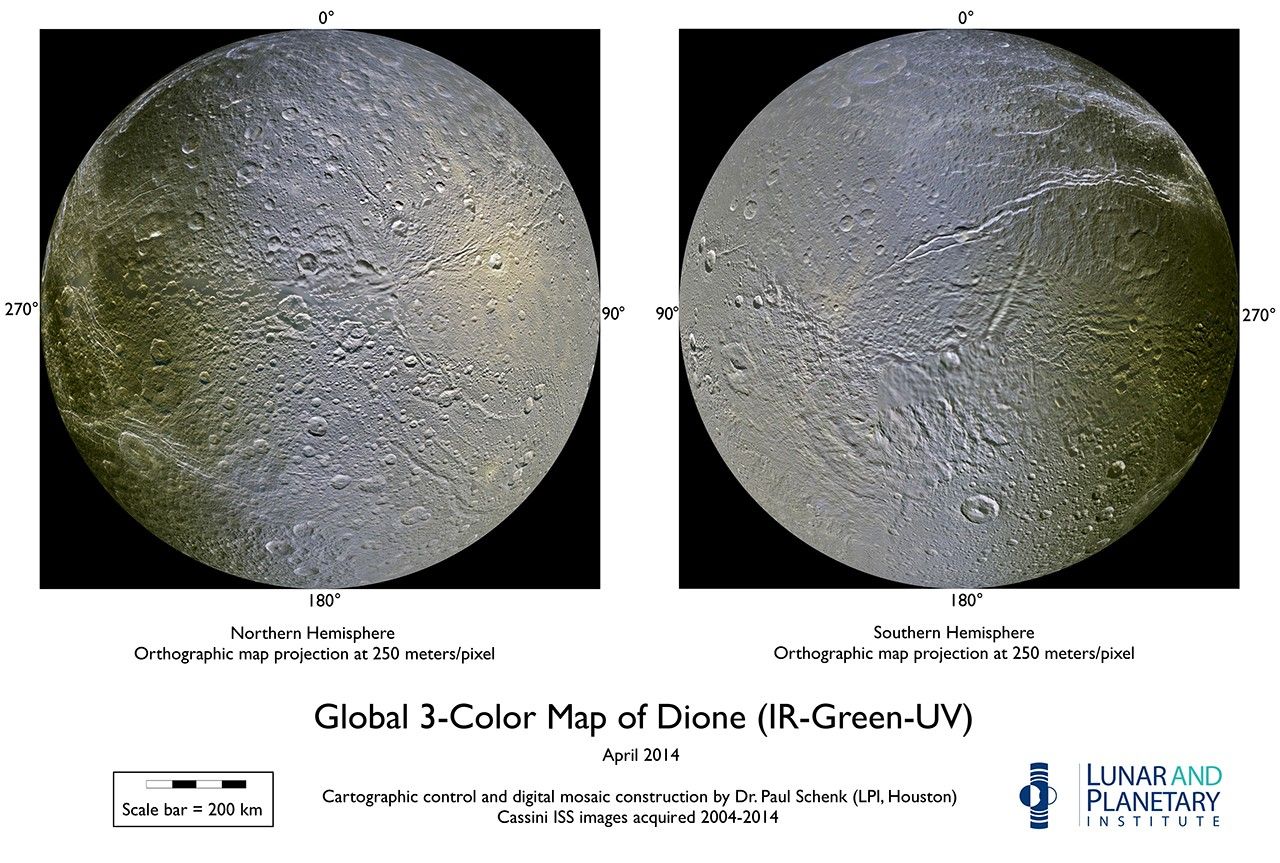
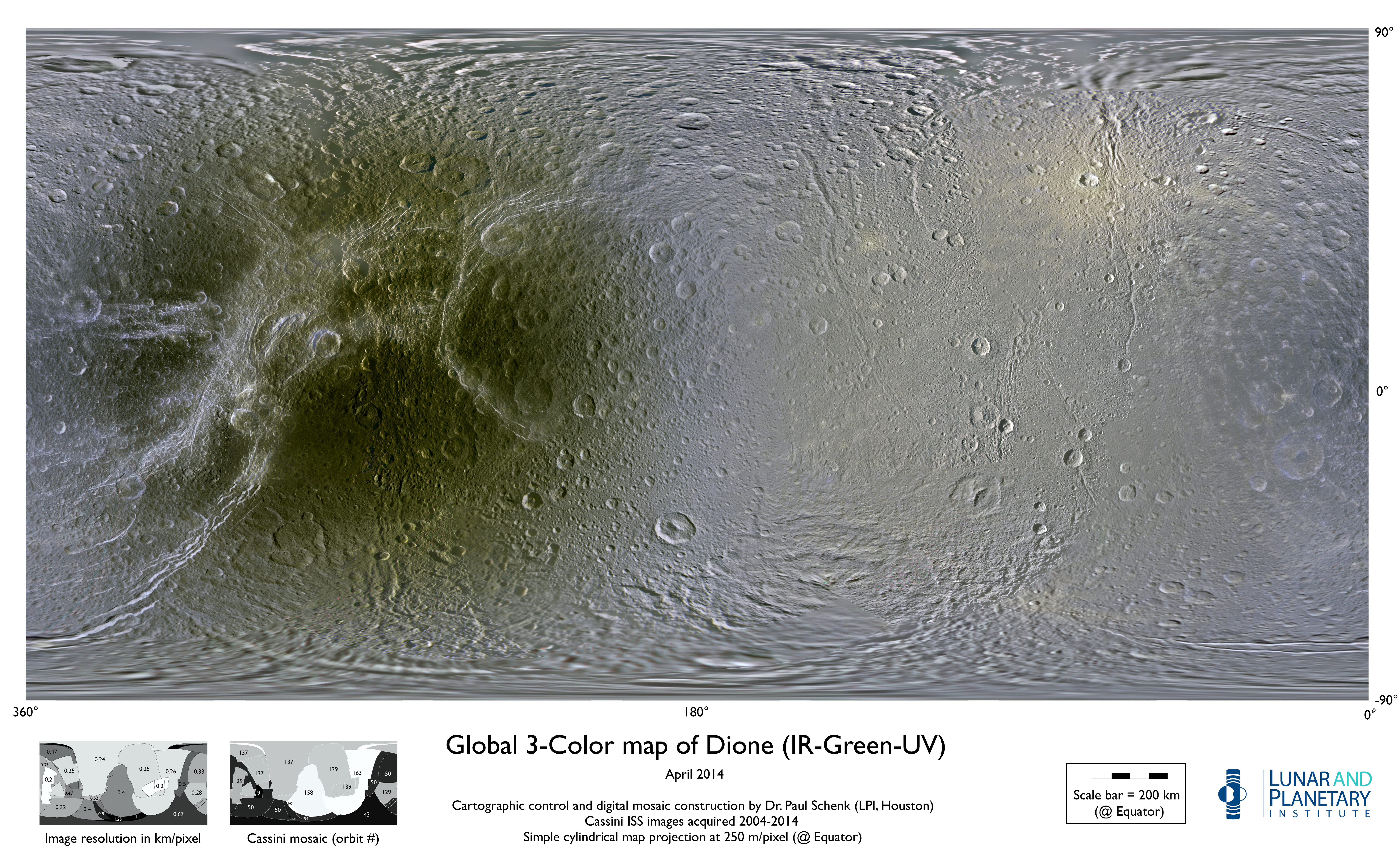
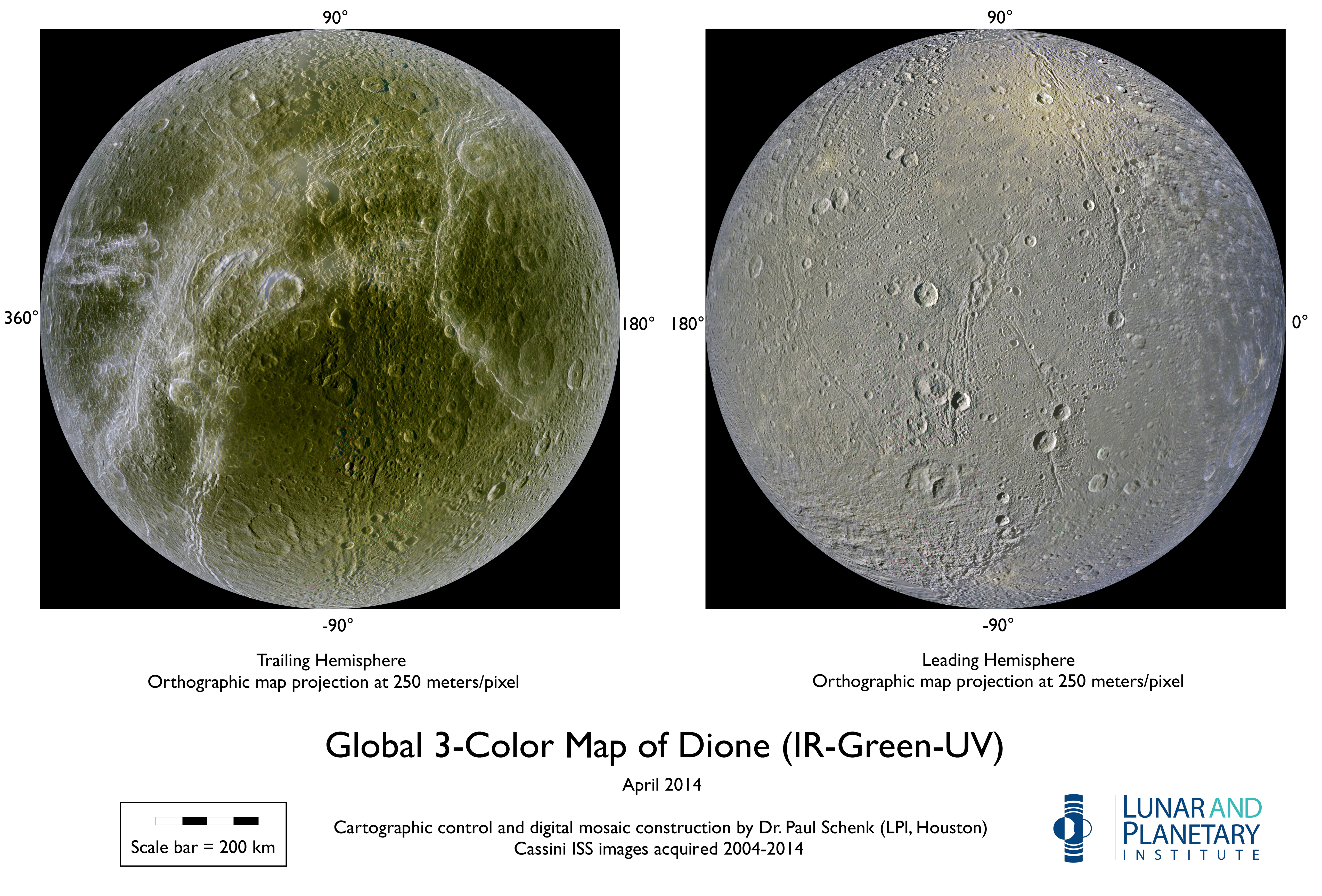
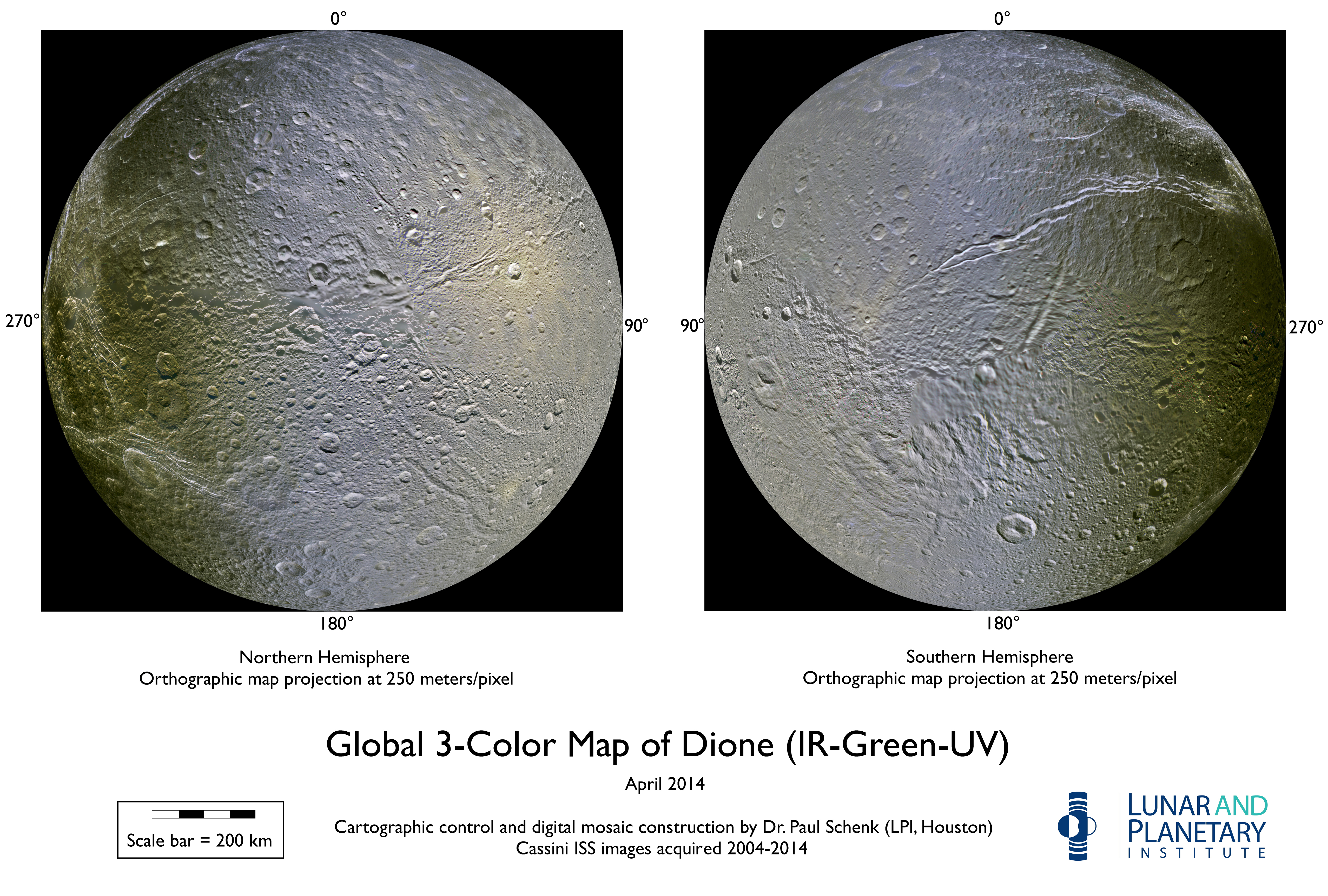
This set of global, color mosaics of Saturn's moon Dione was produced from images taken by NASA's Cassini spacecraft during its first ten years exploring the Saturn system. These are the first global color maps of these moons produced from the Cassini data.
The most obvious feature on the maps is the difference in color and brightness between the two hemispheres. The darker colors on the trailing hemispheres are thought to be due to alteration by magnetospheric particles and radiation striking those surfaces. The lighter-colored leading hemisphere is coated with icy dust from Saturn's E-ring, formed from tiny particles ejected from Enceladus' south pole. These satellites are all being painted by material erupted by neighboring Enceladus.
The colors shown in these global mosaics are enhanced, or broader, relative to human vision, extending into the ultraviolet and infrared range.
Resolution on Dione in the maps is 250 meters per pixel.
Image selection, radiometric calibration, geographic registration and photometric correction, as well as mosaic selection and assembly were performed by Paul Schenk at the Lunar and Planetary Institute. Original image planning and targeting for Saturn's icy moons were performed by Tilman Denk (Frei Universitat, Berlin) and Paul Helfenstein (Cornell University, Ithaca, New York).
The Cassini-Huygens mission is a cooperative project of NASA, the European Space Agency and the Italian Space Agency. NASA's Jet Propulsion Laboratory, a division of the California Institute of Technology in Pasadena, manages the mission for NASA's Science Mission Directorate, Washington. The Cassini orbiter and its two onboard cameras were designed, developed and assembled at JPL. The imaging operations center is based at the Space Science Institute in Boulder, Colo.
For more information about the Cassini-Huygens mission visit http://saturn.jpl.nasa.gov and http://www.nasa.gov/cassini. The Cassini imaging team homepage is at http://ciclops.org.