























Description
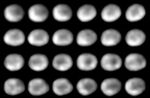
This is a NASA Hubble Space Telescope series of 24 images showing the full 5.34-hour rotation of the 325-mile diameter (525 kilometer) asteroid Vesta.
Hubble resolves features as small as 50 miles across, allowing astronomers to map Vesta's geologically diverse terrain. The surface is a complex record of Vesta's four billion-year history. Features include ancient lava flows, and a gigantic impact basin that is so deep, it exposes the asteroid's subsurface, or mantle.
This sequence was taken with Hubble's Wide Field Planetary Camera 2 between November 28 and December 1, 1994, when Vesta was at a distance of 156 million miles from Earth.
When combined with ground-based data, astronomers will be able to make the first geochemical map of Vesta's surface.
More information about asteroid Vesta is online at http://www.nasa.gov/dawn and http://dawn.jpl.nasa.gov.