











Annual Essay Contest
2024 - 2025 Power to Explore Winners
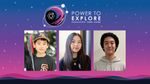
Terry Xu, Maggie Hou, and Kairat Otorov's winning essays won them a trip to NASA's Glenn Research Center.
2024 - 2025 Contest Winners
Power to Explore Challenge Winners Visit NASA Glenn
The three student winners of NASA’s 2025 Power to Explore Challenge went behind the scenes at NASA’s Glenn Research Center in Cleveland in August.
During the national essay contest, K-12 students learned about radioisotope power systems, "nuclear batteries" used in space. While touring NASA Glenn, the winning students met with engineers and researchers to discover more about innovative technologies advancing exploration of the Moon, Mars, and beyond.
Winners of the 2024-2025 Power to Explore Student Writing Challenge were invited to NASA’s Glenn Research Center in Cleveland for a prize trip that consisted of an exclusive tour of Glenn’s world-class facilities, and a day at Great Lakes Science Center — home of the NASA Glenn Visitor Center.
The three national winners, accompanied by a parent, started the prize trip on Aug. 14 with a welcome from Dr. Michael Barrett, director, Space Flight Systems at Glenn. The tour included a close-up view of the Simulated Lunar Operations Laboratory, Zero Gravity Research Facility, Stirling Research Lab, Power Systems Facility, Graphic & Visualization Lab, and the 10x10 Supersonic Wind Tunnel. The trip concluded with an encounter with the NASA Glenn Visitor Center at Great Lakes Science Center.
The winners are:
Grades K-4
- Terry Xu, ten-year-old from Arcadia, California
Grades 5-8
- Maggie Hou, 14-year-old from Snohomish, Washington
Grades 9-12
- Kairat Otorov, 17-year-old from Trumbull, Connecticut
2024 - 2025 Finalists
NASA has named nine finalists out of the 45 semifinalist student essays in the Power to Explore Challenge, a national writing competition for K-12 students featuring the enabling power of radioisotopes. Contestants were challenged to explore how NASA has powered some of its most famous science missions, and to dream up how their personal “superpowers” would energize their success on their own radioisotope-powered science mission.
Entries were split into three categories: grades K-4, 5-8, and 9-12. Every student who submitted an entry received a digital certificate and an invitation to the Power Up virtual event that announced the semifinalists. Students learned about what powers the NASA workforce to dream big and work together to explore.
Grades K-4
- Mini M, Ann Arbor, Michigan
- Zachary Tolchin, Guilford, Connecticut
- Terry Xu, Arcadia, California
Grades 5-8
- Lilah Coyan, Spokane, Washington
- Maggie Hou, Snohomish, Washington
- Sarabhesh Saravanakumar, Bothell, Washington
Grades 9-12
- Faiz Karim, Jericho, New York
- Kairat Otorov, Trumbull, Connecticut
- Saanvi Shah, Bothell, Washington
2024 - 2025 Semifinalists
NASA selected 45 student essays as semifinalists of its 2024 Power to Explore Challenge. The 2024-2025 contest received 2,051 submitted entries from all 50 states, Guam, U.S. Virgin Islands, American Samoa, Northern Mariana Islands, Puerto Rico, and the Department of Defense Education Activity (DoDEA) Overseas.
Grades K-4
- Vihaan Akhoury, Roseland, NJ
- Ada Brolan, Somerville, MA
- Ashwin Cohen, Washington D.C
- Unnathi Chandra Devavarapu, San Marcos, CA
- Viviha Dinesh Kumar, Pflugerville, TX
- Tamanna Ghosh, Orlando, FL
- Ava Goodison, Arnold, MD
- Anika Lal, Pflugerville, TX
- Diya Loganathan, Secaucus, NJ
- Mini M, Ann Arbor, MI
- Mark Porter, Temple Hills, MD
- Rohith Thiruppathy, Canton, MI
- Zachary Tolchin, Guilford CT
- Kavin Vairavan, West Windsor Township, NJ
- Terry Xu, Arcadia, CA
Grades 5-8
- Chowdhury Wareesha Ali, Solon OH
- Caydin Brandes, Los Angeles, CA
- Caleb Braswell, Crestview, FL
- Lilah Coyan, Spokane, WA
- Ashwin Dhondi Kubeer, Phoenix, AZ
- Jonathan Gigi, Cypress, TX
- Gagan Girish, Portland, OR
- Maggie Hou, Snohomish, WA
- Sanjay Koripelli, Louisville, KY
- Isaiah Muniz, South Orange, NJ
- Sarabhesh Saravanakumar, Bothell, WA
- Eliya Schubert, Katonah, NY
- Gabriel Traska, Fort Woth, TX
- Jaxon Verbeck, Riggins, ID
- Krish Vinodhkumar, Monrovia, MD
Grades 9-12
- Samaria Berry, Kinder, LA
- David Cai, Saipan, MP
- Reggie Castro, Saipan, MP
- Ryan Danyow, Rutland City, VT
- Faiz Karim, Jericho, NY
- Sakethram Kuncha, Chantilly, VA
- Katerina Morin, Miami, FL
- Emilio Olivares, Edmond, OK
- Kairat Otorov, Trumbull, CT
- Dev Rai, Herndon, VA
- Shaurya Saxena, Irving, TX
- Saanvi Shah, Bothell, WA
- Niyant Sithamraju, San Ramon, CA
- Anna Swenson, Henderson, NV
- Alejandro Valdez, Orlando, FL
About the Challenge
About the Power to Explore Student Essay Challenge 2024 - 2025
Did you know that our solar system has more than 891 moons? This includes 421 officially recognized moons orbiting planets — including Pluto. These moons provide an incredible opportunity for discovery. Radioisotope Power Systems, a type of nuclear "battery," have powered missions near Jupiter's moon Io, where over 400 active volcanoes were revealed; Saturn's dusty moon Titan, where it helped uncover its methane lakes, oceans, and rivers; and Pluto's moon Charon, where NASA recently discovered jagged mountains and deep canyons.
If entrants could plan an RPS-powered mission to any moon in our solar system, which moon would they choose to unravel its mysteries?
NASA wants to know what they plan to explore, the discoveries they hope to make, and how they would use this special power to achieve mission success.
Entries needed to address the topics below:
- Dark, dusty, or distant mission destination: Tell us which moon your RPS-powered space mission will go and describe your mission goal(s). Keep in mind that your mission can either flyby, orbit, land, or rove.
- Radioisotope Power Systems (RPS): Explain the importance and advantages of using RPS for this mission. How does this technology overcome the challenges of these extreme environments and destinations?
- Your power: NASA missions are also powered by people – from mission planning and development, to designing, launching, and operating a spacecraft. Tell us what you think your unique power is and how your special power will help you achieve mission success. Your power could be a skill, personality trait, or other personal strength that is uniquely you.
About the Challenge
The challenge is funded by the Radioisotope Power Systems Program in NASA’s Science Mission Directorate and administered by Future Engineers under a Small Business Innovation Research phase III contract. This task is managed by the NASA Tournament Lab, a part of the Prizes, Challenges, and Crowdsourcing Program in NASA’s Space Technology Mission Directorate.