












NASA Selects 23 U.S. Research Teams to Advance Science Priorities, Develop Future STEM Workforce
NASA’s Science Mission Directorate has selected 23 research teams, led by faculty at a broad range of U.S. institutions of higher education, that will allow for hundreds of students, mostly undergraduates, to perform groundbreaking research alongside faculty and NASA mentors over the next two years. The COMPASS (Collaborative Opportunities for Mentorship, Partnership and Academic Success in Science) Startup Awards (CSA) Element of ROSES-2025 (F.19) provides support for faculty investigators and their students to carry out SMD-relevant research in collaboration with NASA scientists and engineers that advances NASA’s scientific priorities while training the future STEM workforce.
COMPASS is responsive to the executive order (EO) Improving Oversight of Federal Grantmaking Section 4 (D) iv that “Discretionary grants should be given to a broad range of recipients rather than to a select group of repeat players” by prioritizing collaborations with academic institutions that have not traditionally been funded by NASA. This is accomplished by soliciting proposals from those institutions not classified as “Research 1: Very High Spending and Doctorate Production” by the Carnegie Classification of Institutions of Higher Education. Of the nearly 4,000 institutions of higher education classified by Carnegie, only 187 are designated as Research 1; however, these institutions traditionally capture most of the federal research funding.
The new COMPASS awards have budgets of up to $400,000 for a duration of 24 months, with the majority of the funding going to support faculty and students carrying out research aligned to NASA’s Earth Science, Heliophysics, Planetary Science, Biological and Physical Sciences, and Astrophysics Divisions. Their projects span a wide array of science priorities, including studying gravitational waves and dark energy in our universe, using satellite data to estimate snow contributions in river basins on Earth, investigating Titan-analog environments in our solar system, using machine learning to make solar forecast models important for Artemis program goals, and studying how microgravity effects plant stress for space agriculture.
The selected teams are as follows:
- “Aligning SEP Forecast Models Objectives with Mission Needs: The Artemis Program as a Guiding Use Case,” Azim Ahmadzadeh, University of Missouri, St Louis
- “MAGMA: Microgravity and Adaptive responses to Gravitational and Moisture stress in Agriculture for space: Space Agriculture Training at a COMPASS Institution,” Chhandak Basu, California State University, Northridge
- “NASA Research Opportunities for Community College Students (NASA ROCCS) Exploring the Early Universe,” Carver Bierson, Maricopa County Community College District
- “ASCEND: A Pathway to Advancing Structural Ceramic Electronics for NASA Science through Integrated Research Collaboration and Student Development,” Kazi Md Masum Billah, University of Houston
- “Calibrated Search-to-Inference Pipelines for Extreme Mass-Ratio Inspirals: Simulation-Based Inference and Compression Benchmarks,” Alejandro Cardenas Avendano, Wake Forest University
- “Full Anharmonic Vibrational Spectra of Neutral and Cation Polycyclic Aromatic Hydrocarbons for Explaining Space-Based Infrared Observations,” Vincent Esposito, Chapman University
- “Integrating Radar and Optical Remote Sensing Data to Produce Decision-Ready Mosquito Vector Suitability Maps,” Caio Martinelle Franca, Southern Nazarene University
- “Targeted data assimilation of vegetation water content to improve model predictions of plant water stress,” Samantha Hartzell, Portland State University
- “Validated Optical Emission Spectroscopy Supporting Electric Propulsion Development and Qualification,” Nathaniel Hicks, University of Alaska, Anchorage
- “Multi-Wavelength Characterization of Stellar Activity in Nearby K Dwarf Stars,” Hodari-Sadiki Hubbard-James, Agnes Scott College Inc.
- “Estimating snow contributions to water resources in the Colorado River Basin,” Laurie Huning, California State University, Long Beach
- “Reconstructing Century-Scale Solar EUV Radiation Using Machine Learning and the Surya Foundation Model,” Haodi Jiang, Sam Houston State University
- “Integrated Mentorship in Planetary Analysis and Career Training (IMPACT),” Claire McLeod, Miami University
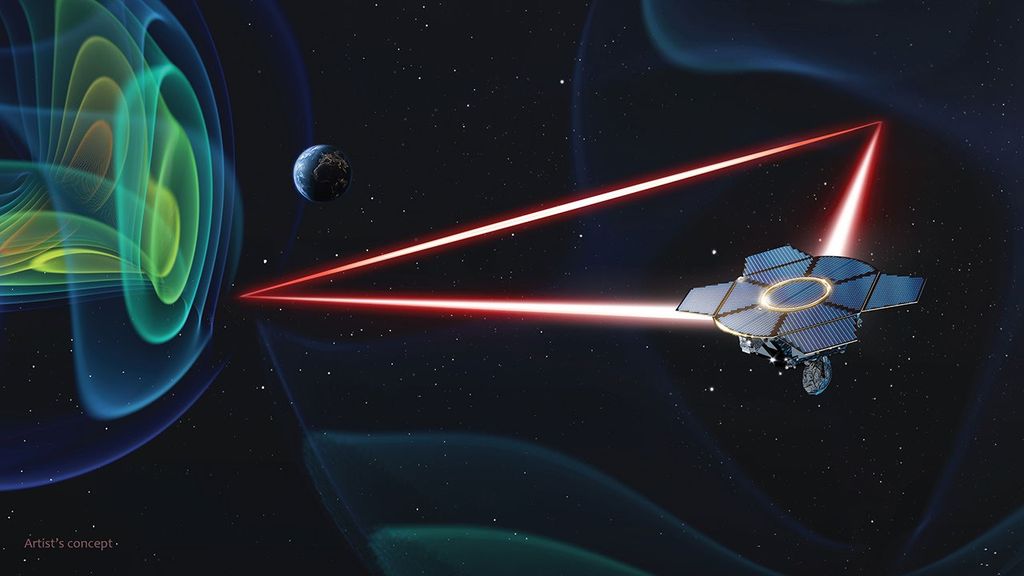
- “Photonic Processor for High-Speed, High-Bandwidth On-Orbit Computing,” Mohammad Ali Miri, Rochester Institute of Technology
- “Quantifying Organic Solubility in Titan-Analog Environments through Simulation and Experiment,” Paul Nerenberg, Claremont McKenna College
- “COMPASS: Building a NASA-Academic Partnership for Training the Next Generation of Scientists through Defect-Engineered WS2 Gas Sensors,” Burcu Ozden, Pennsylvania State University
- “Cosmic Neighborhoods: Roman-Ready Tools for Linking Galaxy Environments and Star Formation Histories,” Jesus Pando, De Paul University
- “RISE-C: Rural Institute for Space Science and Engineering Collaboration,” Lanika Ruzhitskaya, Saint Francis University
- “KERR: Knowledge and Education in Relativistic Reflection - A Complete Methodology for Systematically Measuring Black Hole Spins,” Aarran Shaw, Butler University
- “Using TEMPO Satellite Data to Assess Ozone Injury to Plants in Atlanta, Georgia while Building a Student Research Pipeline at Spelman College,” Jessica Terrien Dunn, Spelman College
- “Robust Photometric Redshift Inference for Roman-Scale Surveys Using Ensemble Machine Learning,” Branislav Vlahovic, North Carolina Central University
- “Experimental Determination of Temperature-Dependent Viscosity in Binary and Ternary Mars-Relevant Magnesium Brines,” Timothy Ward, Millsaps College
- “Preparing to Unveil the Nature of Dark Energy using Initial Images from the Nancy Grace Roman Space Telescope,” Charlotte Wood, North Carolina Agricultural & Technical State University