
















NASA Selects Projects to Engage Communities Across the US With NASA Science
NASA’s Science Mission Directorate (SMD) has selected the next portfolio of Science Activation project teams through the ROSES‑25 (F.6 Science Activation) solicitation.
Science Activation is a nationwide network of competitively-selected, collaborative projects that extend the impact of NASA science by connecting people and communities – many of whom would not otherwise meaningfully engage – with NASA science data and experts, local partnerships, and authentic science experiences. These sustained, community-embedded, and relevant opportunities and resources enable widespread involvement and participation - doing NASA science - inspiring the future STEM workforce and changing lives.
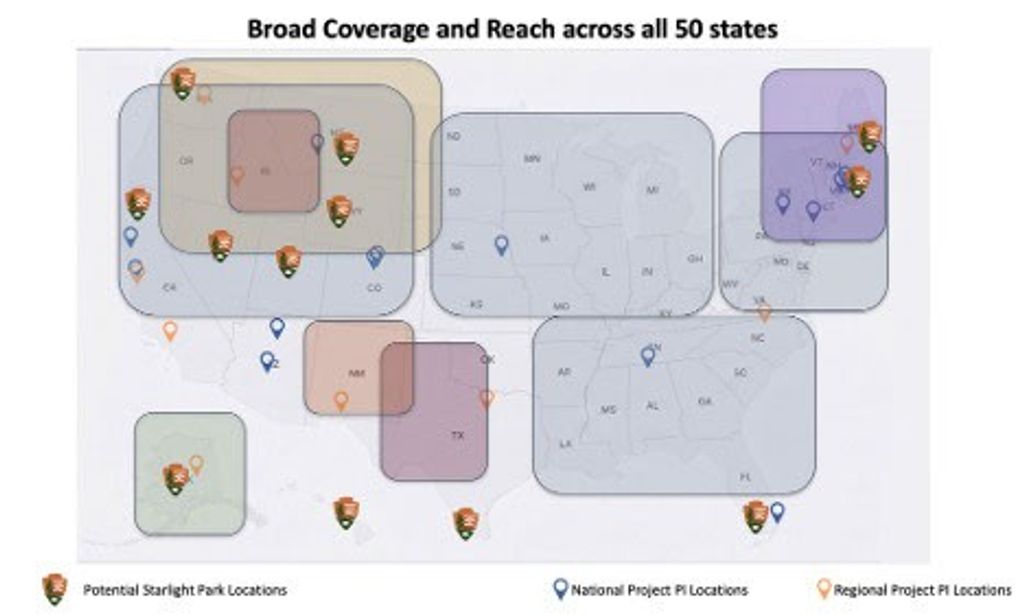
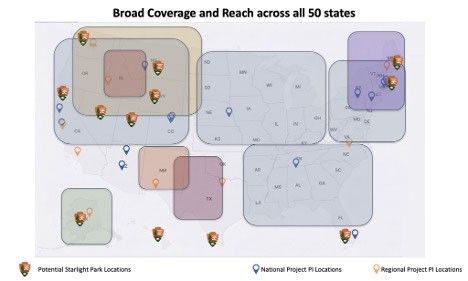
NASA has awarded approximately $23 million to the 24 organizations that make up this new cohort of projects to begin their work. The portfolio spans all five SMD science divisions – Astrophysics (APD), Biological & Physical Sciences (BPS), Earth Science (ESD), Heliophysics (HPD), and Planetary Science (PSD) – and will operate across all 50 states plus U.S. territories, reach people of all ages and backgrounds, include both formal and informal learning organizations, and engage community partners to deepen and extend reach and impact. SciAct accomplishes this in several ways, including:
Authentic participation & open science
Hands‑on research, data-rich analysis, and participatory/community science activities help people build skills to use NASA data and contribute to accelerating scientific discovery.
Developing the future STEM workforce
Many teams emphasize Artificial Intelligence/Machine Learning, coding, sensors, geospatial analysis, data literacy, engineering design, and modeling – skills essential for NASA missions and the commercial space economy.
National reach and community partnership
SciAct teams have historically reached learners in all 50 states, all U.S. territories, and communities not typically served – expanding access through intentional cross-collaboration, multiple local and regional partnerships, informal learning venues, and digital platforms.
Science Activation Selections (ROSES‑25)
The following selections are organized as National Portfolio Projects (broad, scalable reach) and Regional Network Projects (place‑based, community‑led engagement). Each project includes the project name, a short description, the Principal Investigator (PI), the Lead Organization, and the project’s aligned NASA SMD divisions.
Regional Network Projects
Learn, Experience, Contribute: A Network Approach to Engage Educators, Youth, and Communities with NASA Science
PI: Peake · Lead Organization: Gulf of Maine Research Institute · Divisions: ESD
Connected learning ecosystems across the Northeast that engage youth in data-rich, place-based investigations incorporating NASA science and data.
Arctic Learning and Engagement with NASA Data for Community Solutions (Arctic LENS)
PI: Spellman · Lead Organization: University of Alaska Fairbanks · Divisions: ESD
Community-centered, mission-connected learning network that enables learners of all ages to apply NASA Earth science data to local challenges around food, energy, and water systems.
Dark Skies to Deep Time: Connecting Astronomy and Geology Through a West Texas Dark‑Sky Landscape
PI: Mayne · Lead Organization: Texas Christian University · Divisions: ESD, PSD
Connects dark-sky astronomical observation, meteorite science, impact geology, and planetary defense into a unified informal science learning program anchored to the 2029 close approach of asteroid Apophis.
STEM Career Exploration Camps: Champion Teachers Bring NASA Science to All Through 3D‑Printed Astronomical Models
PI: Madura · Lead Organization: San José State University · Divisions: APD, BPS, HPD, PSD
Uses a combination of 3D printing, hands-on astronomy, and teacher Professional Development to use astrophysics as an evidence-based way to deepen participation in NASA science.
Solar Stories Studio: Place‑Based Heliophysics STEAM Engagement for Grades 4–8
PI: Chatterjee · Lead Organization: New Mexico State University · Divisions: HPD
Modules built from NASA imagery, Sun—Earth system data visualizations, and curated heliophysics resources to prevent student disengagement from science during the middle grades, in a state with high need for STEM workers but low science scores.
Building Sustained Participation in STEM Pathways through Coordinated, Place‑Based Engagement in Authentic NASA Science and Engineering
PI: Snowden · Lead Organization: Central Washington University · Divisions: BPS, ESD, PSD
Coordinated, multi-state STEM ecosystem that connects students and educators with authentic NASA science content, data, and subject matter experts. Student challenges with Companion Course and a supply loan program that reduces cost barriers.
Researchers Inspiring Public Participation in Lake Education and Science (RIPPLES)
PI: Yelton · Lead Organization: University of North Carolina at Chapel Hill · Divisions: ESD
Multi-faceted science learning that uses local lakes to engage and inspire educators, citizen scientists, and other lay publics around the water cycle.
The NASA Starlight Parks Network: Bringing NASA Science to America’s National Parks
PI: Hummels · Lead Organization: California Institute of Technology · Divisions: APD, HPD, PSD
Establishes the NASA Starlight Parks Network, a partnership between NASA and the National Park Service to enhance NPS programming while delivering high-impact, place-based engagement with NASA science.
The Central Idaho Dark Sky Reserve STEM Network
PI: Jackson · Lead Organization: Boise State University · Divisions: APD
Astronomy engagement in partnership with an internationally-recognized dark sky reserve in an under-served area. Provides telescopes and training to teachers around the state.
National Portfolio Projects
ARK (Antarctic Resilience and Knowledge): A Collaborative Network for Discovery and Education of Antarctica’s Iconic Species and Their Changing Habitats
PI: Stammerjohn · Lead Organization: University of Colorado Boulder · Divisions: ESD
Leverages very high-resolution remote sensing data to accelerate polar science through authentic experiences for citizen scientists. Integrates machine learning with humans in the loop.
Tactile Opportunities for Understanding Cosmic Horizons (TOUCH) Science
PI: Ray · Lead Organization: University of Nebraska–Lincoln · Divisions: APD, ESD, PSD
Creates 3D models of planetary and Earth science phenomena to help students develop an understanding of spatial relationships, relative sizes and distances, orbital structures, as well as variations in density and internal structures.
NASA Science and Engineering for All: Pathways for Teen Participation in NASA Science
PI: Cominsky · Lead Organization: Sonoma State University · Divisions: APD, ESD, HPD, PSD
Expand access to authentic NASA science experiences for underserved teens, particularly those in rural or economically disadvantaged communities and those with learning differences.
Amplifying OpenSpace: Building Community to Disseminate a Universe of Data
PI: Kinzler · Lead Organization: American Museum of Natural History · Divisions: APD, ESD, HPD, PSD
Open-source interactive data visualization of the entire known universe deployed and available through a network of informal science institutions (ISI). Creates a national pipeline of NASA science and discoveries.
Growing Beyond Earth: Science Activation Through Distributed Space Crop Research
PI: Lewis · Lead Organization: Fairchild Tropical Botanic Garden · Divisions: BPS
Mobilizes students and educators in plant growth research that informs NASA’s early-stage crop evaluation pipeline.
ASCEND (Aerial Science, Collaboration, and Education Network for Discovery) 2027–2029
PI: Walach · Lead Organization: Montana State University · Divisions: ESD
Expands access to hands-on Earth science and engineering experiences for 2-year-college and undergraduate students that contribute to NASA investigations of atmospheric processes using high altitude balloons, radiosondes, and uncrewed aircraft systems.
Planetary Learning that Advances the Nexus of Engineering, Technology, and Science (PLANETS)
PI: LeMer · Lead Organization: Northern Arizona University · Divisions: APD, BPS, ESD, HPD, PSD
Out-of-school-time STEM units integrating NASA planetary science and engineering designed for wide use across the country. Includes units on astronaut geology for the Moon and planetary defense.
NASA SMD Community of Practice for Education (SCoPE)
PI: Swann‑Kreiter · Lead Organization: Arizona State University · Divisions: APD, BPS, ESD, HPD, PSD
A coordinated system that moves subject matter engagement from episodic to sustained in ways that advance participation in scientific discovery and science literacy.
Sungrazer 2.0: From Armchair Discovery to Data‑Driven Comet Science
PI: Severino · Lead Organization: ARISA Lab, LLC · Divisions: HPD, PSD
Expands access to NASA heliophysics data, supporting STEM skill development through authentic engagement. Provides scaffolded pathways for meaningful contributions to NASA science. Discovery of unknown comets around the Sun.
Discovering the SPARC: Space Physics through Amateur Radio Communications
PI: Frissell · Lead Organization: University of Scranton · Divisions: HPD
Brings hands-on space weather science to communities nationwide through NASA learning materials and amateur radio equipment. Entrains high schools in a national research network.
Data to Dome: From Scientific Discovery to Immersive Experience
PI: Weigel · Lead Organization: Alabama Space Science · Divisions: APD, ESD, HPD, PSD
Establishes a scalable system for delivering live, data-driven NASA science experiences through planetaria, and extends engagement through digital assets and interactive tools for mobile devices.
Telescopes for All: Promoting Audience Engagement with NASA Science via Participatory Data Experiences Using Robotic Telescopes
PI: Dussault · Lead Organization: Smithsonian Astrophysical Observatory · Divisions: APD, PSD
Expands public access to authentic astronomical research experiences through a coordinated, user-friendly network of professional robotic telescopes. Allows people to observe, analyze, and contribute to NASA-aligned research.
NASA Community College Network: From Earth to Space
PI: Steel · Lead Organization: SETI Institute · Divisions: APD, ESD, HPD, PSD
Resource network for the teaching of NASA science in the nation’s community college system, including facilitation of a peer community connecting generally isolated science instructors across institutions and states.
Cosmic Data Stories: Making Sense of NASA Data from Earth to the Edge of the Universe
PI: Goodman · Lead Organization: Harvard College · Divisions: APD, ESD, PSD
Creation of online, interactive experiences to explore NASA data and build literacy and STEM skills. Multiple levels of engagement; topics tied to key NASA missions and research areas.
Tiny Scientists, Big Universe: Developing Nature‑Based Science Foundations and Data Literacy through NASA Collaborations with Early Childhood Learners, Educators, and Scientists at Play
PI: Malmberg · Lead Organization: University Corporation for Atmospheric Research · Divisions: APD, BPS, ESD, HPD, PSD
Develops nature-based science foundations and data literacy through NASA collaborations with early childhood learners, educators, and scientists to connect young children with NASA science.