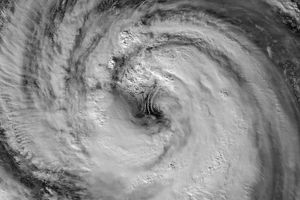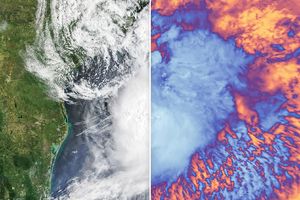






























The Tropical Rainfall Measuring Mission (TRMM) satellite took this imageof Cyclone Beni at 16:20 UTC on November 12, 2003, as the storm strengthened in the central Indian Ocean. At the time of this overpass, Beni was still classified as a tropical storm with winds estimated at over 60 mph by the Joint Typhoon Warning Center.
The image shows Beni from above with rainfall rates from the TRMM Precipitation Radar (PR) in the inner swath and the TRMM Microwave Imager (TMI) in the outer swath overlaid on infrared data from the TRMM Visible Infrared Scanner (VIRS) in white. The rainfall data shows that Beni appears to have a closed eye with mainlymoderate rainrates (green areas) along the northern eyewall with surroundingrainbands to the south, east and north (blue areas). The VIRS data shows asymmetrical storm indicative of low wind shear. This in combination withthe heat being released from the moderate rainfall rates near the stormâscore mean that conditions are favorable for possible storm strengthening, as was seen in a later image.
TRMM helps to provide scientists and forecasters with valuable information on storms that are well out to sea, outside the range of coastal radars and not easily accessible by aircraft. TRMM is a joint mission between NASA and the Japanese space agency NASDA.
References & Resources
Images produced by Hal Pierce (SSAI/NASA GSFC) and caption by Steve Lang (SSAI/NASA GSFC)