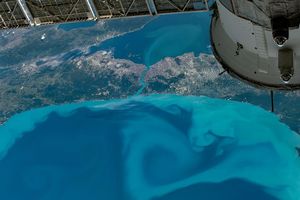






























Phytoplankton form brilliant swirls of green in the Barents Sea north of Norway. Phytoplankton are microscopic marine organisms that thrive in nutrient-rich cold waters. The striking turquoise color is caused in part by sunlight reflecting off of chlorophyll in the phytoplankton, which (like terrestrial plants) use the process of photosynthesis to create carbohydrates from carbon dioxide and water. The brightness of the color indicates that the plants are probably coated with calcium carbonate, white chalk, which makes the water appear a bright blue in satellite imagery. Phytoplankton blooms are common in the Barents Sea in the summer, after winterâs ice has receded from the region.
The Moderate Resolution Imaging Spectroradiometer (MODIS) on NASAâs Aqua satellite acquired this image on July 27, 2004. The large image provided above is at MODISâ maximum resolution of 250 meters per pixel. It is available from the MODIS Rapid Response Team in additional resolutions.
References & Resources
NASA image courtesy Jeff Schmaltz, MODIS Land Rapid Response Team at NASA GSFC