

















August 20, 2014-August 9, 2019
Retreat Begins at Taku Glacier
For nearly four decades, Mauri Pelto has been studying the advance and retreat of glaciers around the globe. He has watched them succumb, one-by-one, to rising temperatures. Of 250 glaciers that he has watched, all had retreated (or shortened) except one: Taku Glacier.
Now a new analysis shows that Taku has lost mass and joined the rest of the retreating glaciers. “This is a big deal for me because I had this one glacier I could hold on to,” said Pelto, a glaciologist at Nichols College. “But not anymore. This makes the score climate change: 250 and alpine glaciers: 0.”
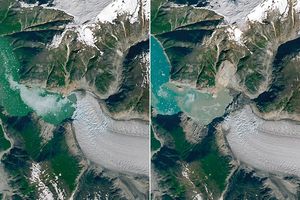
The natural-color images above show the glacier on August 20, 2014, and August 9, 2019. The images were acquired by the Operational Land Imager on Landsat 8. Though subtle, the changes are most visible at the boundaries between the glacier and river.
Taku stands north of Juneau, Alaska, and is one of 19 notable glaciers in the Juneau Icefield. (The area also includes the famous Mendenhall Glacier, which has experienced an unusually fast retreat—about one third of a mile in the past decade.) Taku is extremely thick: In fact, it is one of the thickest known alpine glaciers in the world, measuring 4,860 feet (1,480 meters) from surface to bed. It is also the largest glacier in the Juneau Icefield.
Using satellite imagery, aerial photography, and GPS field mapping, glaciologists with the Juneau Icefield Research Program (JIRP) have been tracking the thickness of Taku’s annual snow layer since 1946. Pelto has personally observed the glacier over a span of three decades, and even spent six months living on the glacier in huts and tents with JIRP in the 1980s.
In his latest research, he used Landsat imagery to look at changes in the transient snowline—the boundary where snow transitions to bare glacier ice. At the end of the summer, the height of the snowline represents the point where the glacier experienced an equal amount of melting and snow accumulation. If a glacier experiences more melting than snow accumulation in a season, the glacier’s snowline migrates to higher altitudes. Researchers can calculate net changes in glacier mass by tracking the shift of the snow line.
For half a century, the Taku Glacier was the only glacier in the Juneau Icefield that did not experience a net loss in mass. In fact, Pelto and colleagues found that the glacier was advancing and gaining mass at around 0.42 meters (1.4 feet) per year from 1946-1988. But by 1989, glacier thickening slowed down significantly; eventually, the researchers noticed some thinning. The terminus also slowed its advance and then stalled.
Usually glaciers experience a transition period, with decades of terminus stability before switching from an advancing phase to a retreating phase. For instance, the Baird Glacier in nearby Glacier Bay stopped advancing and stood still for three decades before it began showing signs of retreat.
“We thought the mass balance at Taku was so positive that it was going to be able to advance for the rest of the century,” said Pelto. “A lot of times, glaciers will stop advancing for quite a few years before retreats starts. I don’t think most of us thought Taku was going to retreat so quickly.”
But it did. Taku Glacier had a short pause (2013-2018), then it began retreating in 2018. That year, Pelto and colleagues observed the highest transient snowline and mass loss in Taku Glacier’s history. The changes coincided with record summer temperatures in Alaska.
“To be able to have the transition take place so fast indicates that climate is overriding the natural cycle of advance and retreat that the glacier would normally be going through,” said Pelto. “Taku Glacier is being exposed to melting it hadn’t before, which will drive new changes.”
References & Resources
- AGU Blogosphere: From a Glacierâs Perspective (2019, October 9) Taku Glacier, Alaska Retreat Begins: A Two Century Long Advance Reversed by Climate Change. Accessed November 4, 2019.
- Pelto, M. (2019) Exceptionally High 2018 Equilibrium Line Altitude on Taku Glacier, Alaska. Remote Sensing for Climate Change Studies. 11 (20) , 2378.
- From a Glacierâs Perspective (2010, May 6) Taku Glacier Equilibrium Line Altitude Summer Rise. Accessed November 4, 2019.
NASA Earth Observatory images by Lauren Dauphin, using Landsat data from the U.S. Geological Survey. Story by Kasha Patel.