



















March 6, 2002-February 2, 2022
Antarctic Berg Grounded for Decades
The journey of every Antarctic iceberg is unique. Some drift many thousands of kilometers in the Southern Ocean before disintegrating and melting away. Others, like Iceberg B-22A, stay closer to home. In the span of 20 years, B-22A has strayed just 100 kilometers (60 miles) from its birthplace, the floating ice tongue of Thwaites Glacier.
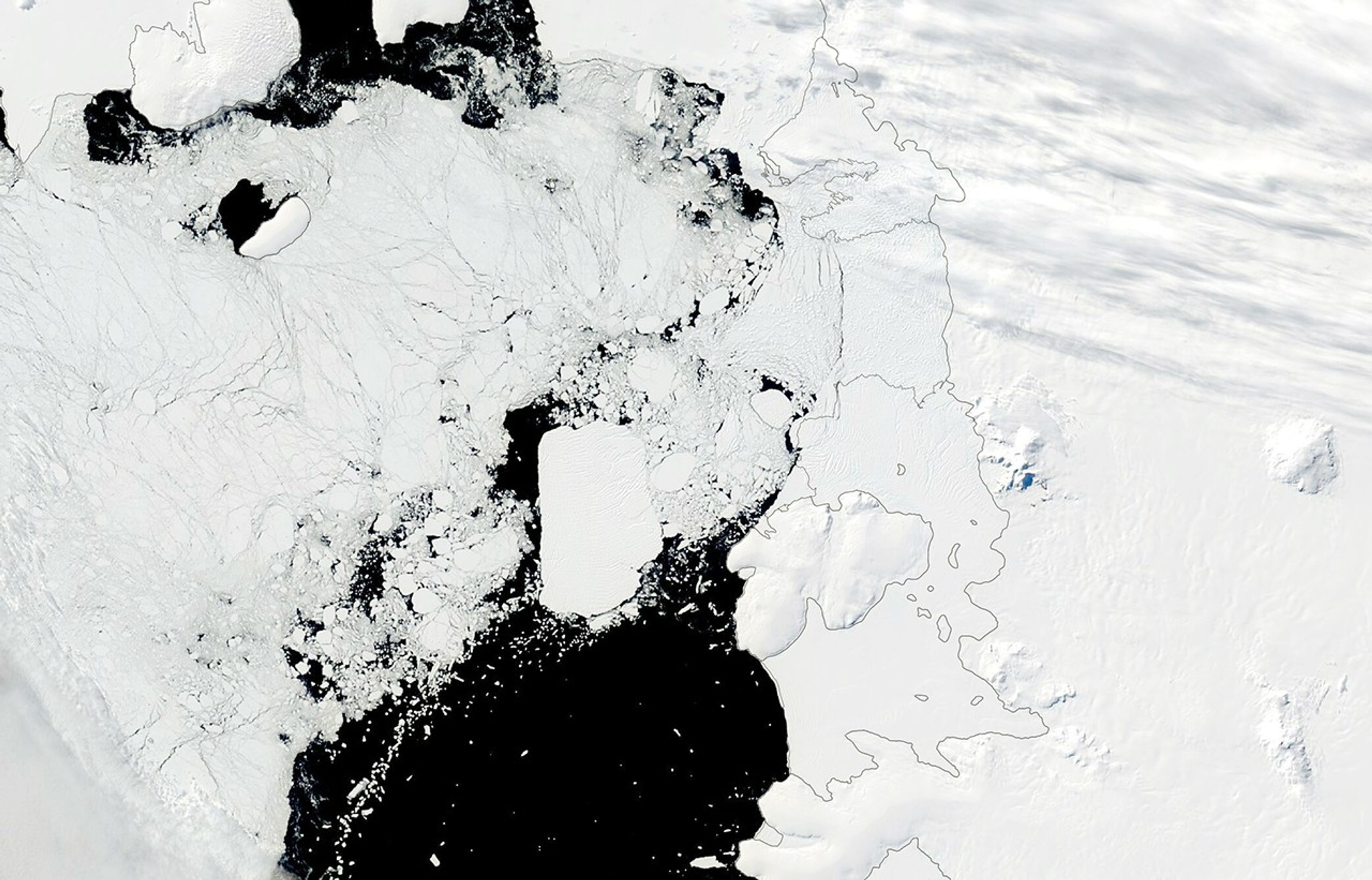
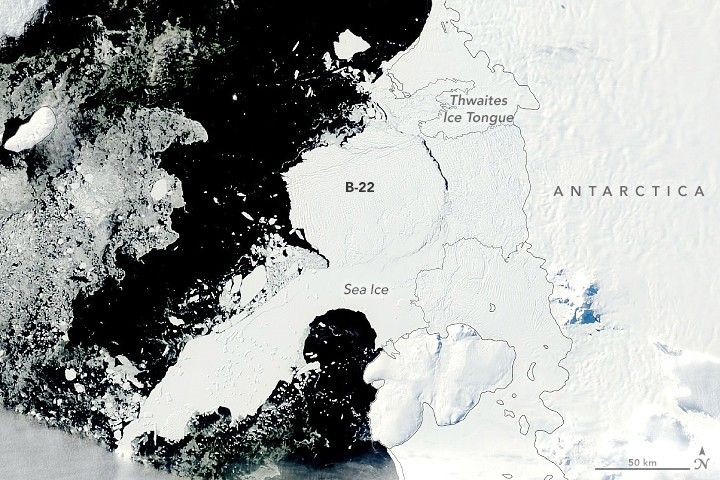
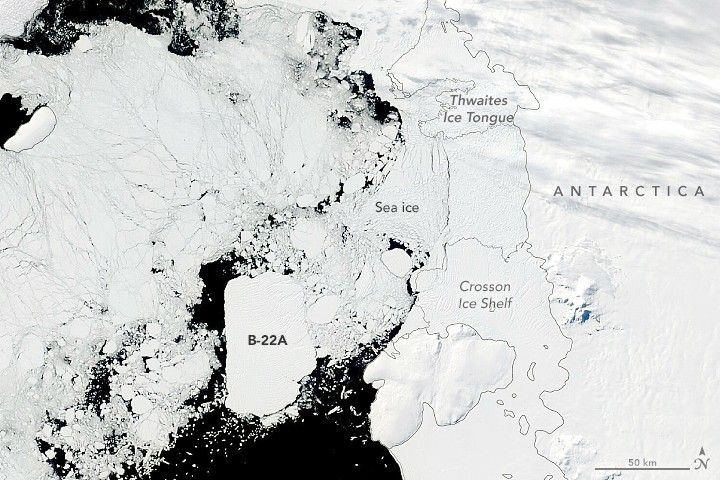
These images, acquired with the Moderate Resolution Imaging Spectroradiometer (MODIS) on NASA’s Terra satellite, show the iceberg around the time it broke from the shelf in March 2002 and two decades later in February 2022.
Notice the wide rift in the March 2002 image where the berg was detaching from the ice tongue. At the time that it broke away, Iceberg B-22 measured 85 kilometers (53 miles) long and 64 kilometers (40 miles) wide—about twice the size of Rhode Island. A few sizable pieces broke off from the berg, and the main piece was renamed B-22A. Two decades later, the berg still measures 71 kilometers (44 miles) by 45 kilometers (28 miles).
After the initial break, the ice tongue accelerated and caught up to the drifting berg, giving it a push out to sea. But overall, B-22A has not moved far, as it is stuck or “grounded” in a relatively shallow part of the Amundsen Sea.
Studies have shown that the grounded iceberg plays an important role in stabilizing sea ice in the area. In some years, a band of landfast sea ice has anchored to the iceberg and ice tongue. This landfast ice is thought to help buttress the Thwaites ice tongue and ice shelf, slowing the flow of ice toward the sea.
Plenty of sea ice persisted in the area throughout the austral summer of 2022, but instead of landfast ice, it consisted primarily of broken sea ice and icebergs, or “mélange.” Scientists were sidetracked this season from an international project to study Thwaites Glacier because sea ice and icebergs blocked ships from accessing the ice shelf. A series of bergs—smaller than B-22A but larger than the pieces now breaking from modern-day Thwaites—are visible near the edge of the Crosson Ice Shelf, which spawned them.
Though B-22A remains grounded, plenty has changed in the area since 2002. The ice tongue stopped advancing and has retreated substantially, as it continues to fracture and separate from the Thwaites Eastern Ice Shelf. And the icebergs that now break from Thwaites are generally not large enough to be named and tracked by the U.S. National Ice Center. Instead, the glacier is constantly producing many small broken bits. As Ted Scambos, a senior scientist at the University of Colorado, said in 2020: “What the satellites are showing us is a glacier coming apart at the seams.”
References & Resources
- AP News (2022, February 2) Giant iceberg blocks scientistsâ study of âDoomsday Glacierâ. Accessed February 28, 2022.
- CNN (2002, March 19) New giant iceberg adrift near Antarctica. Accessed February 28, 2022.
- The Conversation (2021, December 22) Antarcticaâs âdoomsdayâ glacier: how its collapse could trigger global floods and swallow islands. Accessed February 28, 2022.
- Miles, B. W. J. et al. (2020) Intermittent structural weakening and acceleration of the Thwaites Glacier Tongue between 2000 and 2018. Journal of Glaciology, 66 (257), 485-495.
- NASA Earth Observatory (2020, February 6) Thwaites Glacier Transformed.
- Stammerjohn, S. E. et al. (2015) Seasonal sea ice changes in the Amundsen Sea, Antarctica, over the period of 1979â2014. Elementa: Science of the Anthropocene, 3, 000055.
NASA Earth Observatory images by Lauren Dauphin, using MODIS data from NASA EOSDIS LANCE and GIBS/Worldview . Story by Kathryn Hansen with image interpretation by Christopher Shuman, NASA/UMBC.