







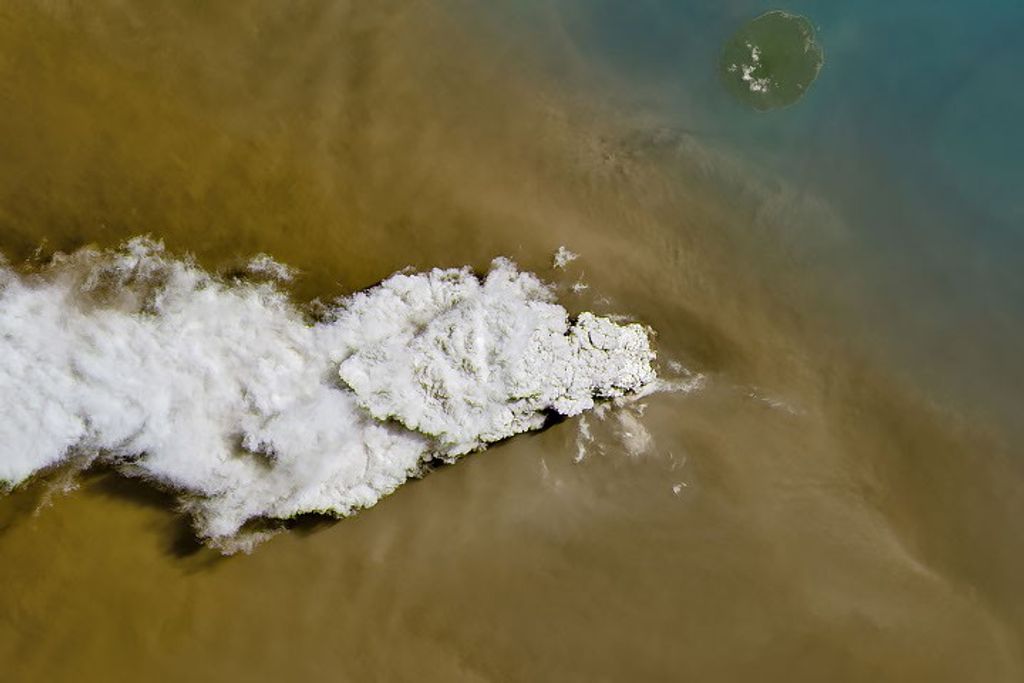










An astronaut aboard the International Space Station took this photograph of cloud formations while orbiting over the Crozet Islands, a part of the French Southern and Antarctic Lands located halfway between South Africa and Antarctica. Visible above the mountainous islands are a series of wave clouds that had formed in the lower atmosphere.
The region around the Crozet Islands has produced similar cloud formations in the past. For example, they were visible in images acquired in 2012 and 2014. Wave cloud formations over these islands are a result of stable air masses over the South Indian Ocean flowing over and around the mountainous island terrain.
When wind blows past a mountain, the air ascends the windward side causing the air to cool and its pressure to decrease. This allows moisture in the air to condense to form water vapor and clouds. As the stable air passes over the mountain peak, it is first pushed upwards; however, gravity then pulls the moist air downwards on the leeward side. The force exerted by the gravity compresses and warms the air, causing moisture in the air to evaporate.
Wave clouds are produced when the warm air on the leeward side is pushed back upwards. The rising movement causes the moisture in the air to recondense and form more clouds, before it is forced back downward by gravity and evaporates again. The cycle repeats and forms a ripple pattern like those seen in this image.
The Crozet Islands are not permanently inhabited, but they serve as a remote site for scientists studying Earth science, zoology, and ecology. One such scientific base is the Alfred-Faure research station on the Île de la Possession, where scientists specialize in studying populations of king penguins (Aptenodytes patagonicus) in addition to other birds and mammals that live on the island.
References & Resources
Astronaut photograph ISS068-E-39246 was acquired on January 8, 2023, with a Nikon D5 digital camera using a focal length of 50 millimeters. It is provided by the ISS Crew Earth Observations Facility and the Earth Science and Remote Sensing Unit, Johnson Space Center. The image was taken by a member of the Expedition 68 crew. The image has been cropped and enhanced to improve contrast, and lens artifacts have been removed. The International Space Station Program supports the laboratory as part of the ISS National Lab to help astronauts take pictures of Earth that will be of the greatest value to scientists and the public, and to make those images freely available on the Internet. Additional images taken by astronauts and cosmonauts can be viewed at the NASA/JSC Gateway to Astronaut Photography of Earth. Caption by Cadan Cummings, Jacobs, JETS Contract at NASA-JSC.