













NAAMES-II Expedition: May 24, 2016
A Peek into the Inner Space of the North Atlantic
Thinking of a “NASA mission” generally conjures images of a telescope pointed towards outer space visualizing a myriad of stars, planets and other celestial bodies. However, NASA’s NAAMES mission turns it focus, quite literally, from outer space to the Earth’s inner space, the North Atlantic Ocean. Using microscopes rather than a telescope, scientists on board the Research Vessel Atlantis have been producing images of marine microbes that at first glance look quite similar to the night sky, provoking similar feelings of wonder and intrigue.
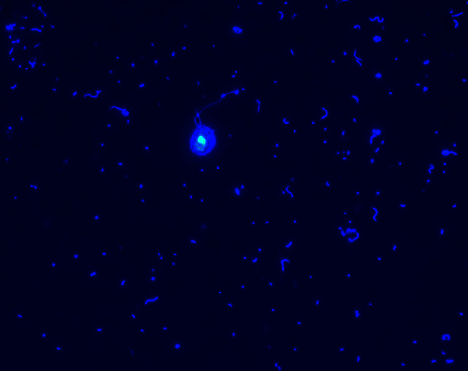
However, this celestial view is dominated by bodies that are less than one millionth of a meter. In one drop of seawater, there are about one million heterotrophic bacterioplankton and up to tens of thousands of photosynthetic microbes. When we apply this estimate to the volume of the entire North Atlantic Basin, we can easily imagine the open sea teeming with life. Though each of these “bugs” live on timescales of days and work on scales of nanometers (billionth of a meter), there are so many of them and they grow so quickly that they affect ocean chemistry on the scales of ecosystems and seasons, as we are witnessing in the North Atlantic during the Spring.
Nick Huynh (graduate researcher) and I (as well as many others on board) are keenly interested in these microbes, specifically the bacterioplankton, because they are the drivers of large-scale biogeochemical cycles on our planet. The way the ocean absorbs and retains carbon largely depends on the growth of microbes and their distribution along the vertical water column, between the ocean surface and abyss. Our individual project (sponsored by the National Science Foundation) has partnered with this NASA mission to investigate marine microbes and their interaction with dissolved organic compounds within the oceanic water column.
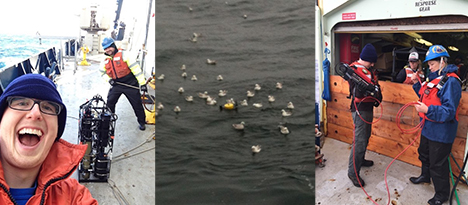
The North Atlantic is the site of one of the largest phytoplankton blooms on the planet and we are fortunate to be at the right place at the right time. Over the past couple of weeks, we have witnessed the spring phytoplankton bloom “spinning up”. The entire research group is using the floating laboratory of the Research Vessel Atlantis, benefiting from its oceanographic capabilities to reach down into the ocean’s inner space (as deep as 1500 meters) and grab biological and chemical samples that will allow us to decipher how the microbial life regulates ocean.
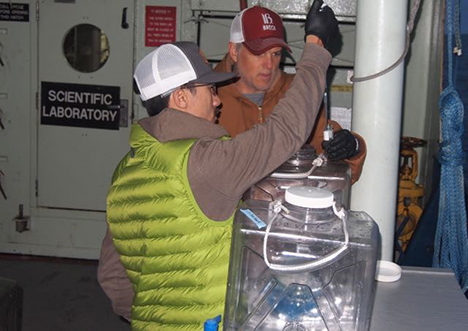
We are conducting experiments at sea that combine tools from ecology, molecular biology, and chemistry to look at how bacterioplankton consume the organic substrates available to them. By examining microbial behavior, we can learn more about how the ocean’s “inner space” functions and how biology helps govern the movement of carbon throughout the planet.
Written by Craig Carlson and Nick Huynh
