
























NAAMES-III Expedition: September 10, 2017
The response of cloud characteristics to increasing aerosol concentrations represents one of the largest uncertainties in our current understanding of climate change. We need to better understand the ability of aerosol particles to act as cloud condensation nuclei (CCN) under relevant atmospheric conditions. CCN activation is determined by particle size, composition, and water vapor supersaturation. Texas A&M University is gathering CCN data throughout the NAAMES III cruise. This data can be compared to data collected on the previous two cruises and can be compared to the CCN data collected by the C-130 aircraft. During NAAMES III the C-130 flight patterns were altered to provide better aerosol data that can be utilized by aerosol groups on the R/V Atlantis.
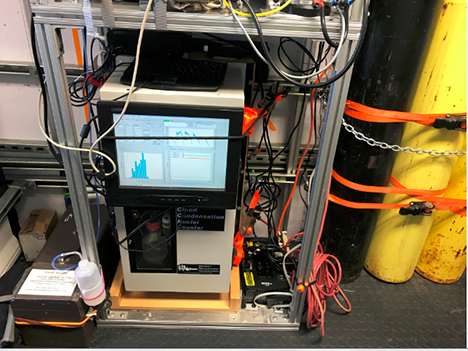
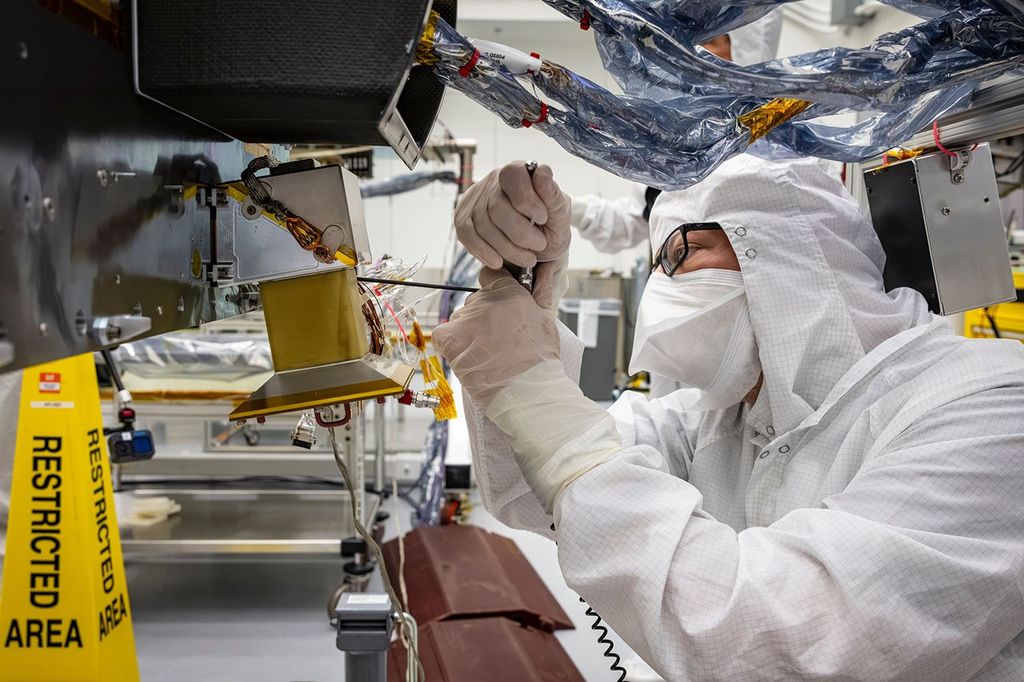
In our current setup, there is a condensation particle counter (CPC) located before the CCN. The CPC detects and counts aerosol particles by first enlarging the particles. The particles come into contact with butanol and then expand to a size that is more easily detected. This setup allows us to see the total number of particles being counted compared to the number of particles that are able to activate as CCN. The data will provide information on the conditions when particles are more easily activated as CCN.
Written by Brianna Hendrickson
