



















In East Asia, the arrival of spring means warming temperatures, greening vegetation, and blooming flowers. But March and April also bring another guest: vast plumes of dust that stream east from the Gobi and Taklamakan deserts and across parts of eastern China, the Korean Peninsula, and southern Japan.
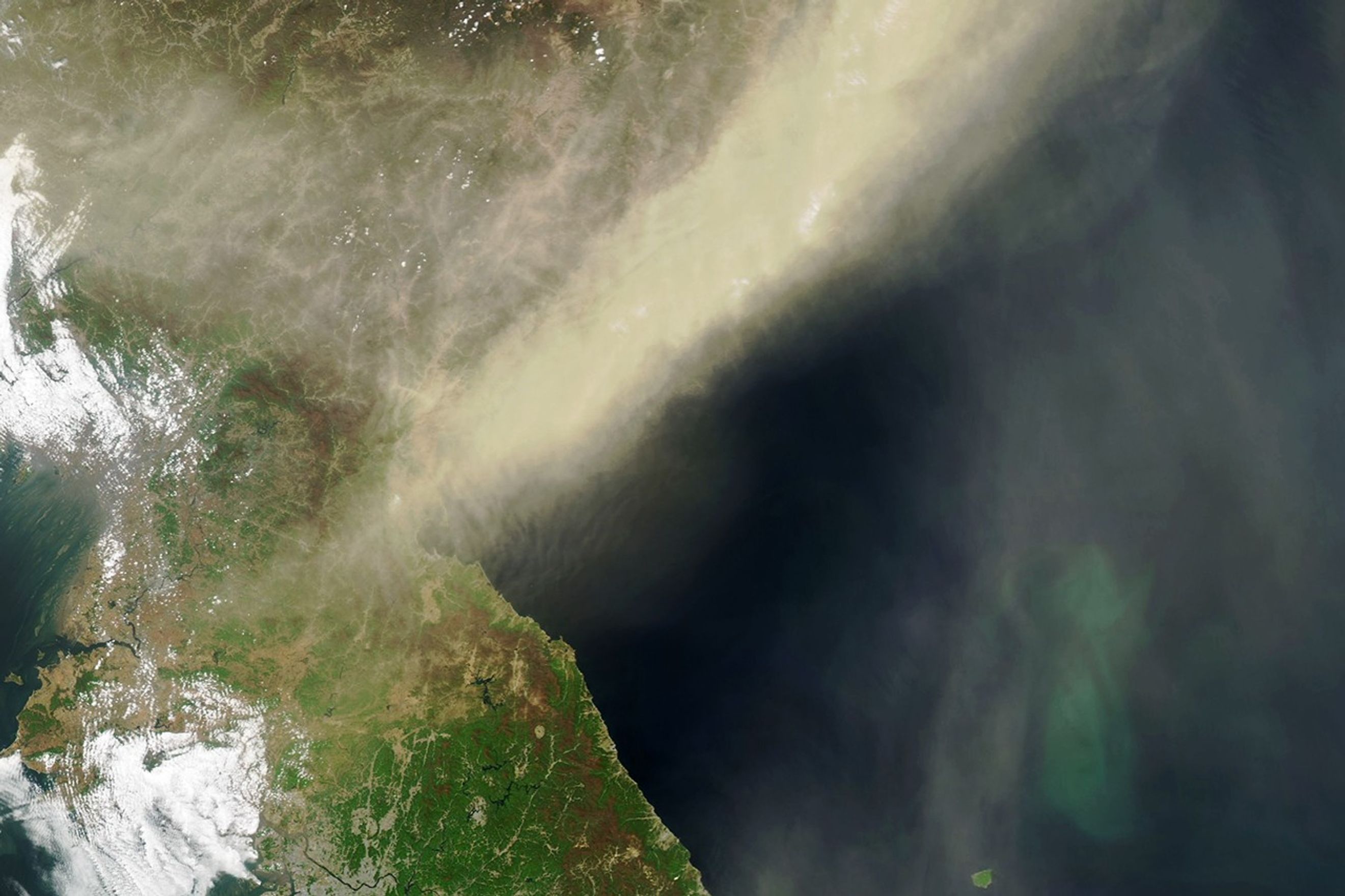
The MODIS (Moderate Resolution Imaging Spectroradiometer) sensor on NASA’s Aqua satellite captured this image of a wall of dust moving across the Korean Peninsula on April 25, 2024. Images collected on April 24 from South Korea’s GEO-KOMPSAT-2A satellite and from NASA’s Terra and Aqua satellites show the source of much of the dust to be the Gobi Desert of Inner Mongolia. A phytoplankton bloom, partially obscured by dust, is also visible east of the Korean Peninsula.
Winds sometimes loft the region’s dust high in the atmosphere, at times above the clouds, allowing dust particles to cross the Pacific Ocean and settle over North America. Other times, the lofted particles stay close to the surface and degrade air quality for millions of people in East Asia, one of the most densely populated regions in the world.
Breathing significant amounts of dust can exacerbate cardiovascular and respiratory disease. One team of NASA scientists based at NASA’s Goddard Space Flight Center has estimated that exposure to high levels of fine particulate matter (PM2.5) contributes to nearly 3 million premature deaths per year globally, with about a fifth of those deaths linked specifically to dust.
NASA researchers have picked up on some changes in dust activity in the Gobi and Taklamakan deserts. A past analysis of nearly two decades of data from the Terra and Aqua satellites found that this was the only region in the world where levels of atmospheric dust have declined since the start of the study period in 2003.
The reasons for this decline are unclear, but it is likely related to the weakening of surface winds since 2001, according to one analysis. Other research has emphasized land management and greening of the landscape as being important factors.
References & Resources
- EO Kids Dust: A True World Traveler. Accessed April 25, 2024.
- NASA Earth Observatory (2012, August 3) Dust Dominates Overseas Aerosol Imports to North America. Accessed April 25, 2024.
- NASA Earth Observatory (2020, January 21) A Decline in Asian Dust. Accessed April 25, 2024.
- NASA Earth Observatory (2019, February 12) China and India Lead the Way in Greening. Accessed April 25, 2024.
- Nature (2024, April 15) Lethal dust storms blanket Asia every spring—now AI could help predict them. Accessed April 25, 2024.
- NOAA (2024, April 24) Sandstorm Sweeps Across the Gobi Desert. Accessed April 25, 2024.
- Song, H., et al. (2016) Spatial and temporal variations of spring dust emissions in northern China over the last 30 years. Atmospheric Environment, 126, 117-127.
- Wang, S., et al. (2021) Weakened dust activity over China and Mongolia from 2001 to 2020 associated with climate change and land-use management. Environmental Research Letters, 16, 124056.
- Wu, C., et al. (2022) Drivers of recent decline in dust activity over East Asia. Nature Communications, 13, 7105.
- Yang, A., et al. (2022) Global premature mortality by dust and pollution PM2.5 estimated from aerosol reanalysis of the modern-era retrospective analysis for research and applications, version 2. Frontiers in Environmental Science, 10.
- Yu, H., et al. (2020) Interannual variability and trends of combustion aerosol and dust in major continental outflows revealed by MODIS retrievals and CAM5 simulations during 2003-2017. Atmospheric Chemistry Physics, 20, 139-161.
NASA Earth Observatory image by Michala Garrison, using MODIS data from NASA EOSDIS LANCE and GIBS/Worldview . Story by Adam Voiland .