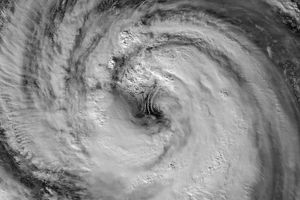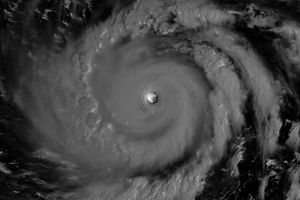






















Typhoon Xangsane formed on September 25, 2006, in the western Pacific near the coast of the Philippine Islands. Over the next 36 hours, it grew from a tropical depression (area of low air pressure) to a typhoon. The typhoon crossed the Philippines and was credited for causing 76 deaths there before crossing the South China Sea and coming ashore in central Vietnam on October 1, according to the Agence France-Presse news service. As the storm came ashore in central Vietnam, it packed winds of 148 kilometers per hour (92 miles per hour), causing another six deaths and many injuries. Vietnamese authorities called Typhoon Xangsane the biggest storm to hit the country in several decades.
This photo-like image was acquired by the Moderate Resolution Imaging Spectroradiometer (MODIS) on the Terra satellite on October 1, 2006, at 10:10 a.m. local time (03:10 UTC). Xangsane at the time of this image was a well-defined spiral of clouds, but other typhoon characteristics were not obvious. It lacked a well-defined eye, and the spiral arms of the storm did not have sharp edges or evidence of strong thunderstorms. Much of the initial power of the storm had apparently been sapped as the typhoon came over land.
References & Resources
NASA image created by Jesse Allen, Earth Observatory, using data provided courtesy of the MODIS Rapid Response team.